
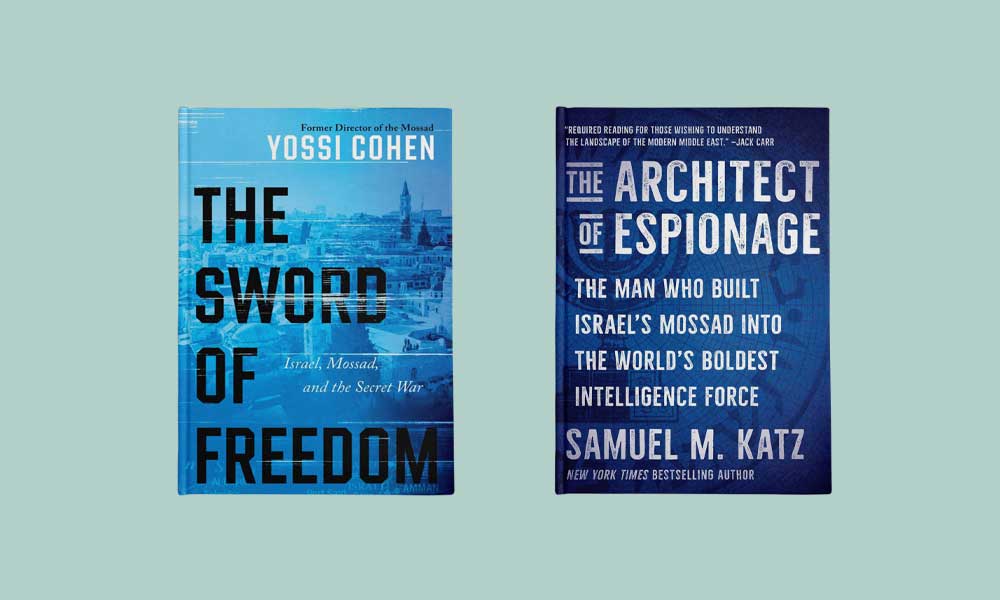
The Sword of Freedom: Israel, Mossad, and the Secret War
By Yossi Cohen
HarperCollins, 288 pp.
The Architect of Espionage: The Man Who Built Israel’s Mossad into the World’s Boldest Intelligence Force
By Samuel M. Katz
Scribner, 432 pp.
Until 1996, it was illegal in Israel to publish the names of the directors of the spy agency Mossad or of Shin Bet, the domestic security service.
But since then, they have become known and influential players in the nation’s political culture. And when one of them retires, there is a burst of interest in what they will reveal about secret operations—and in what they’ve really thought about Israeli leaders, including Benjamin Netanyahu. Two recent books about past Mossad spy chiefs—one an autobiography, the other a biography—both of which appeared shortly before the announcement of a new Mossad chief, Roman Grofman, who takes office in June—reflect that continuing public hunger for information.
Yossi Cohen, who worked for 38 years in the Mossad—most of that time undercover until he became the agency’s director from 2016 to 2021—gives us a lot of what we’re seeking in The Sword of Freedom. He declares, justly, that his greatest operation was the theft of Iran’s nuclear archive—a huge cache of documentation of secret nuclear activities—in 2018 from a warehouse in Tehran. He provides minute-by-minute details of how 25 Mossad agents broke into the safes and spirited away 55,000 files and disks. Information gleaned from that treasure trove, he says, strengthened Donald Trump’s resolve to tear up the Iran nuclear accord.
The fruit of the unique break-in—which Cohen himself likens to the heist film Ocean’s Eleven—also pinpointed the key role of Iranian nuclear scientist Mohsen Fakhrizadeh. Without making any apologies for Israel’s policy of killing Iranians who were working on the atomic bomb project, Cohen describes the ground-breaking 2020 assassination of Fakhrizadeh, who was shot by an AI-enhanced remote-controlled machine gun that was somehow built and placed at the side of a road in Iran. Cohen makes a point of saying that he insisted on merging the human capabilities of Mossad combatants with the technological wizardry of Israeli inventors.


He also treats us to a range of personality profiles, mostly of high-level figures he met during his career—including a set of observations based on multiple meetings with Russia’s President Vladimir Putin, whom he admires as a fellow practitioner of espionage. By comparison, Cohen portrays Ukraine’s President Volodymyr Zelensky as unimpressive, a man who he thinks could have made a few concessions to stop the Russians from invading and ravaging his country. Cohen writes that he has “great faith” in Saudi Arabia’s Crown Prince Mohammad bin Salman, finding him to be “perceptive, pragmatic” and “a pivotal figure” who will change the Middle East for the better—if and when he establishes diplomatic relations with Israel.
As for American presidents—of whom he had working conversations with three—Cohen declares that relations with President Barack Obama were “difficult and challenging,” relating that Obama declared, “Yossi, you are so wrong,” when he expressed total distrust of Iran. President Joe Biden “was a true friend,” but his Middle East legacy “is insubstantial.” President Donald Trump, on the other hand, has greatly impressed the former Mossad chief. He hails Trump for “his idiosyncratic, unconventional thinking” and willingness to confront Iran forcefully.
After many years of working under Netanyahu, Cohen offers only mild criticism but does discuss his meetings with opposition politicians trying to forge an anti-Bibi coalition for next year’s Israeli election.
Cohen has publicly said he does not intend to be a candidate for political office in the upcoming elections, instead staying in his current job in the highly paid international finance industry. He writes that his wife insisted that he stay away from politics, but “after further reflection, she bemoans the country’s lack of leadership, and insists I have no choice but to throw my hat into the ring.” So, eventually, he will.
To persuade us he is well-read and possesses the “intellectual capacity to be PM,” Cohen likens himself to the Roman statesman Cicero. To signal he is well-rounded, he quotes John Lennon and other popular lyricists. Cohen also makes a brief reference to the widespread opinion that he is handsome, reporting that his very close professional friend Mike Pompeo, CIA director in Trump’s first term, cracked “a knowing joke about my supposedly well-groomed appearance.” Cohen’s nickname in the Mossad and the Israeli media is, in fact, “The Model.”
He has thus given us a campaign platform of sorts, in the form of a well-written book that goes beyond a personal memoir. Cohen often pauses to reflect, with sound historical observations, on the constantly challenging efforts by Israel to find acceptance and peace as a Jewish state in an overwhelmingly Muslim Middle East.
Another new book about another Mossad director, Meir Dagan, takes us back before Cohen’s time, and thus contains even more background about the history of Israel and the Jewish people—going back to 1945, when Dagan was born in Ukraine to parents who barely escaped death in the Holocaust. Samuel M. Katz, who has written a dozen books on Israeli defense and espionage, offers an in-depth narrative on Dagan’s arrival in Israel in 1950, his childhood, his years as an IDF commando, how General Ariel Sharon took him under his wing, and his appointment as Mossad director in 2002.
Dagan, though an outsider thrust into the famed espionage agency, had such a great impact that the late Sharon’s successor as prime minister, Ehud Olmert, kept him on the job beyond the customary five years. Dagan truly changed the Mossad in many ways, serving almost nine years—until 2011—and insisting that Israel’s spies go far beyond merely collecting intelligence from assets they recruited in enemy countries. Under Dagan, Mossad men and women were commanded to generate action plans, and Dagan funneled key resources into sabotage and assassinations aimed at crippling Iran’s nuclear program.
Katz writes that Dagan refused to accept accusations that the Mossad “had lost its sense of initiative, content to sit back and wait for things to happen.” As for the feisty prime minister to whom he reported, “Sharon never doubted Dagan…The bond between the two men was unbreakable.”
The Architect of Espionage will be a delight for readers who appreciate historical detail. Although another biographer might have summarized some of the material more briefly, the tales of immigrants to Israel in the 1950s, the Yom Kippur War of 1973, Lebanon in the 1980s, West Bank violence in the 1990s, and numerous clandestine meetings with Arab leaders serve to place Dagan against the background of a volatile, ever-changing Middle East.
Along with the history, Katz includes the personal dimension, painting Dagan as an interesting, insightful man who was often underestimated because he looked more like a short tough guy than the incisive political analyst he was. Always first to arrive at his office in Mossad headquarters north of Tel Aviv, and often last to leave at night, he was a dynamo who fit a fairly typical Israeli mold: “No matter where he ventured,” Katz writes, “regardless of which spy chiefs and royal family members he had met during the week, Dagan was back in his home in Rosh Pina for Friday night dinners with the family.”
Dagan succumbed to cancer in 2016, at age 71, but he made a point in his final year of speaking out against Netanyahu. According to Katz, the former Mossad chief feared “the prime minister was leading Israel down a disastrous path.”
In a quivering voice at an outdoor anti-Bibi rally in early 2015, Dagan declared that Israel could handle its external enemies but that “I am frightened by our leadership, and I am afraid because of the lack of vision and loss of direction.” He said Israel was in a deep crisis, and a decade later, he almost surely would have been alarmed by the deepening division in Israeli society. Believing in accountability, Dagan would have insisted on a full investigation of the defense and intelligence failures that permitted Hamas to stun Israel with the October 7 massacres and kidnappings.
As a bonus, Cohen paints a vivid picture of Dagan in his book as well, saying he considered Dagan his mentor. “He placed a dagger between our teeth,” Cohen writes of his predecessor. “My wish was to be a leader of that kind.” Cohen paints a picture of Dagan as a “passionate” commander who yelled at his staffers, demanding that they show results, who did indeed get things done.
Since the humiliating security breakdown represented by October 7, the Mossad has taken the lead in what many Israeli politicians call a major comeback. Based largely on impressive intelligence and spies in enemy countries, Israel can boast that it has greatly weakened Hezbollah in Lebanon and the nuclear program in Iran. The overthrow of the Assad dictatorship in Syria is generally considered a positive. And the IDF takes credit for devastating Hamas—though demolishing much of the Gaza Strip and killing tens of thousands in the process of doing so.
Israel is still plagued by unresolved questions surrounding how to get along with Palestinians: eternal conflict, or genuine moves toward coexistence with dignity and respect? The aftermath of the two-year Gaza war, if it is truly over, could lead to a United Nations-approved program of reconstruction and deradicalization with an Israeli pullback, or the optimistic Trump-based plan may collapse into another descent into hell. It’s inevitable, then, that any discussion by Mossad leadership carries reflections on politics. And not just on Gaza, but on broader issues.
For instance, when the retired spymaster Cohen writes about how the Mossad planted explosives in pagers and walkie-talkies—that it then sold to Hezbollah through a dummy corporation in Europe—he reveals that the mission’s goal was not strictly to blow up the devices. Indeed, the explosions killed or wounded thousands of enemy fighters in Lebanon and Syria in September 2024. But Cohen suggests the principal goal, which lasted for years, was to track and eavesdrop on Hezbollah.
He provocatively adds that we all are just as vulnerable to an utter loss of privacy. “Your life is on your phone,” Cohen writes. “Once I enter the device, it tells me who you communicate with and where you are…Yours is mine. All that remains is for us to harvest the information you will unwittingly supply.” Here is a Mossad man, not hiding the fact that unblockable surveillance may reduce terrorism—but at a price.
Dan Raviv, a former CBS News correspondent and a Moment contributor, is co-author of six books on the Mossad, including Spies Against Armageddon and Target: Iran.
Moment Magazine participates in the Amazon Associates program and earns money from qualifying purchases.