
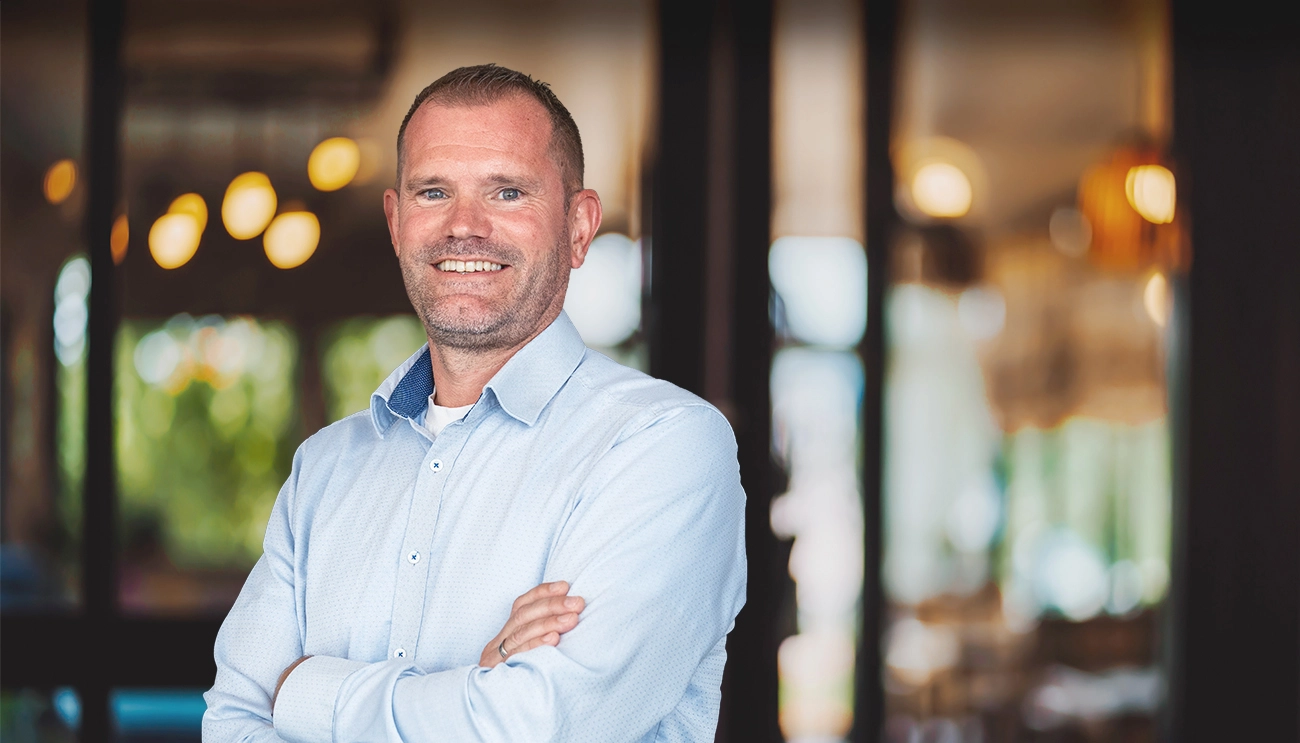
Conrad Wagemakers started his Ricoh journey in November 1998, when he joined Nashautec, then a part of the company, as a service engineer.
He is originally from the small town of Hoeven, he later relocated to the medieval coastal town of Zierikzee and has grown with the company. Conrad became a supervisor of a service team in 2013, initially focused on office printing, although he confesses that his heart is on graphical applications.
In 2014, he took an opportunity to switch into his chosen area and he is presently manager of field services for RICOH Graphic Communications (RGC), responsible for the RGC service delivery and projects across Ricoh Netherlands. In parallel with his day-to-day responsibilities, he has taken a number of Digital & Service Academy courses.
Estimated reading time: 5 min
Which Ricoh Europe Learning & Development and Digital & Service Academy programs have you taken to date? And what has been the focus of those courses?
In addition to the mandatory core modules, the programs have included training programs focused on developing my management skills, such as the Involve program, Information Technology Infrastructure Library [ITIL] certification and, recently, AI Awareness. Another course was focused on connecting actions to all the available data for daily operations, to ensure that we met targets and make sure that the actions that we were taking were not based on emotion or intuition, but based on facts. Data that molds actions can have the best impact on our daily operations.
Why did you initially decide to take part in the Digital & Service Academy program?
As part of my daily responsibilities, making decisions to achieve set objectives plays a crucial role. It can be tempting to make choices based on limited information, driven mainly by emotion or intuition. However, with the vast amount of data available to us, we must be able to define well-supported actions that lead to informed decisions. While I already work extensively with data, I wanted to further develop my ability to apply it in a structured way, not necessarily by doing the analysis myself, but by asking the right questions and clearly defining the objectives I aim to achieve. This is what motivated me to take these courses.
Before you started on the program, what did you hope to get out of the experience? Did you achieve that ambition?
I love to work with data and so the data courses are perfect for me. I’ve also noticed that because we get so much data, you need to work to keep up. So data courses were appealing because I was interested and, of course, this means that I can also help colleagues when they have questions. Overall, the programs have given me what I expected: valuable knowledge that I can put into practice. However, this is only part of an ongoing development journey, and I am convinced that if there is an ultimate goal of learning, I have not yet achieved it.
Do you believe you got more out of the program than you initially expected? If so, what were the extra benefits to you?
I would have to say that the training surprised me because it gave me more than I expected. It was really interactive so there were a lot of discussions with colleagues working with big data from all across Europe. So I developed new skills, but I also know that continuous development means this is something that I still have to work on. And because the group was composed of colleagues from different operating companies, it significantly expanded my network.
If you had to describe the courses you have completed in a single word, what would that word be and why?
I would describe the course as “interactive.” The setting was totally different because it was all of us working together. I like to discuss things with colleagues, not just accepting information and assuming that it is correct, but asking why, having a discussion, hearing all the different arguments and suggestions from colleagues about what works best and why. This approach to learning suits me well because interaction keeps me engaged and challenges me to push myself further.
Since completing the courses, have you been able to apply the new knowledge in your workplace?
I was already using data to guide my actions and we always set targets that we want to achieve over the year, with a lot of those targets really based on something that we can measure. One of our objectives has been to reduce the number of bottles used that collect waste toner, which of course has an impact on the environment. I took a more structured approach to the issue, defining the right questions to identify actions that would help us to reach our goal first and then identifying the data needed to analyze our actions and then to act effectively.
Do you believe the knowledge you gained through the academy has helped you outside the workplace?
Most of the training I have completed has been closely related to my work roles, but there are courses on management skills that will certainly develop you as a person as well.
Would you recommend to colleagues that they take courses through the program? Why?
Absolutely. In the future, the data we are exposed to will only continue to grow and being able to manage that will become even more critical in helping us shift from a mostly reactive approach to taking more proactive actions. Certainly, for some people these courses will be interesting but also expand their understanding. And from other people I have spoken to about the courses, the feedback has been positive.
Are you planning to take more courses in the future and, if so, have you decided which ones? What extra skills do you hope they might give you?
I do not have any new courses scheduled or decided upon, but I am very interested in further developing my skills on a tactical level. I’m not sure what that would look like, but I’m absolutely open to the idea. I want to develop my technical skills and although I’m busy in the near-term, I would definitely be interested in taking more programs in the future.
Is the opportunity for continuous learning, such as through the Digital & Service Academy, one of the reasons you choose to stay at Ricoh?
There are many reasons why I choose to stay at Ricoh, and the opportunity for continuous learning is certainly one of them. Having access to programs like the Digital & Service Academy reinforces my commitment to the company, it definitely gives me no reason to look elsewhere. If you look at my record, where I started and where I am now, that would not have been possible without continuous learning. It is that fundamental.
Why do you believe that continued learning throughout your career is beneficial to both you and your company?
Continued learning keeps me adaptable and relevant, enabling me to perform better and take on new challenges. For my company, it means benefiting from updated skills and innovative thinking, which drive growth and competitiveness.
Feedback on the article