
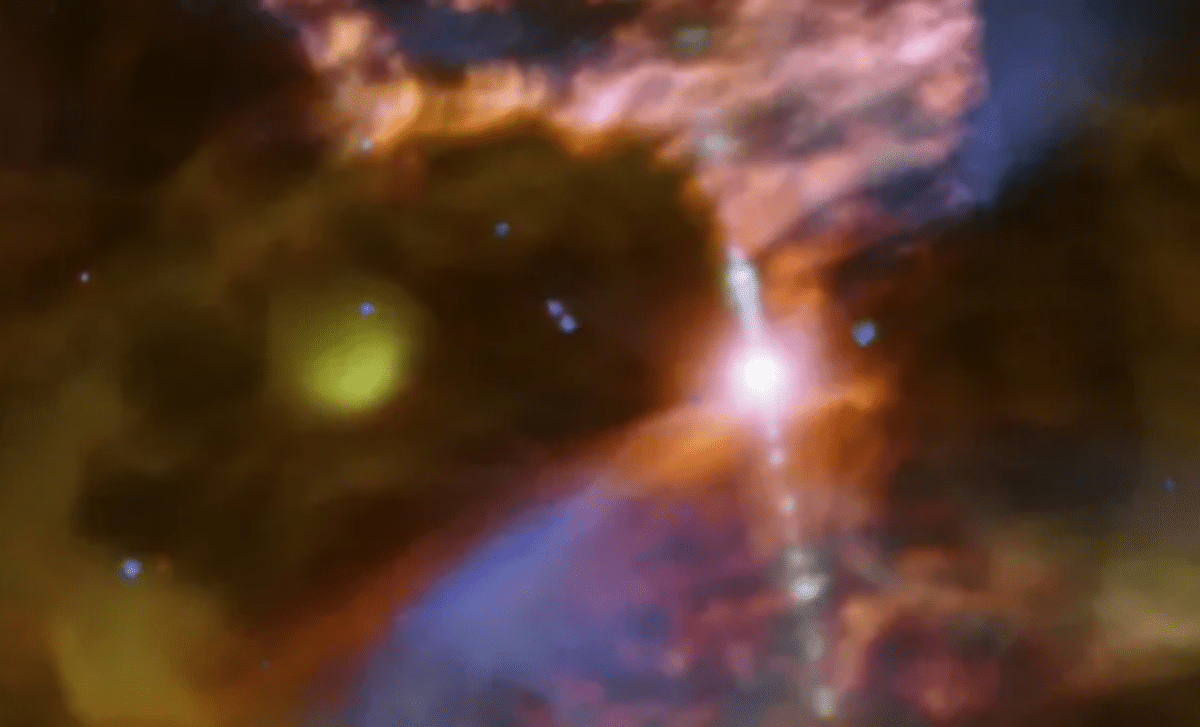
The European Southern Observatory’s Very Large Telescope (VLT) recently captured an extraordinary image that features both the explosive remnants of a dead star and the birth of a new one. This awe-inspiring photo, revealed on February 3, 2026, combines the mystery of a neutron star with the raw energy of a young stellar formation. The image centers on the object known as Ve 7–27, once thought to be a dying star, but new data have shown it to be a star in the early stages of life, giving a fresh perspective on the dynamic processes of the cosmos.
The Incredible Image: Stellar Death Meets Birth
The VLT’s image of Ve 7–27 is an exceptional example of how space is filled with contrasts. The image initially puzzled astronomers, who believed the object to be a planetary nebula, a dying star shedding its material. However, new observations made using the MUSE instrument revealed that Ve 7–27 is not a dying star, but a newborn one, still in the process of forming.
The structure of Ve 7–27 features energetic jets, spewing out bright knots of material, known as “bullets.” These jets are typical of young stars as they begin their journey, violently interacting with their surrounding environment.
“Instead of being the ‘last breath’ of a dying star, Ve 7-27 is a newborn one,” said Janette Suherli, a Ph.D. candidate at the University of Manitoba and the study’s lead author.
This revelation adds an exciting layer to our understanding of star formation and marks a significant discovery in the study of cosmic phenomena. The image shows both the remnants of past stellar explosions and the bright promise of new life, demonstrating the cyclical nature of star birth and death in the universe.
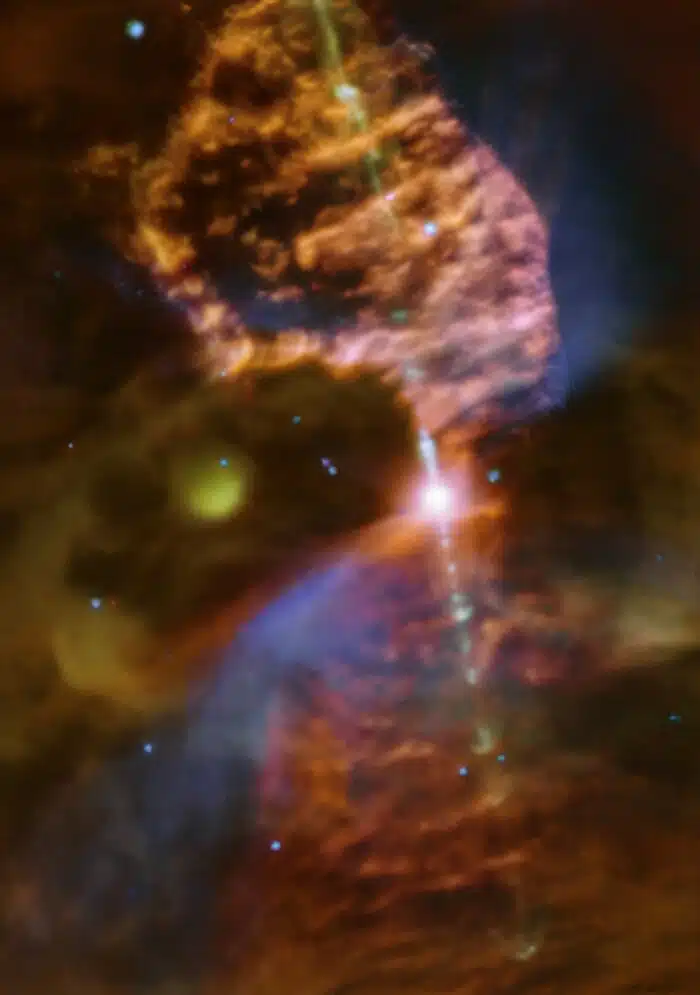 Credit:ESO/J. Suherli et al.
Ve 7-27’s Place in the Vela Junior Supernova Remnant
Ve 7-27 is located in a region known as the Vela Junior supernova remnant, which is the remains of an ancient star explosion. The debris from this explosion has been scattered throughout space, creating a cloud of material that surrounds Ve 7-27. This association with the Vela Junior remnant connects the newborn star with the debris of a dead one, creating a fascinating cosmic link between life and death. The location of Ve 7-27 is approximately 4,500 light-years away, in a region of the sky rich with history and ongoing stellar processes.
Astronomers have long debated the true nature of the Vela Junior remnant, but by linking it to the young star Ve 7–27, they have been able to better understand its distance and size. The newly discovered connection helps to resolve discrepancies in the previous estimates of the remnant’s size, expansion rate, and age. With Ve 7–27 providing a clear distance marker, astronomers can now place the Vela Junior remnant more accurately within the vast reaches of space, shedding light on the true scale of this cosmic object.
The Role of the VLT in Space Exploration
The European Southern Observatory’s Very Large Telescope (VLT) continues to be at the forefront of astronomical discoveries, pushing the boundaries of what we can see in space. Located in Chile, the VLT consists of four individual telescopes working together to produce incredibly detailed images of distant stars, nebulae, and galaxies. The VLT’s ability to observe in such high resolution allows scientists to make precise measurements of distant objects, revealing important details about their composition, movement, and behavior.
In the case of Ve 7-27, the VLT’s imaging power was instrumental in determining the true nature of this object. The MUSE instrument, which is attached to one of the VLT’s telescopes, enabled astronomers to capture crucial data that allowed them to differentiate between a dying star and a forming one. This new data has advanced our understanding of the processes that occur in stellar nurseries and the aftermath of supernovae.
The Cosmic Dance of Star Birth and Death
Space is filled with complex phenomena, and the interaction between stellar birth and death is one of the most fascinating. The discovery of Ve 7-27 highlights the dynamic and ever-changing nature of the universe. Young stars like Ve 7–27 emerge from the energetic chaos of cosmic material, while neutron stars, remnants of massive stellar explosions, represent the other side of the equation: the end of a star’s life.
This cycle of creation and destruction is a fundamental part of the universe’s evolution. As stars form, they release vast amounts of energy, influencing the formation of new stars and shaping their environment. When stars reach the end of their lives, they explode in a supernova, releasing heavy elements into space, which can eventually form new stars, planets, and even life. The discovery of Ve 7–27 provides a vivid snapshot of this cosmic dance, offering insight into the intricate processes that govern the birth and death of stars.