
We wake up in the morning and go to bed at night — most of us, at least. When we change our clocks in spring or autumn, or go on a long flight that changes our time zone, we’re left disoriented and exhausted.
Called the circadian rhythm, scientists have some answers as to why it exists. They know, for instance, that every organ in the body contains a biological “clock” that regulates its function to the rhythm of the day. Yet there are still outstanding questions as to how and why these clocks function. For instance, why does almost every species on Earth seem to have a version of these clocks?
One class at Northeastern University takes students on a scientific journey to unravel the circadian rhythm and its function in the body. Through deep engagement with the field’s landmark papers and experiments, they embark on a scholarly investigation into the mystery of clock cells.
 01/29/26 – BOSTON, MA. – Northeastern professor Dr. Matthias Schlichting teaches the innovative Biological Clocks course, incorporating active learning methodologies to engage students in understanding circadian rhythms and temporal biological processes, in ISEC on Thursday, Jan. 29, 2026. Photo by Alyssa Stone/Northeastern University
 01/29/26 – BOSTON, MA. – Northeastern professor Dr. Matthias Schlichting teaches the innovative Biological Clocks course, incorporating active learning methodologies to engage students in understanding circadian rhythms and temporal biological processes, in ISEC on Thursday, Jan. 29, 2026. Photo by Alyssa Stone/Northeastern University
 01/29/26 – BOSTON, MA. – Northeastern professor Dr. Matthias Schlichting teaches the innovative Biological Clocks course, incorporating active learning methodologies to engage students in understanding circadian rhythms and temporal biological processes, in ISEC on Thursday, Jan. 29, 2026. Photo by Alyssa Stone/Northeastern University
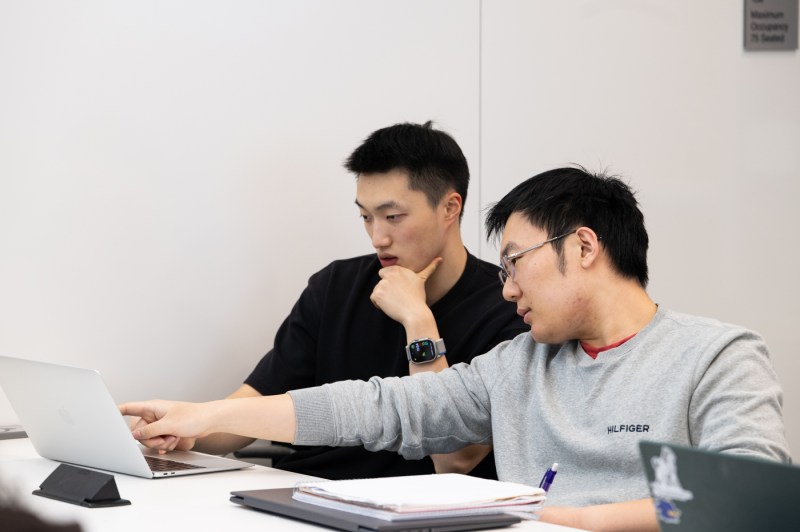 01/29/26 – BOSTON, MA. – Northeastern professor Dr. Matthias Schlichting teaches the innovative Biological Clocks course, incorporating active learning methodologies to engage students in understanding circadian rhythms and temporal biological processes, in ISEC on Thursday, Jan. 29, 2026. Photo by Alyssa Stone/Northeastern University
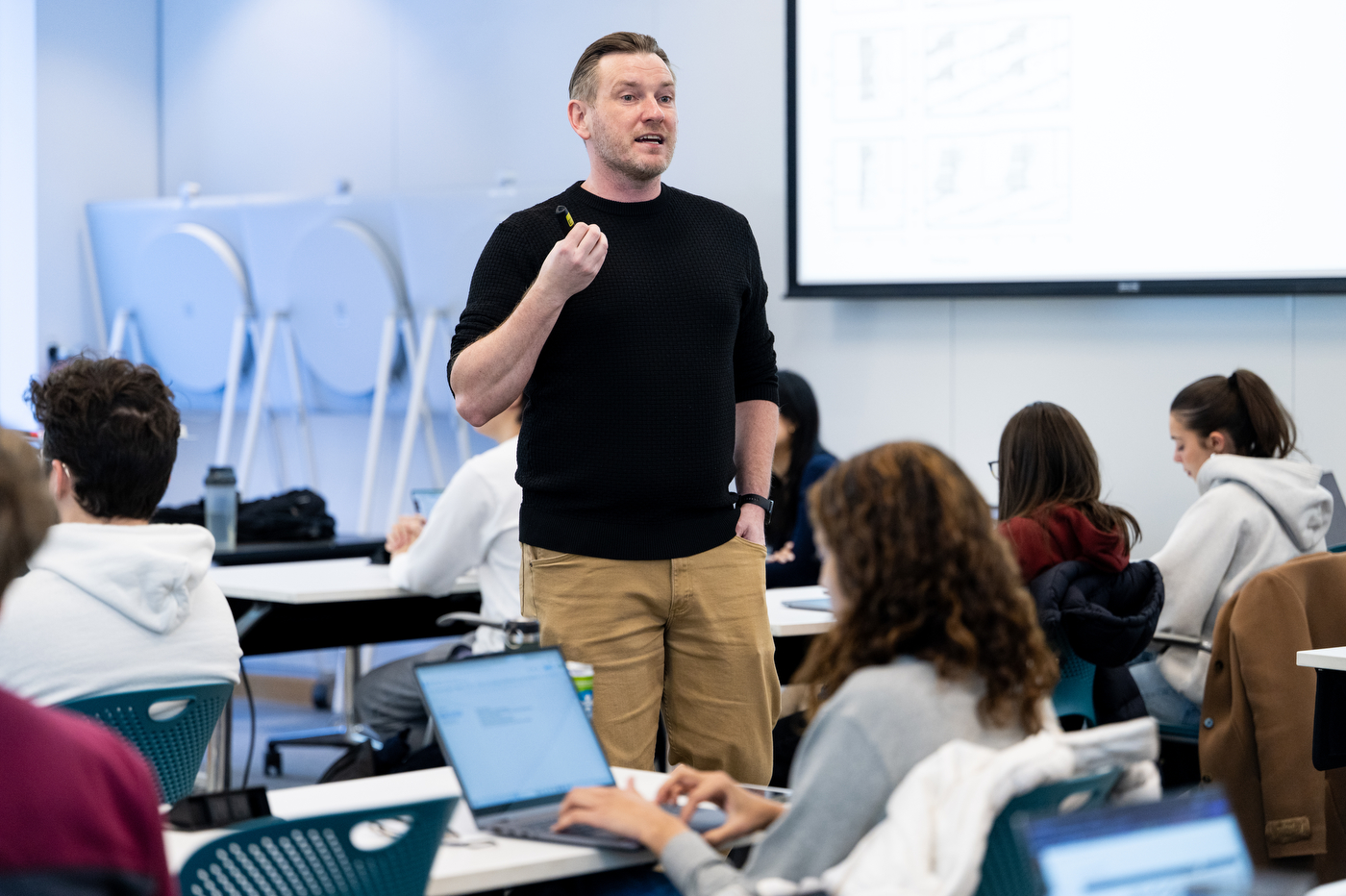
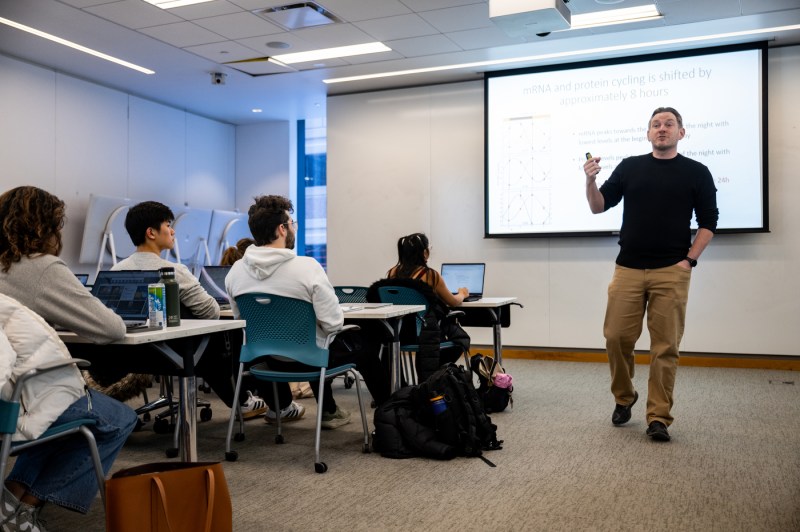
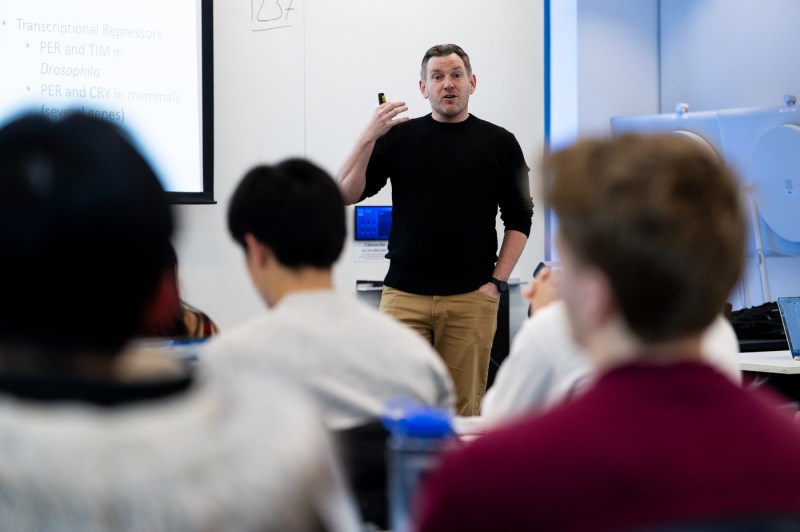
Schlichting says he takes a “time travel approach” to the course, working chronologically through the major papers on the subject. Students aren’t allowed to take the results at face value, however, but are encouraged to critique and re-examine the results to determine how rigorous the original experiments were. Photos by Alyssa Stone/Northeastern University
A temporal mystery
Guiding them into the story, and the clues thus far, is Matthias Schlichting, an associate teaching professor. His upper-level biology course, BIOL 5306: Biological Clocks, introduces students to the cellular makeup of the clocks and the experiments researchers used to discover them.
Schlichting’s own research investigates the mechanisms behind how light enters the clock cells, how a clock cell “knows” what time of day it is.
In class, Schlichting says he takes something like a “time travel approach,” working chronologically through the major papers on the subject. This is no mere literature review, however, as Schlichting guides his students through an almost forensic examination of how researchers have conducted their experiments to draw the conclusions they now suspect to be true.
Zaineb Irfan, a fourth-year biochemistry student, says she found the course’s organization useful. “We were able to see the development of how the methodologies that are used in the field evolved,” she says.
Further, Schlichting doesn’t allow his students to accept these papers at face value, their results or their experimental approaches. Irfan recalls critiquing experimental methodologies, deciding for herself, with her peers, how reliable a certain approach might be, and occasionally disagreeing with the original author.
This has informed how she plans to develop experiments in the future, she continues.
The proper functioning of our internal clocks also has deep ramifications for human health, Schlichting points out. Shift workers, whose schedules and waking hours are constantly in flux, have notably higher rates of cancer, and breast cancer, he continues, has also been correlated to clock misalignment.
Brian Hulbert, a fifth-year double major in biology and philosophy, says he really appreciated the seminar-style approach of the class.
“What really was helpful, though,” Hulbert continues, “was how Dr. Schlichting helped us dissect figures and read research papers,” and not solely focus on the authors’ interpretations.
This methodology was especially topical for Hulbert, who was working on a personal research paper at the time and applied what he was learning directly to his own writing.
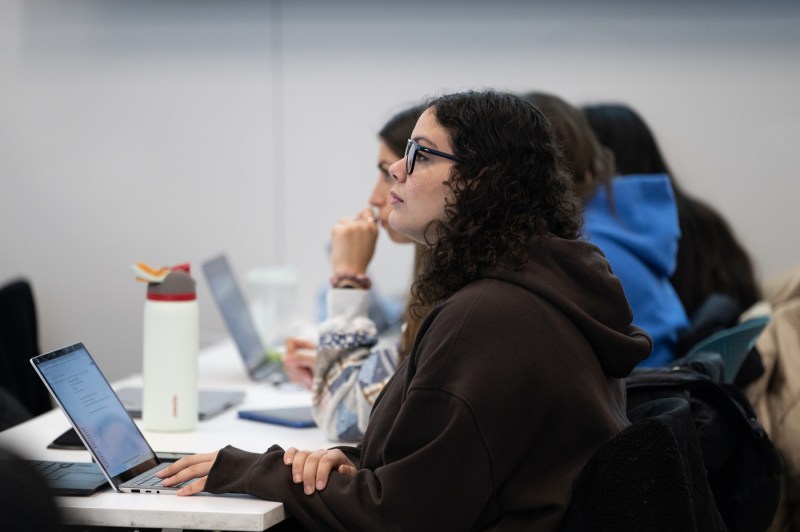 01/29/26 – BOSTON, MA. – Northeastern professor Dr. Matthias Schlichting teaches the innovative Biological Clocks course, incorporating active learning methodologies to engage students in understanding circadian rhythms and temporal biological processes, in ISEC on Thursday, Jan. 29, 2026. Photo by Alyssa Stone/Northeastern University
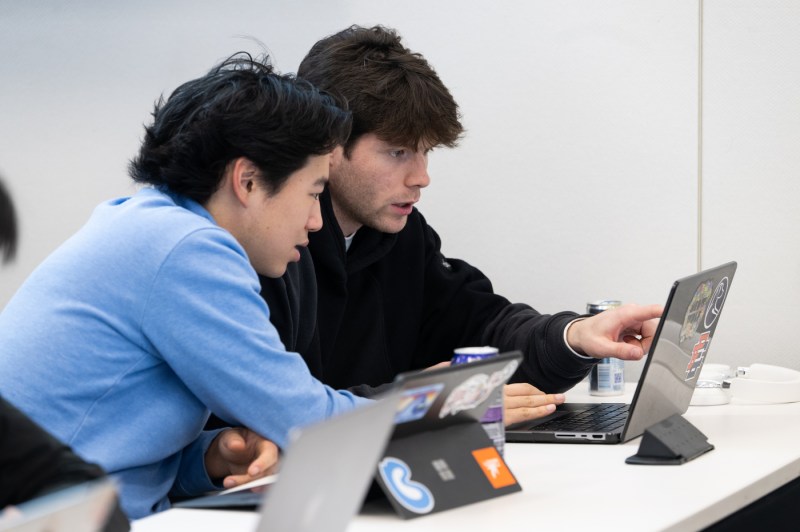 01/29/26 – BOSTON, MA. – Northeastern professor Dr. Matthias Schlichting teaches the innovative Biological Clocks course, incorporating active learning methodologies to engage students in understanding circadian rhythms and temporal biological processes, in ISEC on Thursday, Jan. 29, 2026. Photo by Alyssa Stone/Northeastern University
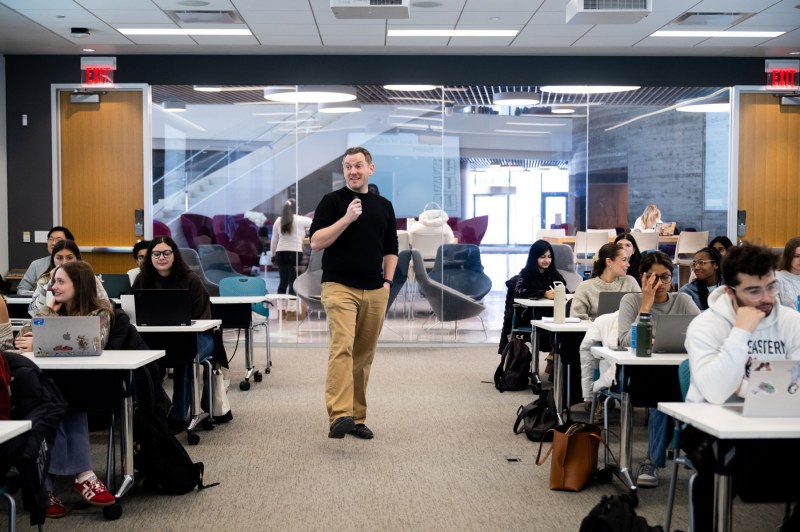 01/29/26 – BOSTON, MA. – Northeastern professor Dr. Matthias Schlichting teaches the innovative Biological Clocks course, incorporating active learning methodologies to engage students in understanding circadian rhythms and temporal biological processes, in ISEC on Thursday, Jan. 29, 2026. Photo by Alyssa Stone/Northeastern University
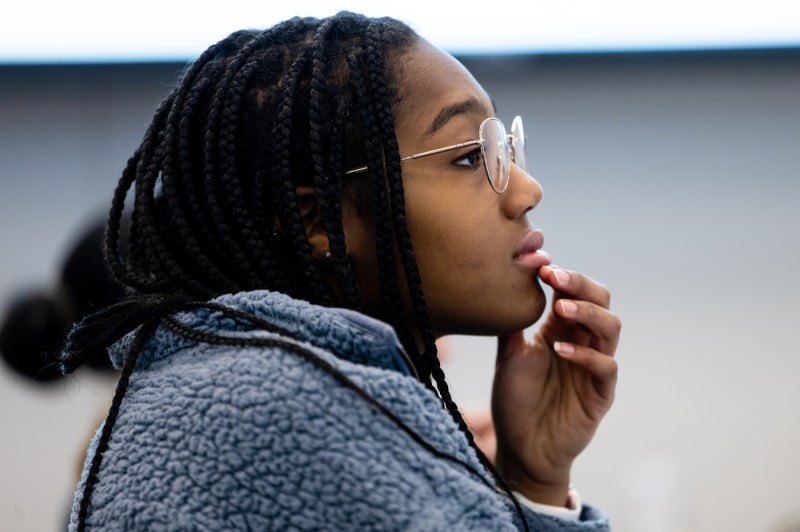
Schlichting also incorporates AI into his assignments, asking students to analyze the results they get from it and determine, for themselves, AI’s strengths and weaknesses. Photos by Alyssa Stone/Northeastern University
A clock by any other name
Schlichting says researchers first determined that internal clocks exist by simply placing plants in a drawer and observing that their leaves continue to rise and lower despite the absence of light. What the control mechanism was, however, took much longer to discover.
Subsequent experiments have identified that “all tissues express some kind of clock gene, to a different extent,” Hulbert says. Specific clock cells in the brains of many species, however, seem to operate as a “master” control mechanism, Schlichting says.
“It is kind of weird,” Schlichting says, “that this process actually takes 24 hours,” as most gene expression processes, like transcription and translation, can take place in only a couple of hours.
Many of the experiments studied in Schlichting’s class involve so-called “clock mutants,” organisms that have had the clock cells in their brains removed or modified. Fruit flies are a common subject.
Schlichting isn’t content to rest on standard approaches to homework, either, incorporating artificial intelligence into students’ projects. Students write detailed summaries of a paper they read for the class and then ask a large language model to write its own.
Just like his students don’t let experimental procedures off the hook, students then analyze the performance of the AI client, comparing it against their own.
Irfan says the AI-generated summary was a little better in organizing the information than her draft, but it failed to go into as much detail about her chosen study.
Hulbert, who had been an AI skeptic, still writes all his own research but has adopted AI as a useful tool to sift through large numbers of papers quickly.
Schlichting says Biological Clocks isn’t a course that’s just about how our bodies keep to their rhythms, but it also provides students with a model for how to conduct their own research. It teaches students about rigor: The necessity of it, how to have it in their own research and how to spot it when it’s missing.
“Hopefully,” he adds with a laugh.
Noah Lloyd is the assistant editor for research at Northeastern Global News and NGN Research. Email him at n.lloyd@northeastern.edu. Follow him on X/Twitter at @noahghola.