

just dropped the number that made the rest of Big Tech’s spending spree look like a warm-up act. The e-commerce giant announced $200 billion in planned capital expenditures for 2026 — a figure so large it exceeds the entire U.S. energy sector’s annual investment budget. The stock fell 9%.
But here’s what the selloff crowd is missing: someone has to build all of this. And the companies supplying the chips, the power, and the plumbing for this unprecedented infrastructure buildout are having their best week of the year.
The Numbers Are Staggering
Amazon’s $200 billion bombshell, dropped alongside otherwise solid Q4 results ($213.4 billion in revenue, AWS growing 24%), was the final piece of a puzzle that’s been assembling all earnings season. Add it up: guided $175 to $185 billion. signaled fiscal 2026 capex growth above its $88.2 billion FY2025 total. committed to spending “significantly higher” than its $70 billion 2025 budget.
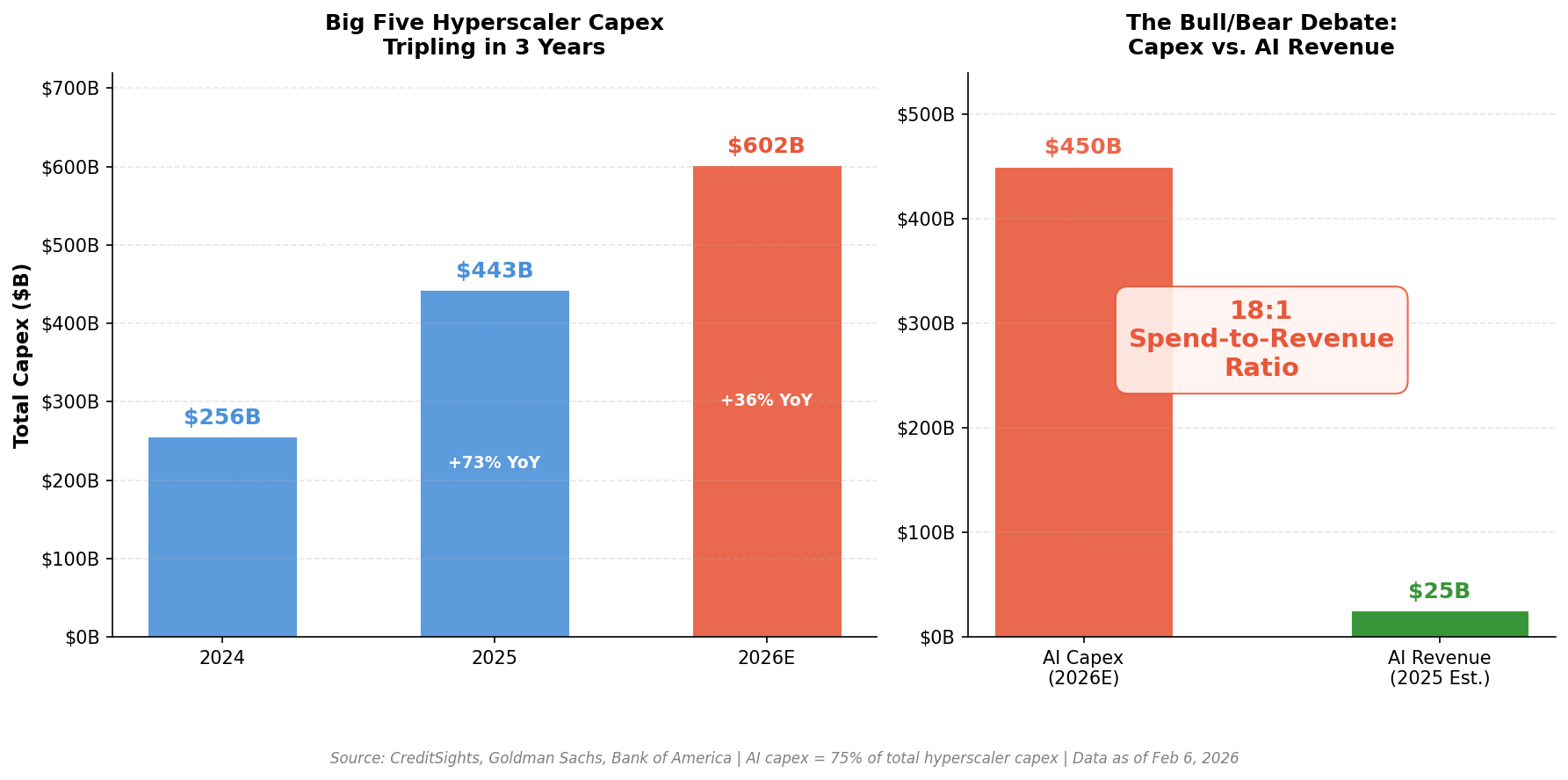
The combined tab for the Big Five hyperscalers — Amazon, Alphabet, Microsoft, Meta, and — now exceeds $600 billion for 2026. That’s a 36% jump from 2025 and more than 4x what the entire publicly traded U.S. energy sector spends to drill wells, refine oil, and deliver gasoline. CreditSights estimates roughly 75% of that spend, about $450 billion, goes directly to AI infrastructure — GPUs, servers, networking equipment, and data centers.
Goldman Sachs had projected hyperscaler capex could exceed $500 billion. They were too conservative. For two straight years, Wall Street’s capex estimates have come in low.
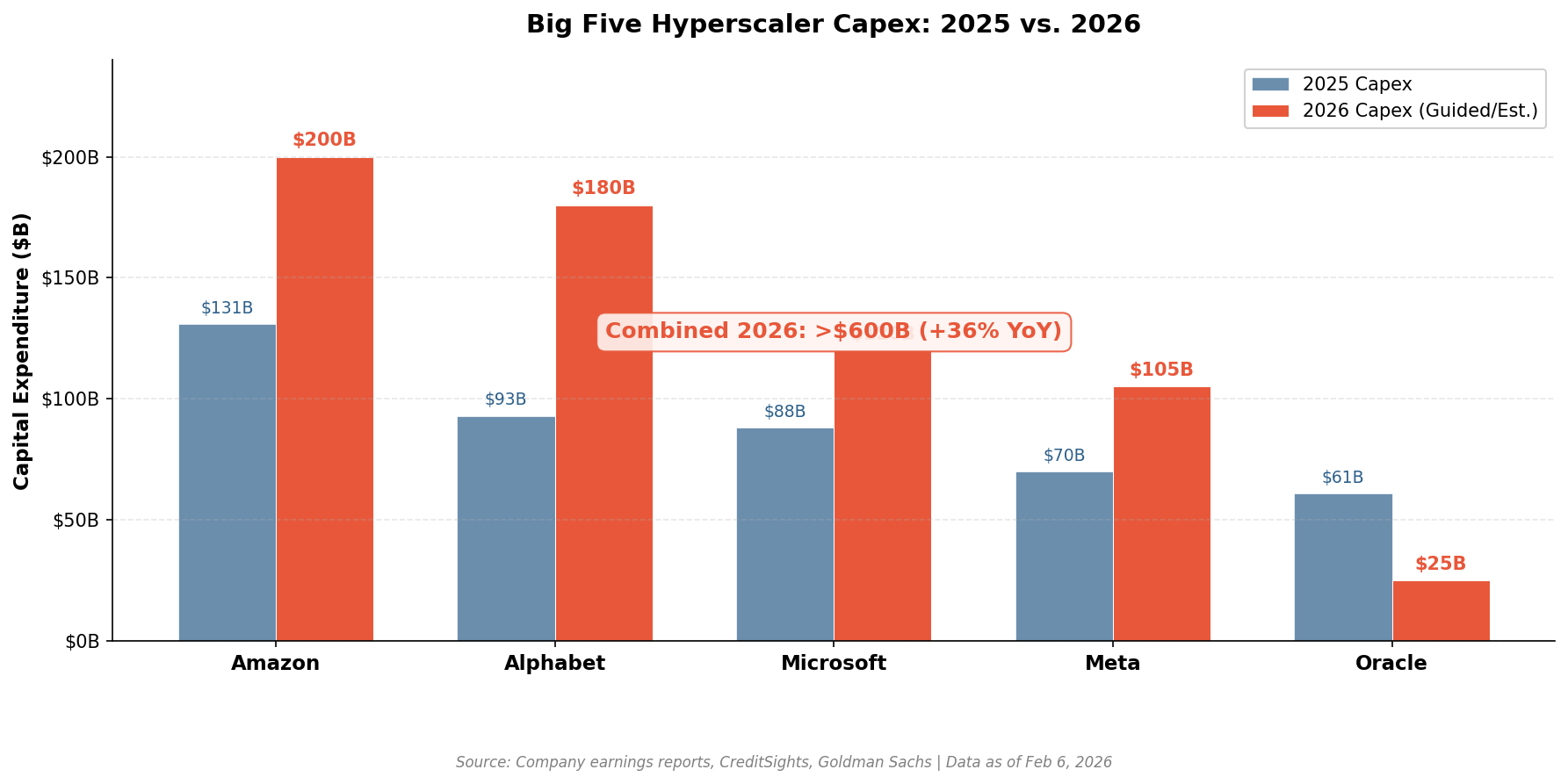
At the start of both 2024 and 2025, consensus implied ~20% annual growth. Actual spending exceeded 50% both times.
CEO Andy Jassy didn’t flinch on the earnings call. “As fast as we install this AI capacity, it’s getting monetized,” he told analysts. AWS now runs at a $142 billion annualized revenue rate, and its custom silicon business — Trainium and Graviton chips — has crossed $10 billion in annual run rate.
Who Actually Wins Here
The market punished Amazon for writing the check. That’s fine. The real question for investors is: who cashes it?
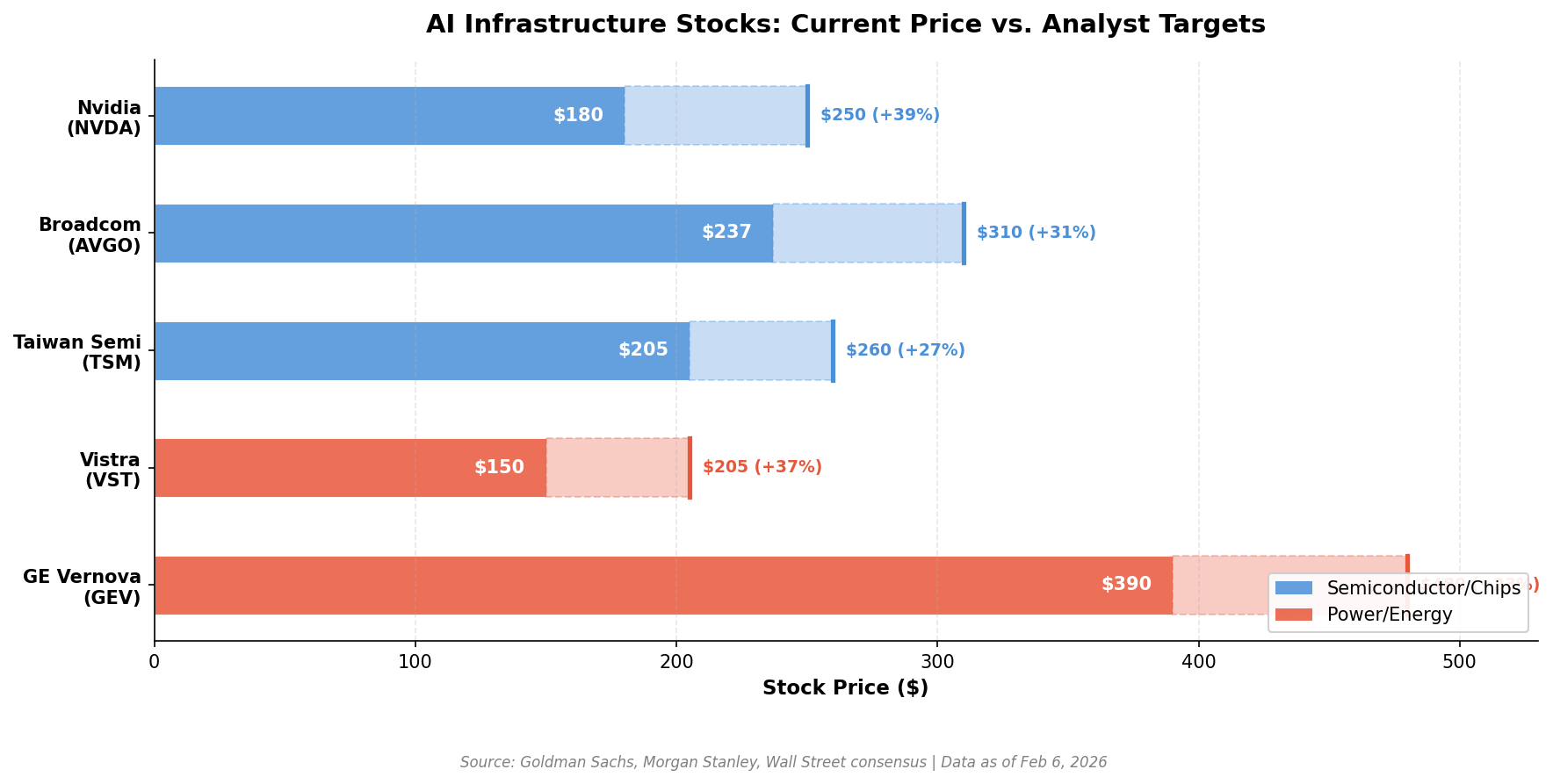
(NVDA, ~$180) remains the most direct beneficiary. The company captures roughly 90% of AI accelerator spending, according to industry estimates, and every hyperscaler’s capex plan starts with GPU procurement. Goldman Sachs reiterated a Buy rating this week with a $250 price target — 39% upside from current levels. Nvidia reports Q4 results on February 25, and the setup couldn’t be better: its customers just committed to spending $600 billion-plus on infrastructure that requires its chips. The stock is up 3% today, rebounding from this week’s tech selloff that knocked shares from $193 to $172.
(AVGO, ~$237) plays a different but equally critical role. While Nvidia dominates training GPUs, Broadcom controls the custom silicon and networking infrastructure that connects them. The company designs custom ASICs for , Meta, Alphabet, and ByteDance — hyperscalers increasingly building proprietary chip architectures to complement Nvidia hardware. Wall Street expects 52% revenue growth for FY2026 to approximately $133 billion. Shares rallied 3.5% Friday morning.
(TSM, ~$205) is the pick-and-shovel play. TSMC manufactures chips for Nvidia, AMD, Broadcom, Qualcomm, and Apple, holding roughly 68% of the global foundry market by revenue.
It doesn’t matter which chip architecture wins — TSMC makes them all. With hyperscaler capex surging 36%, the demand pipeline for TSMC’s advanced nodes is only getting deeper.
The Power Play Nobody’s Talking About
Building data centers is one thing. Powering them is another. Microsoft’s electricity demand for AI data centers is projected to surge over 600% by 2030. Google spent $4.75 billion acquiring power company Intersect Power. Meta just signed a massive power purchase agreement with for its Comanche Peak nuclear facility.
Vistra (VST, ~$150) is Goldman Sachs’ top pick in the AI power trade, with a $205 price target. The Meta deal prompted Goldman to raise its 2027 EBITDA estimate by 5%. “The company is able to secure sizeable PPA contracts with a shorter ramp, even in the face of continued policy uncertainty,” the firm noted. Nuclear power is emerging as the preferred baseload solution for data centers that can’t afford intermittent supply.
(GEV, ~$390) rounds out the infrastructure chain. The energy equipment maker supplies gas turbines, grid solutions, and electrification products — all critical for the power infrastructure buildout. Shares are up over 40% in the past year as data center energy demand reshapes the utility investment thesis.
The Bull Case and the Bear Case
The bull case writes itself: $600 billion in confirmed spending creates a multi-year revenue tailwind for infrastructure suppliers. Unlike the dot-com era, today’s hyperscalers are profitable, generating massive cash flows, and their customers are paying. AWS grew 24%. Google Cloud grew 48%. Azure grew 39%. The demand isn’t theoretical — it’s showing up in quarterly revenue.
The bear case is about timing and returns. Bank of America calculates that hyperscaler capex now consumes 94% of operating cash flows after dividends and buybacks. That’s forcing companies into the debt markets — the Big Five raised $108 billion in bonds in 2025 alone, with JP Morgan projecting $1.5 trillion in tech debt issuance over the coming years. And AI services generate only about $25 billion in direct revenue today, roughly 4% of what’s being spent on infrastructure. If monetization stalls, the write-downs would be historic.
Alphabet CEO Sundar Pichai himself has acknowledged “elements of irrationality” in the current spending pace.
What to Watch
Nvidia’s February 25 earnings will be the next major catalyst. If the company’s revenue guidance reflects the $600 billion capex wave, expect another leg higher for the entire AI infrastructure complex. The University of Michigan consumer sentiment reading drops later today, and the January jobs report — originally scheduled for this morning — has been delayed due to the government shutdown, removing a potential source of volatility.
For now, Wall Street has spoken: the hyperscalers can argue about who’s spending too much. The companies selling them shovels are just counting the money.