
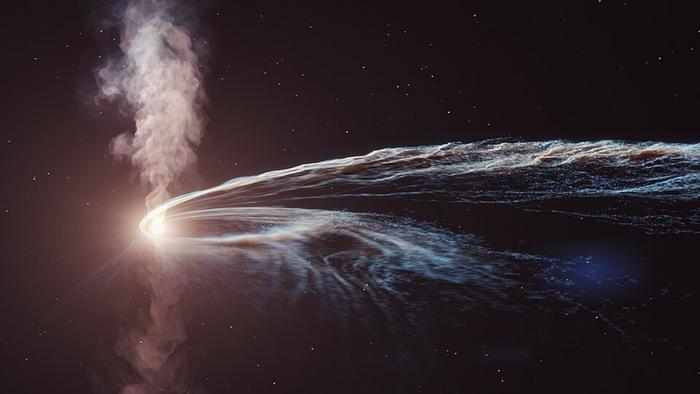
An artistic representation of a tidal disruption event, or a black hole shredding a star.
Source: DESY, Science Communication Lab
In 2018, a supermassive black hole about 665 million light-years away ripped a passing star apart. At the time, it was “the most boring, garden-variety event,” one researcher recalled. Years later, the same object, AT2018hyz, has become an extreme late-time radio source, with its 5–7 GHz flux climbing from about 1.4 mJy to 33.3 mJy between 972 and 2160 days after the disruption. A new Astrophysical Journal study finds the brightening follows a steep power law, and models suggest the light curve could start turning over at some radio frequencies as soon as early 2027, depending on whether the emission comes from a delayed spherical outflow or a highly off-axis relativistic jet.
The object, known as AT2018hyz, is a tidal disruption event, the kind of cosmic accident that happens when a star strays too close to a black hole and gets torn apart by gravity. Those events have been spotted before, but the late-blooming surge in radio emission is what makes this one strange. Lead author Yvette Cendes of the University of Oregon first flagged the odd behavior years after the star was shredded, when the system began lighting up in radio wavelengths long after it would have been expected to go quiet.
The study, “Continued Rapid Radio Brightening of the Tidal Disruption Event AT2018hyz,” was published February 5, 2026, in The Astrophysical Journal (DOI: 10.3847/1538-4357/ae286d). The research was supported by the U.S. National Science Foundation.
That delayed ramp-up suggests astronomers may be missing a whole class of “aftershocks” simply because they stop looking too soon. One possibility is geometry: if the jet was not pointed toward Earth at first, it could have been effectively invisible until it reoriented or strengthened enough to stand out. Either way, if the prediction holds and the radio output continues to rise into 2027, AT2018hyz will become a rare real-time test of how black holes feed, launch jets, and keep dumping energy into space long after the initial flare is over.
The numbers that make this novel
At radio frequencies near 5 to 7 GHz, one of the best-sampled bands, flux density climbed from about 1.4 millijanskys when radio emission was first detected at 972 days post-disruption to 33.3 millijanskys at 2,160 days. The peak luminosity has reached roughly 10^40 ergs per second, a figure that puts AT2018hyz in the same class as Swift J1644+57, the textbook example of a relativistic tidal disruption jet.

Cendes poses like Ellie Arroway from the 1997 movie Contact, based on the Carl Sagan book of the same name.
Photo courtesy of Cendes
That comparison is the real surprise. Swift J1644+57 was recognized immediately as an extreme event: a rare, on-axis relativistic jet aimed almost directly at Earth. AT2018hyz was not. It started out looking like a standard, non-relativistic tidal disruption.
For a sense of raw energy output: Cendes points out that Star Wars fans have calculated the theoretical energy of the Death Star’s superlaser. The energy pouring out of AT2018hyz, she says, exceeds that by at least a factor of a trillion, and possibly by as much as 100 trillion.
Two models, one answer still pending
The paper lays out two competing explanations for what’s driving the brightening, and they imply fundamentally different physics.
The first is a delayed spherical outflow. In this scenario, the black hole didn’t immediately launch the material that’s now producing the radio signal. Instead, an expanding shell of debris was ejected roughly 620 days after the star was disrupted, moving outward at about one-third the speed of light. As the shell plows into surrounding gas, it generates a shock wave that produces synchrotron radio emission. The inferred kinetic energy in this model climbs over time, reaching about 10^50 ergs by the latest observations.
The second is an off-axis relativistic jet. Here, the black hole launched a fast, narrow jet early on, but the jet was pointed nearly perpendicular to our line of sight, at an extreme viewing angle of 80 to 90 degrees. Because relativistic jets beam most of their radiation forward, a jet seen from the side would appear far dimmer. As the jet decelerates and its beam widens, more of its emission becomes visible to observers on Earth.
Both models can reproduce the key observational signatures: a peak frequency that has remained stubbornly near a few gigahertz while peak brightness climbs by an order of magnitude. But they diverge in their predictions for what happens next. If the off-axis jet model is correct, certain radio frequencies should begin to turn over — declining in brightness — before others, as the jet’s geometry reshapes the signal. The spherical outflow model predicts a more uniform evolution across frequencies.
That is exactly what makes the next 18 months so valuable. Some frequencies already show hints of flattening around 2,050 days post-disruption, while others keep rising. If the signal peaks as predicted around early 2027, coordinated multi-frequency observations should be able to distinguish between the two geometries — and, in doing so, reveal how and when the black hole actually ejected the material that’s now lighting up.
What comes next
If the team’s modeling is correct, AT2018hyz’s radio output should continue rising before turning over sometime around early 2027. That makes it one of the few astrophysical phenomena where a specific prediction about peak brightness and timing can be tested against real-time data as it arrives.
Cendes’s team has been tracking the object with the Very Large Array in New Mexico, the MeerKAT radio telescope in South Africa, and ALMA in Chile, along with X-ray observations from NASA’s Chandra Observatory, and plans to continue multi-frequency monitoring.
Whether AT2018hyz turns out to be powered by a delayed outflow or an off-axis jet, the event has already changed the calculus for how tidal disruptions are observed.