
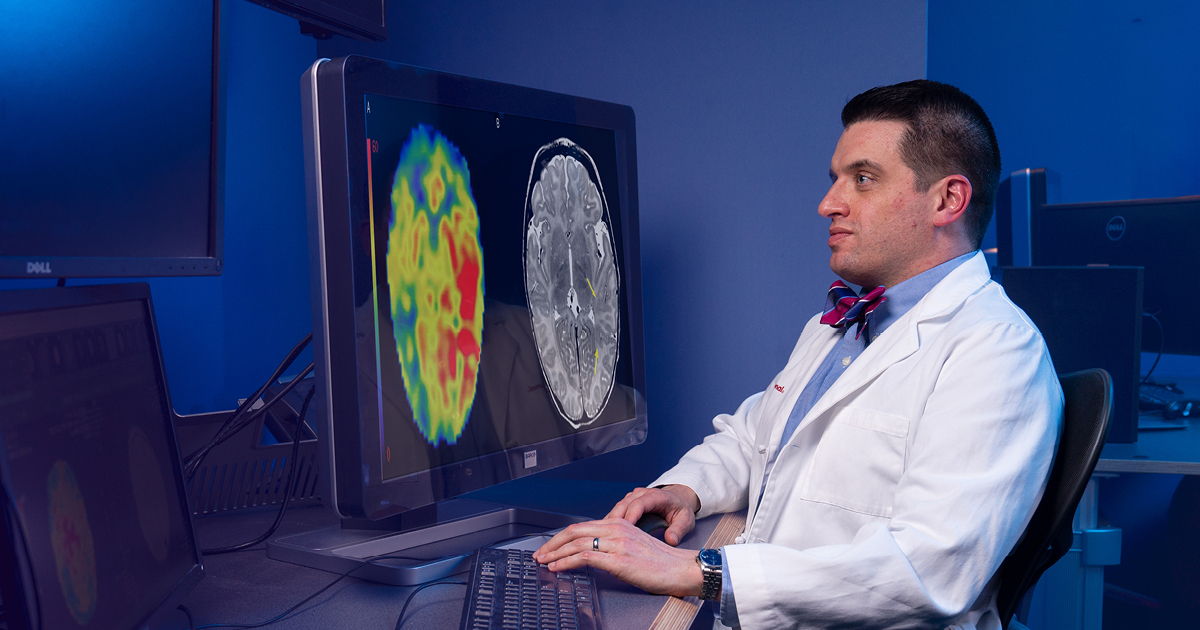
For many children with focal cortical dysplasia (FCD), seizures begin early and persist despite standard medical therapy, placing patients and families on a prolonged and uncertain path. As the most common cause of surgically treatable epilepsy in children, FCD-mediated epilepsy carries a risk of developmental and cognitive comorbidities. FCDs have subtle imaging features, heterogeneous presentations and complex network-level effects that have historically been difficult to detect.
At Children’s National Hospital, clinicians and researchers are reshaping how FCD is understood by moving beyond region-based models toward a deeper, network-informed understanding of pediatric epilepsy – work that is redefining clinical decision-making and improving outcomes for children with dysplasia.
Deepening understanding through research
Through the NIH-funded Focal Cortical Dysplasia Research Program led by Nathan T. Cohen, MD, investigators at Children’s National are advancing the field’s understanding of how focal lesions disrupt broader brain networks and drive both seizures and comorbidities. Leveraging advanced computational neuroimaging, one recent study demonstrated that overlap between FCD lesions and the frontoparietal control network is associated with real-world measures of executive dysfunction in children with focal epilepsy. This work establishes FCD as a powerful natural model for linking epileptogenic lesions to distributed cognitive networks and common epilepsy comorbidities through novel structural–functional correlations.
In a complementary study, researchers used sophisticated network mapping of resting-state functional MRI to identify functional connectivity signatures that distinguish children with FCD-related drug-resistant epilepsy from healthy controls. These signatures were shown to relate directly to underlying pathology and surgical outcomes, highlighting the ability to move beyond visual lesion detection toward biologically meaningful, predictive imaging markers. Together, these studies reflect the sophisticated computational neuroimaging capabilities at Children’s National and underscore the strength of close collaboration among experts in epilepsy, neuropsychology, neuroradiology, computational cognitive neuroscience, and neurosurgery within the Comprehensive Pediatric Epilepsy Program.
“By applying advanced computational neuroimaging, we are showing that focal cortical dysplasia is not just a focal lesion, but also a network-level disorder. In our studies, overlap with key control networks helps explain executive dysfunction, while distinct connectivity signatures distinguish drug-resistant FCD and relate directly to pathology and surgical outcomes,” said Dr. Cohen. “These findings point toward a future of network-informed, individually predictive diagnosis and treatment for children with epilepsy.”