
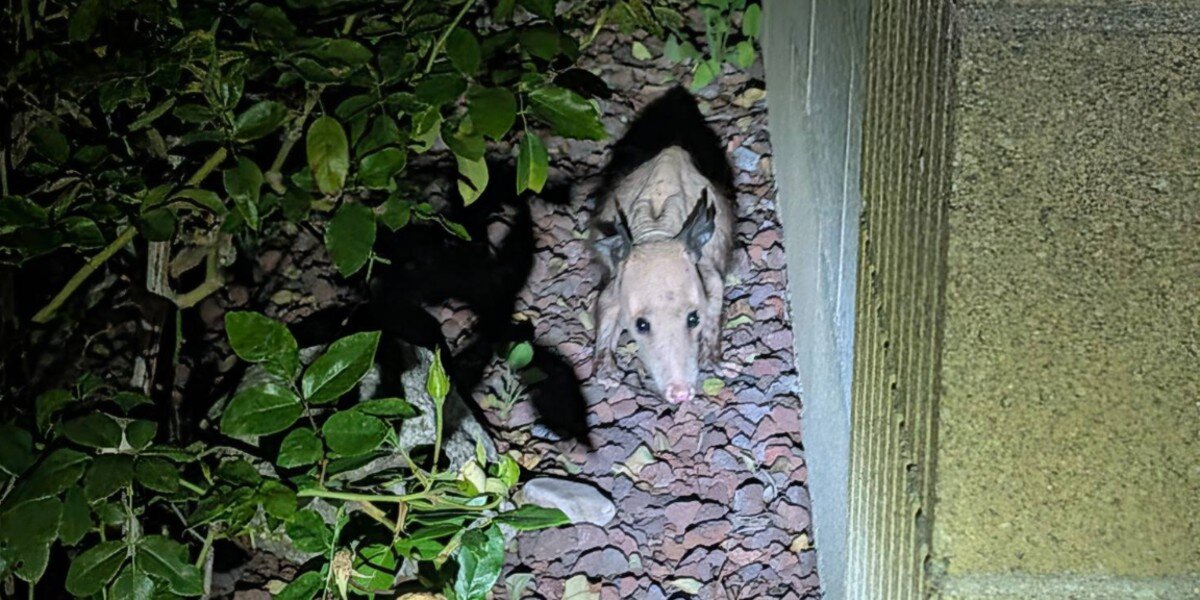
Last year, Kenneth Kick and his wife, Paige, couldn’t believe their eyes when an unusual wild animal came sprinting across their yard. As dedicated volunteers with the Wildlife Foster Program (WFP), they’re always on the lookout for animals in need — and this giant, hairless, rodent-like creature immediately caught their attention.
“They couldn’t believe what they saw,” WFP wrote on Facebook. “Then came winter, and she was never seen again.”
 Facebook/Wildlife Foster Program
Kenneth and Paige spent the next few months searching for the naked opossum around their neighborhood, sadly to no avail. While winters in Anaheim, California, aren’t as frigid as in other parts of the county, they still feared that the helpless and hairless animal wouldn’t survive the cold.
It wasn’t until months later, in January 2026, that Kenneth and Paige heard of her again. The couple was enjoying dinner with WFP’s founder, Debra Jo Chiapuzio, when they suddenly received an unexpected message from their neighbors.
“Their neighbor texted saying they had seen her again!” WFP wrote.
 Facebook/Wildlife Foster Program
The rescuers rushed back to Kick’s home and scoured the property, hoping to finally capture the opossum. But by the time they’d arrived, she’d already run away.
Defeated, the group eventually disbanded. Chiapuzio returned home while Kenneth and Paige settled in for the evening. Then, at 3 a.m., their phone’s ring jolted them awake.
“[T]he neighbors [said] they got her!” WFP wrote.
 Facebook/Wildlife Foster Program
Everyone was elated. After months of searching, the poor opossum was finally safe, and they drove her to WFP’s headquarters first thing the following morning to ensure her survival.
When the couple dropped off the opossum at WFP, they said she resembled a chupacabra. So, her caregivers gave her the perfect name: Chewy.
You can see more footage of Chewy’s rescue here:
Shortly after her arrival, Chiapuzio thoroughly examined Chewy and developed a theory about her hair loss.
“Does she have alopecia? While opossums do get that, it’s not always my first go to,” WFP wrote. “First, alopecia usually presents as patchy hair loss. Her skin is not wrinkly, which often is a [telltale sign] as well. However, dermatitis, parasites, malnutrition, and stress can also cause this condition. Just to name a few.”
 Facebook/Wildlife Foster Program
It was unclear exactly what caused Chewy to lose her hair, but she’d thankfully landed in the right place. The sweet girl quickly acclimated to her new surroundings and grew stronger each day.
Thanks to the incubator and the shirt that kept her warm, and to the small but delicious meals Chiapuzio regularly fed her, Chewy survived the impossible. And she began to thrive.
“Chewy is eating kitten chow!” WFP wrote on Facebook. “And tomorrow she starts on fresh veggies.”
You can see Chewy eat dinner while wearing her shirt here:
By the end of the month, Chewy had grown strong enough to be transferred to a kennel outdoors, where she’s been ever since.
The resilient girl has a long recovery journey ahead, as her fur is still missing and she’s still battling a list of physical ailments, but her rescuers are beyond hopeful that she will pull through.
 Facebook/Wildlife Foster Program
Chiapuzio, Kenneth and Paige are all counting down the days until Chewy’s triumphant return to the wild, hopefully sporting a new warm coat. They’re taking each day with Chewy as it comes, but they remain devoted to her survival and look forward to her eventual release.
“[W]e are feeling very optimistic about her!” WFP wrote on Facebook.
To keep up with Chewy’s progress, you can follow Wildlife Foster Program on Facebook.
To help animals like Chewy get the care they need, you can donate to Wildlife Foster Program here.
