
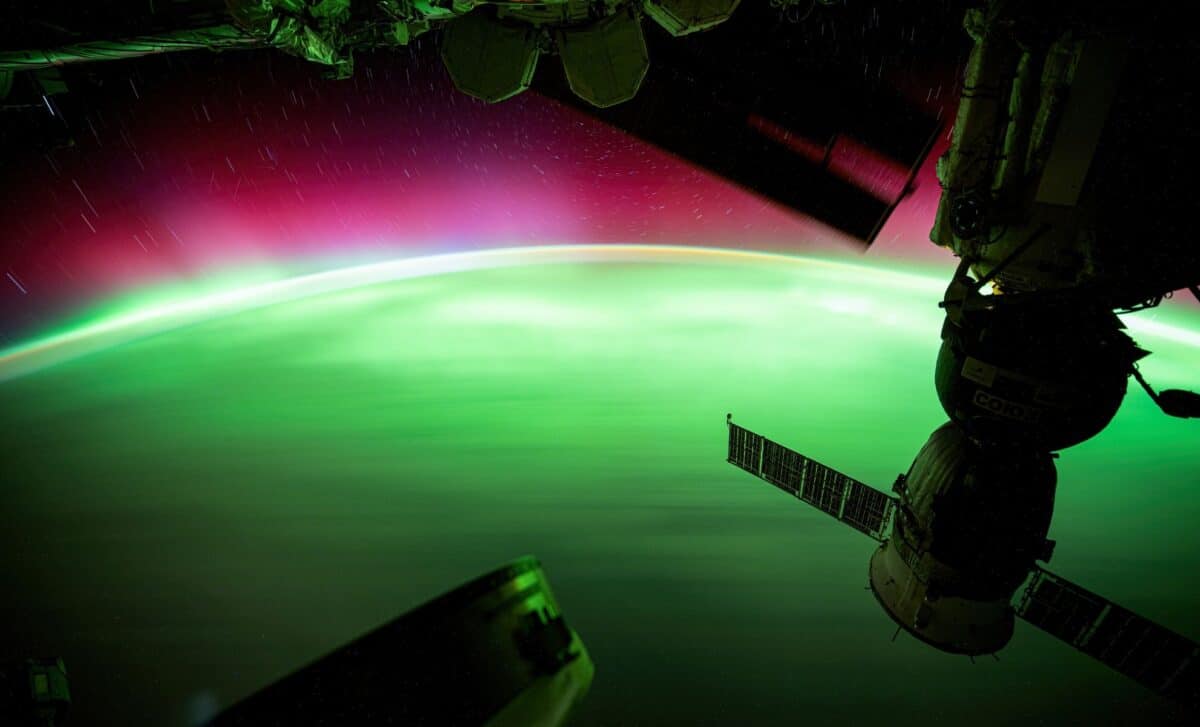
Shimmering green lights have once again danced across Earth’s upper atmosphere, captured in a striking timelapse from the International Space Station (ISS). The footage, recently released by NASA, shows vivid ribbons of aurora flickering over the planet’s curve just as a powerful solar flare surged toward Earth.
These auroras are real-time indicators of space weather in motion. Triggered by interactions between solar particles and Earth’s magnetic field, such events signal heightened solar activity. With the Sun entering an active phase, these displays are becoming more frequent and more widespread.
Auroras From Above: The View From The ISs
Captured during one of the recent geomagnetic episodes, the video shared by NASA reveals Earth’s limb edged in a soft orange glow, the thin shell of its atmosphere, with rippling green bands floating just above it. According to Fox Weather, this visual contrast emphasizes the altitude at which auroras occur, typically between 80 and 300 kilometers above Earth’s surface. From the ISS, their scale and structure become all the more evident.
The clip provides a rare orbital perspective of an atmospheric process that is usually observed from the ground. It highlights the continuous exchange between Earth and the Sun, made visible through light. The green glow stems primarily from oxygen molecules, which emit this color when excited by solar particles. Nitrogen, by contrast, contributes the occasional hues of blue and purple, according to NASA’s explanation.
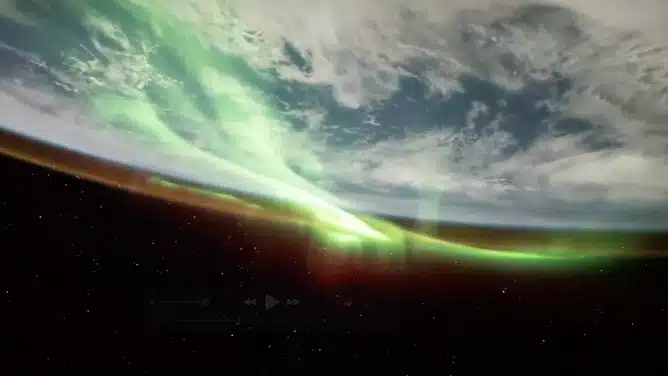 Watch green auroras rip through earth’s skies in stunning iss footage. Credit: NASA
Geomagnetic Activity Triggered By Recent Solar Flare
The auroras shown in the footage likely followed a powerful solar flare on February 3, one of several eruptions observed in recent days. These flares are accompanied by coronal mass ejections, which are massive bursts of solar material that travel toward Earth. When they arrive, they can disturb Earth’s magnetic field and lead to visible geomagnetic storms.
Both NASA and NOAA have noted that such disturbances are not just visually striking. They can also affect satellites, power grids, and communication systems. In this case, however, the effects were most visible in the sky. Multiple sightings of the aurora borealis were reported across the United States and parts of Europe in late January and early February. Among the locations were Missouri, Colorado, and Wiesbaden, Germany, all far from the usual auroral zones.
ORBITAL GLOW: Stunning new footage from the International Space Station shows green auroras rippling over the Earth. pic.twitter.com/54Y1lOCuSj
— Fox News (@FoxNews) February 6, 2026
Unexpected Auroras Seen Worldwide
During this period of heightened solar activity, the Northern Lights extended into areas not typically associated with auroral displays. According to images and reports cited by Fox Weather, people in towns like Lexington, Virginia, and Athens, Alabama, were able to witness the phenomenon. In some cases, the red tint of the aurora was visible to the naked eye. The intensity of these lights was such that passengers aboard a flight to Iceland captured them through plane windows.
The images posted by observers on social media platforms show a remarkable spread of auroral visibility. This underscores the scale of recent geomagnetic disturbances. One observer in Floyd County, Kentucky, noted that the glow was clearly visible without specialized equipment. These widespread appearances are consistent with data from NOAA and NASA indicating that stronger solar events can extend the reach of auroras well beyond typical latitudes.