
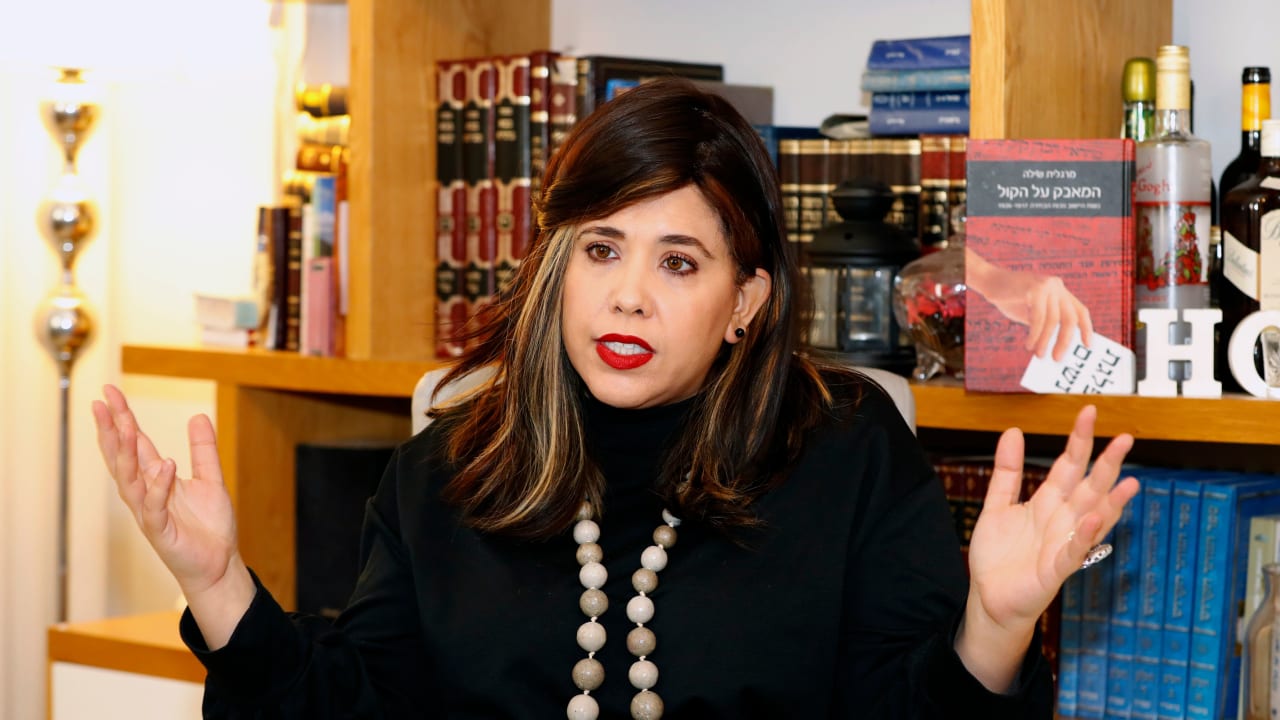
Esty Shushan has blazed a trail as an activist for women’s rights in the haredi community, founding the organization Nivcharot – Ultra-Orthodox Women for Voice and Equality.
She’s also a podcaster, artist, and poet, not to mention a mother of four. Now, she has found a different way to express herself, by directing her first full-length feature film, a powerful drama called The Book of Ruth, which opened in theaters across Israel on Thursday.
It stars Meshi Kleinstein as Ruth, a young haredi (ultra-Orthodox) wife and mother whose world is shattered when she and her husband are forced to cope with a sudden, devastating tragedy. While her husband, Shmuel (Aury Alby), who blames himself for what happened, is drawn to increasingly extreme religious observance, Ruth struggles to find a way to move forward.
Shushan is used to fighting authorities and speaking out loudly and clearly about what she believes, but her movie is a complex, poetic, and philosophical story about finding meaning in life after suffering a loss that can be interpreted in many ways.
When she talks about it, she uses the word “message,” but then corrects herself, saying, “There isn’t a message in the conventional sense in the movie. What I was trying to do was really, first of all, to allow the audience to enter a somewhat foreign world, a slightly different world.”

She realizes that the film, which she wrote more than a decade ago, will be seen by a largely secular audience, although she said that quite a few in the ultra-Orthodox world will likely see it as well, eventually. But still, most of the audience will be from outside her community.
Without filters
“I want them to go into it, I would say, without the usual filters, without romanticizing this world, but to identify with the characters and look inward into what it means for them in their own lives,” she said.
Shushan is acutely aware of all that has been happening in the haredi world recently, and she noted that a screening of the film in Jerusalem took place on the evening of the disaster in a daycare center where two infants died.
“People came carrying that with them… The film tells a different story, but the questions it raises are about that gap – between our responsibility as human beings and placing responsibility on God… I’m aware of that gap; I know it. As a religious woman, I know that faith is an anchor that really helps us hold ourselves steady against a world that is sometimes hard to understand, why it’s run the way it is, and why bad things happen.
“In recent years, especially after the Meron disaster [an event in which 45 men and boys attended a religious celebration and were crushed to death in 2021], it really sharpened this for me. In all kinds of cases like this, I find myself asking, mainly in relation to the authorities, those who were supposed to supervise and make sure things didn’t collapse there, why they didn’t do what they were supposed to do.”
Another important issue the film raises is how even people with good intentions can be pushed into extremism and intolerance. “One of the things I wanted to examine was how tragedies serve as a discourse of radicalization. I mean, I think that’s what happens with the character of Shmuel.
“It’s really to look at a father’s pain like that… He feels guilt; he takes the guilt onto himself. And the way he chooses to cleanse himself of that guilt is literally to cleanse himself of everything he thinks doesn’t serve God, but he cuts himself off in many ways from his wife and so many other aspects of life.”
The film’s heroine chooses a different way: “First of all, she wants to be inside the pain, to stay inside the pain. Not to immediately try to fix it in all sorts of ways, to find some route toward repair or healing. Her way is to look at everything differently…
At the beginning, she thinks she mainly wants quiet. There’s so much noise coming at her from outside and also at home.” Eventually, Ruth finds her path, and late in the film, there is a twist that brings her story full circle, with a kind of poetic justice.
A layer of music
The music also added another layer to the film, and she spoke about collaborating with acclaimed musician Dudu Tassa on the film’s theme song. After they saw a rough cut of the film, she told him she wanted a theme song for the film, and he asked if she had lyrics for it.
“I said, ‘I don’t have lyrics, but I have one line that’s been stuck in my head for a long time. Let’s start with that and see where it takes you.’ It was a line from a prayer, ‘Please, God, heal her.’ Moses says it in the desert, for Miriam, his sister. He simply picked up the guitar and started playing, and I started writing the words as he played.” The song is now available on multiple platforms.
The film was finished before the war, but Shushan wanted to wait until after it was over to release it.
“We’ve gone through two very hard years, extremely hard, things we never could have imagined. When I wrote the song and when I made the movie, I didn’t think we would go through things like this, that we would experience events as surreal as these. I think the emotions raised by the war come through in the story and in the theme song. I want there to be a little comfort, a little healing at the end of the film. So that we remember, too, that even after the very worst, we’re here, we’re alive, we have to live.”