
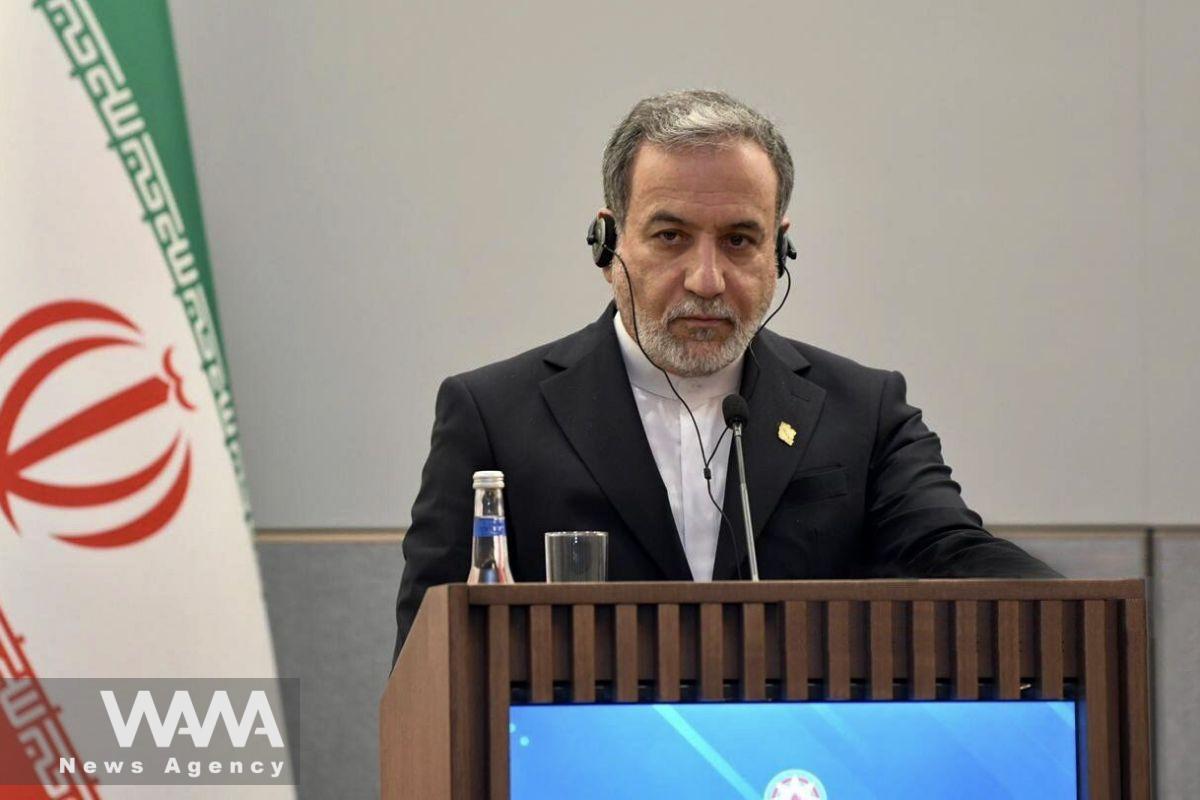
WANA (Feb 07) – Iran’s Foreign Minister Seyed Abbas Araghchi on Saturday delivered a wide-ranging speech at the 17th Al Jazeera Forum in Doha, sharply criticizing Israel’s actions in Gaza and warning that what he described as Israeli expansionism is undermining international law, destabilizing the Middle East, and setting dangerous global precedents.
Araghchi said that if the international community genuinely seeks peace, it must stop “rewarding aggression,” end support for expansionist policies, and apply international law equally, without what he called double standards.
Palestine as a Central Global and Regional Issue
Opening his remarks, Araghchi said Palestine is not merely one issue among many, but the central moral and strategic question in West Asia and beyond.
“Palestine is the strategic and moral compass of our region,” he said, adding that it represents a test of whether international law still matters, whether human rights are truly universal, and whether international institutions exist to protect the weak or to justify the power of the strong.
He said that for decades the Palestinian crisis was understood primarily as the result of illegal occupation and the denial of Palestinians’ right to self-determination. However, he said the situation has now gone far beyond occupation.
‘This Is Genocide’
Araghchi said that what is taking place in Gaza is not a conventional war or a conflict between equal parties. “This is not an unintended consequence of security measures,” he said. “What is happening is the deliberate and widespread destruction of civilian life. This is genocide.”
He said the scale of civilian suffering in Gaza has shocked global public opinion and wounded the conscience of humanity.
According to Araghchi, the devastation has deeply affected not only Muslims but also people of other faiths, including Christians and Jews, who reject the idea that children’s lives can be used as bargaining chips, that hunger can be used as a weapon, that hospitals can be turned into battlefields, or that the killing of families can be justified as self-defense.
Moral Failure of the International Community
Araghchi said Gaza has become a mirror reflecting both Palestinian suffering and the moral failure of those who had the power to stop the violence but instead justified it, enabled it, or normalized it.
“Palestine today is not only a tragedy,” he said. “It is a reflection of the moral collapse of those who chose not to act.”
Global Impact: Erosion of International Law
Araghchi warned that Israel’s conduct in Palestine, combined with what he described as political protection and immunity from accountability, is seriously weakening the international legal order.
He said a dangerous precedent is being set in which states with sufficient political backing can:
Bomb civilians
Besiege entire populations
Destroy civilian infrastructure
Carry out cross-border assassinations
Still claim legal legitimacy
“This is no longer just about Palestine,” he said. “We are witnessing a transformation of the world into a place where force replaces law.”
Regional Impact: Destabilization and Expansion
On the regional level, Araghchi said Israel’s policies are having a direct and destabilizing impact on the security of all neighboring countries.
He accused Israel of openly violating borders, undermining national sovereignty, assassinating officials, carrying out what he called terrorist operations, and expanding its military and intelligence reach across multiple fronts.
He said these actions are carr ied out openly, not covertly, because Israel has learned that there will be no meaningful international accountability.
Araghchi warned that if Gaza is “resolved” through destruction and forced displacement, this model will be repeated in the West Bank, and annexation of Palestinian territory will become formal policy.
He said this reflects what he described as a long-standing expansionist vision often referred to as the “Greater Israel” project.
Structural Impact: Permanent Strategic Inequality
Araghchi said the third and most dangerous consequence is structural, arguing that Israel’s expansionist project requires the long-term weakening of surrounding states militarily, technologically, economically, and socially in order to preserve Israel’s strategic superiority.
He said Israel is allowed to expand its military arsenal without limitation, including what he described as weapons of mass destruction outside any inspection regime.
At the same time, he said, other countries are pressured to disarm, sanctioned for scientific and technological progress, or punished for strengthening their national resilience.
“This is not arms control. This is not non-proliferation. This is the imposition of permanent inequality,” he said. “This is a doctrine of dominance.”
Call for Legal, Diplomatic, and Economic Action
Araghchi said expressions of concern, statements, and symbolic gestures are no longer sufficient. He called for a coordinated international strategy — legal, diplomatic, economic, and security-based — grounded in international law and collective responsibility.
He urged the international community to support legal accountability mechanisms and ensure that violations carry real consequences. He called for comprehensive and targeted sanctions against Israel, including:
An immediate embargo on arms sales
Suspension of military and intelligence cooperation
Restrictions and penalties on officials deemed responsible
Prohibitions on trade
Political Horizon for Palestine
Araghchi also called for a credible political framework based on international law, including:
An end to the occupation
The right of return and compensation for Palestinians under international law
The establishment of an independent, unified Palestinian state with East Jerusalem as its capital
Humanitarian Responsibility
He said the humanitarian crisis must be treated as an urgent international responsibility, stressing that collective punishment must never be normalized.
Regional Coordination and the Global South
Araghchi urged regional countries to coordinate more closely to protect their sovereignty and deter what he described as aggression. He said countries in the Islamic world, the Arab world, and the Global South should form a unified diplomatic front.
He called on organizations such as the Organization of Islamic Cooperation and the Arab League to move beyond symbolism and toward coordinated legal support, diplomatic initiatives, economic measures, and strategic communications.
He stressed that this call was not an invitation to confrontation, but an effort to prevent the region from being reshaped through force.
Warning Against Impunity
In closing, Araghchi warned against allowing any actor to operate above the law. “No one should miscalculate,” he said. “A region in which one actor is allowed to act beyond the law will never be stable.”
He said the doctrine of impunity does not bring peace, but instead produces wider and more dangerous conflicts.
He concluded by saying that justice for Palestine, accountability for crimes, an end to occupation and what he described as apartheid, and a regional order based on sovereignty, equality, and cooperation are essential for lasting stability.
“If the world wants peace, it must stop rewarding aggression. If it wants stability, it must end support for expansionism. And if it believes in international law, it must apply it equally and without double standards,” he said.
“If the peoples of this region want a future free of endless wars, they must accept a fundamental truth: Palestine is not merely a cause for solidarity. It is an unavoidable cornerstone of regional security.”