

February 7, 2026 — 7:00pm
Save
You have reached your maximum number of saved items.
Remove items from your saved list to add more.
Save this article for later
Add articles to your saved list and come back to them anytime.
Got it
AAA
Victoria has fast-tracked more than $9 billion worth of renewable projects in under two years, using sweeping powers available to the planning minister to bypass objections and speed up approvals.
But the state’s energy infrastructure planning agency, VicGrid, has paused consultation on renewable energy zones in fire-affected communities.
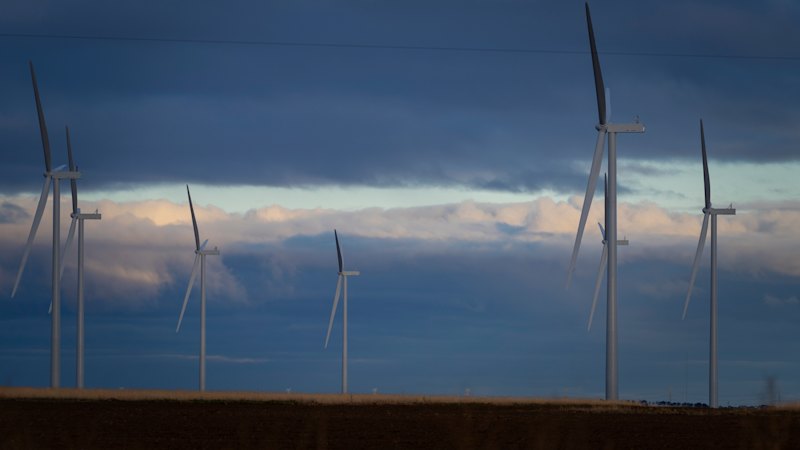
 TagEnergy’s Golden Plains wind farm near Geelong in Victoria.Eamon Gallagher
Government data shows Planning Minister Sonya Kilkenny, using powers under the Development Facilitation Program, has sped up approvals for 25 renewable projects worth more than $9 billion since 2024.
When completed, these will generate power for more than 735,000 homes a year, while battery storage projects in the pipeline could deliver enough power to supply 2 million households during the evening peak.
The program is a COVID-era scheme that was extended in 2024 to deliver the government’s housing and energy agenda.
The changes sought to treat every new renewable projects as a significant economic development, making them eligible for a faster approval process that removes the need for planning panels and third–party VCAT appeals.
Projects at VCAT were also able to apply for the faster pathway, estimated to take just four months to complete.
Third-party objections are still allowed as part of this process but can be resolved faster than they would through VCAT.
Among the most recent approvals under the scheme are a 300-megawatt battery approved in Heywood with capacity to meet evening demand for 103,000 homes, while the Glenrowan 400-megawatt battery can power 138,000 homes during busy periods.
They are near key parts of the power grid to store excess energy created by solar and wind during the middle of the day and shore up supply at night, when demand is high and generation is lower.
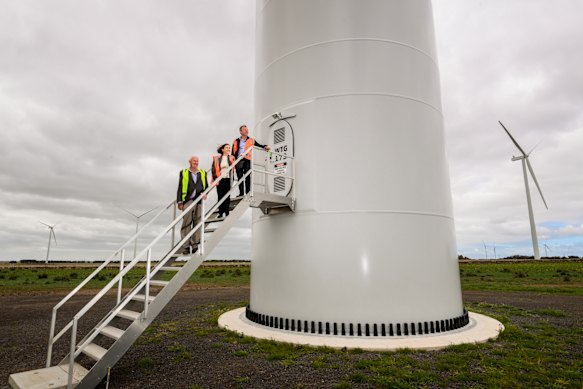 Energy Minister Lily D’Ambrosio visits the Golden Plains wind farm in 2024.Justin McManus
To lodge a bid under the program, companies were required to consult the community and government agencies about their proposal.
Before the expansion of the Development Facilitation Program, the government estimates more than one in five applications for renewable energy programs received since 2015 had ended up delayed in the Victorian Civil and Administrative Tribunal, in some cases blowing out their timelines by two years.
“This fast-tracked pathway has unlocked more than $9 billion worth of investment into renewable energy projects, helping provide cheaper and cleaner energy to hundreds of thousands of Victorian households,” Kilkenny said.
This week, Victoria confirmed it had exceeded its renewable energy target for 2025, with renewables accounting for 22.6 per cent of electricity generation compared with a legislated goal of 40 per cent.
There are nearly 100 large-scale projects in operation, including 54 solar farms, and rooftop solar supplied about 16 per cent of the state’s electricity last year.
Wind farms generated about 24 per cent of the state’s power and 10 more onshore farms have been approved for construction.
“We know the cost of living is tough for many Victorians. That’s why we’re building the energy future that will help lower power prices and deliver real benefits for households and businesses,” Energy Minister Lily D’Ambrosio said.
The scale of renewable energy and storage approved and under way represents a significant change to the state’s power grid before the planned closure in 2028 of the Yallourn power station, one of Australia’s biggest coal-fired generators.
Victoria’s offshore wind auctions, initially expected to deliver two gigawatts of power, are already a year behind schedule, placing more pressure on onshore wind, solar and batteries to offset the loss of 1.48 gigawatts of power at Yallourn when it exits the grid.
However, the rollout of these projects in regional Victoria, and the transmission lines needed to connect them to population centres, has at times faced stiff opposition from local communities.
Related Article
These frustrations have largely centred on the use of land for projects that largely benefit supply and reliability for capital cities or poor consultation by developers, prompting governments to offer more targeted benefits for regional communities and clamp down on cowboy behaviour.
A conference held by the Across Victoria Alliance in Horsham this weekend, which will include a speech by rebel Nationals-turned-One Nation MP Barnaby Joyce, will focus heavily on the impact of these projects on the bush at a time when One Nation’s polling numbers are surging.
Joyce told this masthead in January his focus would be stopping Victoria’s rollout of wind farms, solar farms and transmission lines.
Related Article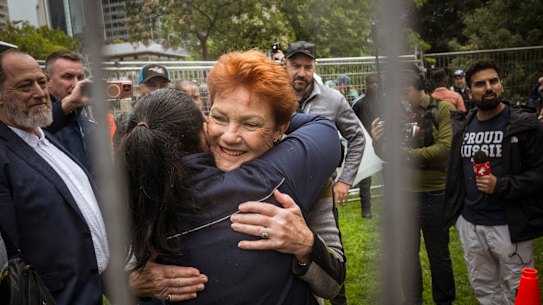
Premier Jacinta Allan has labelled the event a “misinformation convention” and won’t attend despite being invited.
Opposition Leader Jess Wilson has pulled out, citing a scheduling conflict, but Victorian Nationals leader Danny O’Brien and Bev McArthur, the opposition’s leader in the upper house, will attend.
On Thursday, VicGrid said it would pause consultation on the declaration of Victoria’s six proposed renewable energy zones – which will be designated as hubs for wind, solar and battery farms – after their boundaries were announced last year.
The government has also made significant changes to the boundaries of the state’s six proposed renewable energy zones to cater for environmental and industry concerns.
In a letter, the agency said now was not the right time to hold consultation on the zones as these communities were still responding to and recovering from this summer’s bushfires.
Community sessions planned in these areas for late January and early February will be rescheduled, and VicGrid aims to extend consultation beyond the current February 22 deadline to give people more time to provide feedback.
Start the day with a summary of the day’s most important and interesting stories, analysis and insights. Sign up for our Morning Edition newsletter.
Save
You have reached your maximum number of saved items.
Remove items from your saved list to add more.
From our partners