
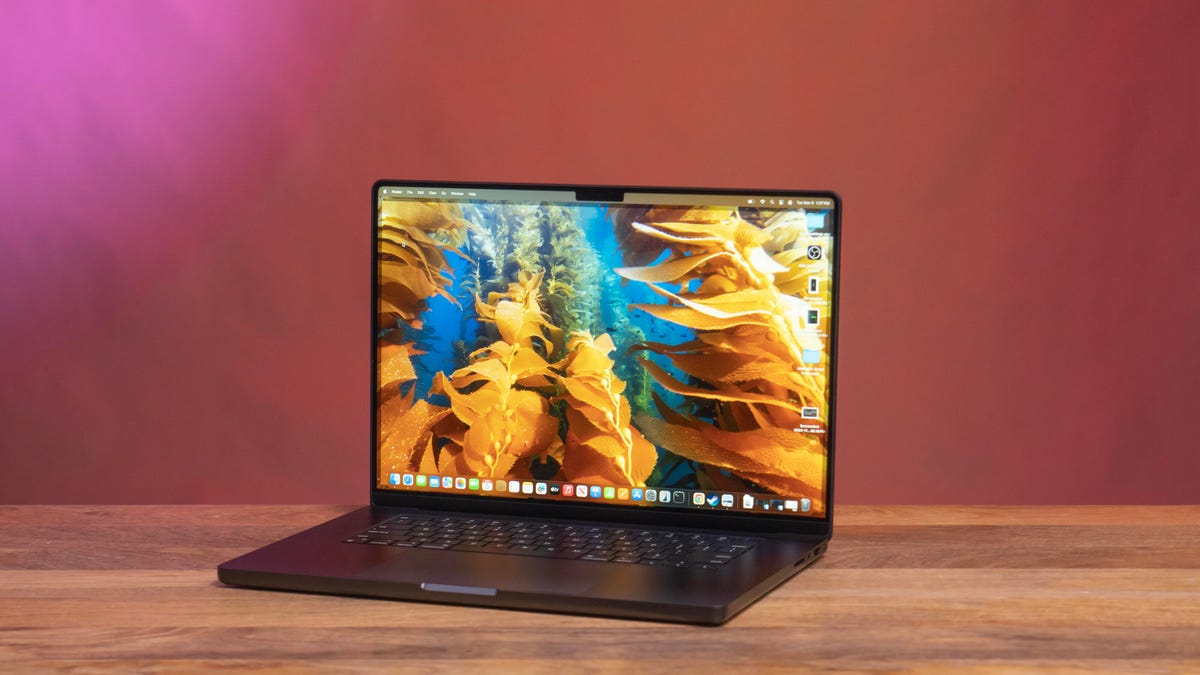
If the rumor mill is to be believed, 2026 will feature an unusually large harvest of Apple products. This is shaping up to be a standout year for MacBooks, and we might be only a week or two away from seeing the first new models.
The MacBook Pro is lined up to be the first MacBook update of the year, with Apple bringing the higher-powered M5 Pro and M5 Max chips to both the 14- and 16-inch MacBook Pro lines later this month or in March. Then Apple could move to the other end of the spectrum and release its rumored $599 budget MacBook. Also in the first half of the year, the MacBook Air is likely to receive an M5 chip refresh. And before the year is out, we could see the first MacBook Pros with OLED touchscreens.
So, yes, the internet is awash in MacBook rumors. Let’s take a closer look at the timing, pricing and details of the MacBook refreshes expected this year.
The 14-inch M5 MacBook Pro released in October, so we’re expecting the rest of the lineup very soon.
Apple/CNETM5 Pro and M5 Max updates for the MacBook Pro
The MacBook Pro was the first MacBook to receive Apple’s latest M5 processor when the 14-inch MacBook Pro was released last October. Now, Apple is expected to extend its M5 offerings and bring the higher-powered M5 Pro and M5 Max chips to the MacBook Pro.
The 16-inch MacBook Pro is still waiting for its M5 update and should also get M5 Pro and M5 Max chips at the same time as its smaller Pro sibling.
CNET’s Lori Grunin tested the M5 chip and noted that it delivers big performance improvements over the M4 “in the narrow areas where it applies, namely on-GPU processing for AI and ray-traced graphics.” Still, the M5 MacBook Pro struggles to keep up with the world of AAA gaming.
The M5 Pro and M5 Max processors will likely follow in the footsteps of previous M-series Pro and Max chips, featuring additional CPU and GPU cores and higher memory allotments.
MacBook Pro models with these high-end chips come at higher prices geared toward processing-intensive tasks like video rendering, 3D modeling and AI workloads. If pricing remains stable, which isn’t a sure bet with the worldwide RAM shortage, the 14-inch MacBook Pro with an M5 Pro chip will likely start at $1,999 and the 16-inch Pro with an M5 Pro will likely start at $2,499.
As with the last MacBook Pro update last October, these M5 updates will be internal upgrades without any significant changes to the laptop’s design. According to Bloomberg’s Power On newsletter, these M5 Pro and M5 Max updates will arrive with Apple’s next major Mac software update, MacOS 26.3, in February or March. If you are eyeing a MacBook Pro purchase, it probably makes sense to hold off on it and wait for the new models to arrive.
Finally, a true budget MacBook?
Apple is reportedly planning to enter the budget laptop market with a low-cost model that’ll be much more affordable than the current cheapest model, the M4 MacBook Air, which starts at $999. This new model will ditch Apple’s M-series in favor of an A-series chip — the same processor that powers the iPhone and could cost as little as $699 or as low as $599 with Apple’s education discount.
Apple already makes the claim that the A19 Pro chip that debuted in the iPhone 17 Pro and the iPhone Air provides “MacBook Pro levels of compute.” But according to industry analyst Ming-Chi Kuo, it’s possible — even probable — that a budget MacBook would utilize an A18 Pro chip (the chip used in the iPhone 16 Pro) instead.
A budget laptop with an A18 Pro chip would likely offer diminishing returns in comparison to the MacBook M4 chips, running roughly 40% slower than the current generation of Macs. The A18 Pro also doesn’t feature support for Thunderbolt ports, so the budget MacBook would likely come outfitted with less-capable USB-C ports instead.
The new rumored budget MacBook will be even more compact than the smallest M4 MacBook Air model.
Josh Goldman/CNET
The other way Apple will reportedly keep the prices down on this new budget MacBook is by shrinking the display size. Kuo reported the laptop will feature an “approximately 13-inch display,” which is a claim corroborated by Bloomberg reporter Mark Gurman. It could feature a 12.9-inch screen, which would be a bit smaller than the 13.6-inch MacBook Air. But it should also be a little lighter than the 2.7-pound Air, making it not only the most affordable MacBook but also the most portable.
This new budget MacBook will compete with Chromebooks and entry-level Windows laptops, which would be a new segment of the market for an Apple laptop. Gurman wrote that the device is intended for “people who primarily browse the web, work on documents or conduct light media editing.” This could be the new MacBook for students. Timing is a little murkier for the release of this budget MacBook, but hopefully it will arrive before the start of the next school year.
M5 coming to the MacBook Air
Just as Apple is reportedly gearing up to give its premium MacBook Pros a refresh with new, more powerful chips, the thinnest, most portable MacBooks are also set to get an upgrade. It’s fairly standard for the MacBook Air to get a springtime refresh, and the M4 MacBook Air was released in March 2025.
Gurman reported that we’ll likely see an M5 MacBook Air release during the first quarter of the year, so we can expect the refresh in the same time frame this year. Like the MacBook Pros, we’re not expecting to see a redesign with the M5 MacBook Air. A new-look Air is at least a couple more years away, according to Gurman.
The 16GB of RAM and 256GB of storage that have been integrated into previous versions of the MacBook Air will likely be standard for any M5 MacBook Air. (I’m keeping my fingers and toes crossed that the minimum storage gets moved up to 512GB, though.)
The M4 MacBook Air starts at $999, and I expect pricing to remain unchanged for the M5 Air.
The first OLED MacBook Pros
Would Apple release two different sets of MacBook Pro laptops in the same year? It’s more likely than you’d think, and it wouldn’t be unprecedented.
Apple released two generations of MacBook Pros in 2023, beginning the year with M2 MacBook Pros and ending it with M3 MacBook Pros. So we know that if Apple deems an advancement significant enough, it will issue multiple refreshes in the same year.
An OLED MacBook Pro lineup would certainly qualify as one of those advancements. According to Gurman, the OLED MacBook Pros would achieve several firsts for Mac computers, integrating a brand new generation of chips and a touchscreen display. Like the previous MacBook Pros, the OLED MacBook lineup would include both 14- and 16-inch models.
The first Macs with OLED displays are also rumored to borrow the Dynamic Island camera cutout from the iPhone.
Kerry Wan/ZDNET
Apple has been catching up to the rest of the industry by integrating OLED panels into more products, including some of its previous iPhone and iPad Pro models. But as Gurman noted, this will mark the “first time that this higher-end, thinner system is used in a Mac.”
Touchscreen displays have been common in Windows laptops for some time, but this rumored design would be the first time Apple integrates them into a MacBook. “The company has taken years to formulate its approach to the market, aiming to improve on current designs,” wrote Gurman. “[Apple] has developed a reinforced hinge and screen hardware to prevent the display from bouncing back or moving when touched.”
The design will reportedly still integrate standard MacBook Pro keyboard and trackpad functionality. What will apparently change, however, is the camera cutout at the top of the screen. Gurman reported that Apple is retiring the iconic “notch” in favor of “a so-called hole-punch design that leaves a display area around the sensor,” similar to the Dynamic Island introduced on the iPhone 14 Pro and Pro Max.
The OLED MacBook Pros could be the first Mac computers to use next-generation M6 chips, according to Gurman. They’ll also feature thinner, lighter frames that make them more portable than current MacBook Pro designs.
If the MacBook Pro adopts a touchscreen design, the computer will be the closest merger between Mac and iPad we’ve seen yet. Industry analyst Kuo believes this shift “reflects Apple’s long-term observation of iPad user behavior, indicating that in certain scenarios, touch controls can enhance both productivity and the overall user experience.”
As it stands, though, the OLED MacBook Pro will still provide a more traditional computer experience than other Apple products — don’t expect the fully hands-on, tactile navigation of an iPad quite yet. A trackpad and keyboard control scheme will remain important pillars of the MacBook experience.
The pricier components and OLED panels will likely result in an increase in the price of the OLED MacBook Pro. The OLED models will likely be several hundred dollars more than their current Liquid Retina display counterparts. The current 14-inch MacBook Pro starts at $1,999, and the 16-inch Pro begins at $2,499.
The OLED MacBook Pros are rumored to go into production this year for a potential release near the end of 2026.