
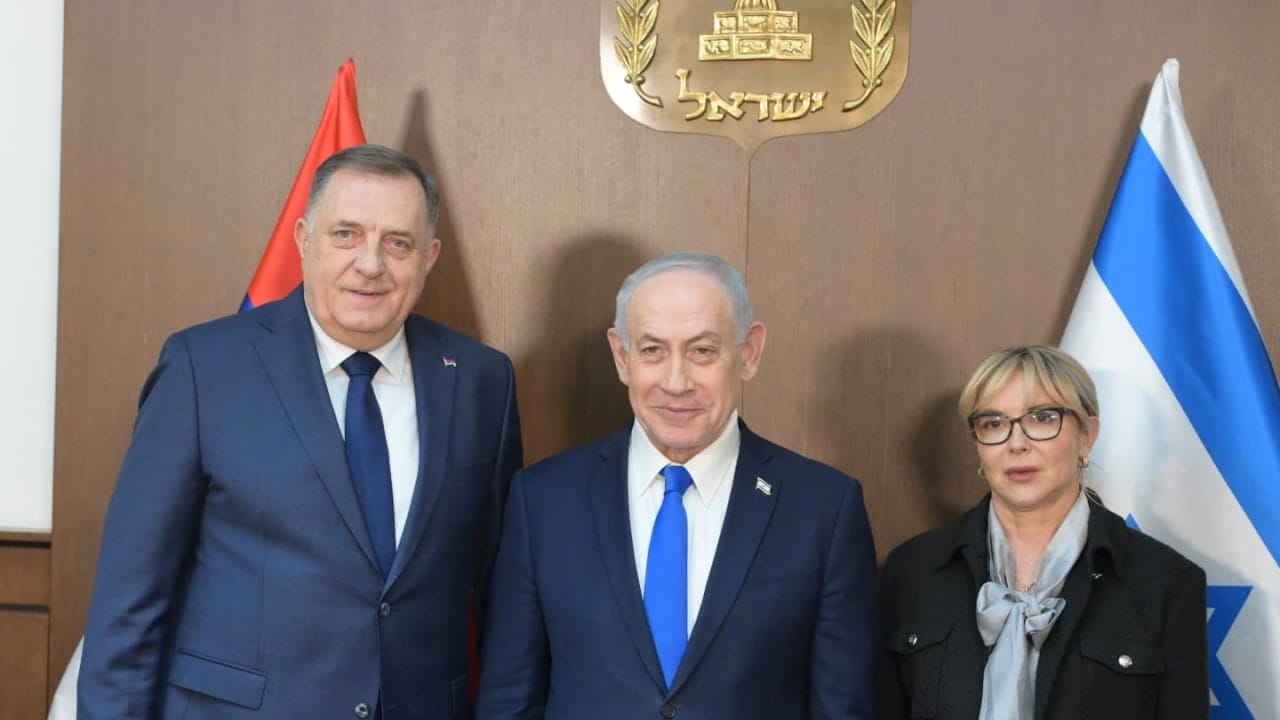
As international representatives gathered in Jerusalem last week to confront antisemitism, a gesture of solidarity by the Republika Srpska was recalled – the illumination of the Palace of the Republic in Banja Luka in the colors of the Israeli flag following the Oct 7 attacks – and an unlikely parallel emerged between two small nations separated by geography but united in their struggle for sovereignty.
Milorad Dodik, the embattled leader of Republika Srpska, had come to receive the Jabotinsky Award for Liberty, and with it, a message that resonated far beyond the ceremony itself.
“They often say – and we feel it that way – that we in Republika Srpska are the ‘Israel of the Balkans,’” Dodik said during his interview with The Jerusalem Post. It was a bold comparison, not just for its political implications but for the deep historical threads it pulled together – threads woven through centuries of Jewish presence in the Balkans, through the horrors of the Jasenovac concentration camp, and through the contemporary struggles of a Serbian entity fighting to maintain its identity against what its leaders see as suffocating European interference.
The weight of an award
The Jabotinsky Award ceremony was more than a diplomatic formality. For Dodik, receiving an honor named after Ze’ev Jabotinsky – the Revisionist Zionist leader who fought against tremendous opposition for the establishment of a Jewish state – carried profound symbolic weight. “Jabotinsky fought for a Jewish state, despite all the obstacles at a time when that was not a popular fight,” Dodik explained. “He’s a great inspiration to us Serbs and to the Republika Srpska, which I represent, where Europe continues to push back even our basic autonomy and try to take even our basic democratic rights.”
The parallel was deliberate. Just as Jabotinsky had insisted on Jewish self-determination when much of the world opposed or was indifferent to Zionist aspirations, Dodik sees himself and Republika Srpska engaged in a similar battle against what he characterizes as European colonialism dressed in the language of human rights and international law.

“This award is very important for me, my people, and the nation and the Republika Srpska,” he continued. “This ties the teaching of Jabotinsky to us, which almost identically is needed for us at this point in time. The struggle for the rights of nations cannot come second on the list of priorities.”
The ceremony itself, held in the Knesset last week, carried the weight of symbolism that both the organizers and the recipient clearly understood. Amir Ohana, the Knesset speaker, framed the moment in terms that connected Jabotinsky’s legacy directly to Dodik’s contemporary struggles.
“It is a moment of special significance to host this ceremony here, at the Knesset in Jerusalem,” Ohana began. “This house is a symbol of the sovereignty and liberty of the Jewish people in their land, our homeland. Today, we gather within its halls to honor an individual who has chosen liberty and truth as his guiding values in his political path.”
Ohana invoked Jabotinsky’s philosophy directly: “Ze’ev Jabotinsky, after whom the prize we present is named, was a statesman who understood that liberty is not granted as a gift. It demands the determination, national pride, and the courage to stand against the prevailing current.” The parallel was unmistakable: Both men, in their respective eras, had positioned themselves as voices willing to defy consensus in defense of what they saw as their people’s fundamental rights.
But Ohana went further, drawing Dodik directly into Jabotinsky’s famous “Iron Wall” doctrine – the idea that peace could only be achieved from a position of unassailable strength.
“Mr. President, through your actions over the years, you have become a part of Jabotinsky’s Iron Wall, defending Israel’s right to exist,” Ohana declared. He cited specific instances: “We will not forget how you stood steadfast in the international arena, when at the United Nations Security Council you prevented unilateral moves against the State of Israel, out of a clear understanding that liberty is not achieved by rewarding terrorism.”

Then Ohana turned to the gesture that had perhaps meant most to Israelis in their darkest hour: “Your friendship has been expressed not only through diplomatic forums but also through powerful gestures of light and courageous solidarity. In the darkest moments, following the horrific atrocities of October 7, you chose to illuminate your residency in Banja Luka with the Israeli flag. This is something we will never forget. At a time when the world stood silent, you sent an unequivocal message of shared destiny with the people of Zion.”
Niva von Weisl, chair of the Jabotinsky Institute, deepened this theme of shared struggle. Her words located the friendship not in political calculation but in historical trauma: “Mr. President, you have chosen to be Israel’s loyal friend, but this is not a friendship of fleeting political interests or convenience. Our people are united by a profound bond of survival, forged in the shared historical trauma and similar security concerns today. This creates an unbreakable link between us.”
It was this invocation of “shared historical trauma” that would echo through Dodik’s own remarks – a trauma rooted in the genocidal horrors of the 1940s, when Jews and Serbs were murdered together in places like Jasenovac.
The deep roots of a parallel
To understand Dodik’s invocation of the Israeli comparison requires understanding the complex, often tragic history of Jews in Bosnia and Herzegovina. The Jewish presence in the region is ancient – records date back to the 2nd century CE, and some scholars argue for a more or less continuous presence since the Roman Empire. But the community’s modern character was forged in 1492, when Ottoman-controlled Bosnia became one of the few territories in Europe to welcome Jews fleeing the Spanish Inquisition.
On the eve of World War II, Sarajevo had one of the most vibrant Jewish communities in the region. The Holocaust shattered that world. However, Bosnia’s Jewish story is not only a story of loss. It is also a story of human choices that complicate easy narratives – Muslims who risked their lives to save Jews, Jews who later helped their neighbors survive Bosnia’s own modern war, and cultural artifacts protected as if they belonged to everyone.
No symbol captures that better than The Sarajevo Haggadah.
The Sarajevo Haggadah – an illuminated 14th-century manuscript believed to have traveled from Spain – has become a Bosnian parable: Jewish heritage preserved not only by Jews but by non-Jews who understood its value. During World War II, when Nazi authorities demanded the manuscript, it was hidden at great personal risk. Later, during the Bosnian War, it survived again – protected as part of the city’s cultural patrimony.
By 1941, the Jewish community of Bosnia and Herzegovina had grown to between 14,000 and 22,000 members. In Sarajevo alone, 12,000 to 14,000 Jews lived, comprising 20% of the city’s population. They had built a vibrant Sephardi and Ashkenazi community, one of the oldest and most diverse in all the former Yugoslav states. In the 19th century, Sephardi Jews contributed to the early industrialization of Banja Luka, building mills, breweries, brick factories, and textile facilities that helped transform the city into a commercial center.
Then came World War II.
When Nazi Germany and its allies dismembered Yugoslavia in 1941, Bosnia was incorporated into the Independent State of Croatia, a puppet state led by the fascist Ustase under Ante Pavelic. What followed was genocide on a scale that shocked even some Nazi observers. The Jasenovac concentration camp complex, established in marshland at the confluence of the Sava and Una rivers, became notorious as one of the 10 largest extermination camps in Europe and the third-largest overall.
But Jasenovac was distinctive in its horror. Unlike German-run camps with their industrial efficiency and gas chambers, Jasenovac “specialized in one-on-one violence of a particularly brutal kind.” Prisoners were murdered with knives, hammers, and axes. The barbarism was so extreme that the camp earned a unique infamy even in the catalog of World War II atrocities.
The victims were primarily Serbs – part of a broader genocide against the Serbian people – but also included Roma and Jews.
Most of Banja Luka’s Jews and Serbs were deported to Jasenovac and Stara Gradiška. On a single day, February 7, 1942, Ustase paramilitaries led by a Franciscan friar named Miroslav Filipovic murdered more than 2,300 Serbs in three villages, including 500 children. The current consensus estimates that the Ustase regime murdered somewhere near 100,000 people in Jasenovac between 1941 and 1945.
It is this shared trauma – of targeted genocide, of being marked for extermination by a collaborationist fascist regime – that Dodik invokes when he speaks of parallels between Serbian and Jewish experience.
“We witnessed manifestations of antisemitism right on our doorstep when Nazi forces and their satraps on the ground – such as the Croatian Ustase – committed crimes,” he told the Post. “Then we saw the greatest crime against Jews and Serbs in the Balkans, in the framework of the Jasenovac concentration camp.”
The contemporary battleground
Today, the Jewish community of Bosnia and Herzegovina numbers just 281 people, recognized as a national minority with generally good relations with both Muslim and Christian neighbors.
But the political landscape Dodik inhabits is far more contentious. He describes a situation in which Republika Srpska, established as one of two constituent entities of Bosnia and Herzegovina under the 1995 Dayton Agreement, finds its autonomy systematically eroded.
“Few people know that for 30 years in Bosnia and Herzegovina, there has been a European administrator appointed by Europe – who was supposed to be appointed even through the United Nations,” Dodik explained with evident frustration.
“They even gave up on that, and then overnight they announce that some German has arrived who governs our lives – who has authority to impose and pass laws, to put people in prison, to strip them of political mandates, and to prevent entire parties – like mine – from being financed from public revenues, in an effort to eliminate them from democratic processes.”
The Office of the High Representative, established by the Dayton Agreement to oversee civilian implementation of the peace accord, has indeed exercised broad “Bonn Powers” since 1997 – the authority to impose legislation and remove officials.
Dodik sees this as colonial governance under a veneer of international legitimacy. “So Europe violates standards massively,” he continued. “And it’s not just double – it’s tenfold double standards. They apply them every time in different ways.”
For Dodik, the parallel with Israel becomes even more pointed when he discusses the peace process. “We, like Israel, signed a peace agreement in the 1990s,” he noted. “In Israel, and with us, that agreement was changed – distorted – so that only our concessions remained, while everything that was promised was taken away from us through the degradation of the Dayton Agreement. All our rights in that agreement were taken and transferred to Sarajevo, with the tendency that Bosnian Muslims would manage things from there.”
The comparison extends to what Dodik sees as institutional bias against both entities. “Institutions like the United Nations and the European Union are irreparably biased against Israel,” he asserted. “Normal rules stop applying when it comes to Israel – and I will add: when it comes to us as well. The same applies to Srpska.”
The question of antisemitism and immigration
When Diaspora Affairs and Combatting Antisemitism Minister Amichai Chikli held his Generation Truth conference addressing antisemitism, Dodik found common ground in the Israeli official’s concerns. But his analysis took a particular turn, focusing on what he sees as the connection between immigration and rising antisemitism in Europe.
“We are grateful to Minister Chikli for his friendship toward us, the Republika Srpska,” Dodik said. “He rightfully expressed his concerns with growing antisemitism in Europe, and especially in Sarajevo, which is the most prominent Muslim city in the Balkans.” He continued with an observation that has become central to his political narrative: “Israel is the birthplace of Judeo-Christianity and its heritage. It is increasingly under attack from liberal elites; but before anything, from what we see in the West, in the form of mass immigration, that usually brings people of the Islamic faith who bring with them deeply rooted and entrenched antisemitism.”
This framing – linking immigration, Islam, and antisemitism – is controversial and contested by many observers. But for Dodik, it represents a coherent worldview in which traditional Christian Europe and Israel both face threats from what he characterizes as misguided liberal policies that undermine sovereignty and cultural identity. “Within concepts tied to a liberal approach that destroys sovereignty and identity, they too easily allow a Muslim view of things in Europe to dominate local public opinion,” he argued. “Srpska opposes the migrations that took place and the antisemitism that follows them.”
The border question becomes particularly acute in this context. “We must be able to control our own borders,” Dodik insisted. “Unfortunately, that is not possible now because the borders are jointly controlled by people from the EU who accepted immigrants – and also by Muslims, Bosnian Muslims – who call on immigrants, their brothers in faith, to come in the most massive form right here and create as large a platform as possible for a struggle against Serbs, Orthodox Christians, Christians; to promote antisemitism; and to fight the Jewish people and Israel as their state.”
The lessons of history
What lessons does Dodik draw from the Jewish experience, and what does he think the world should learn from Republika Srpska’s struggles? His answer reveals the core of his political philosophy. “You know, antisemitism is not integration – it is disintegration and destruction, in every sense,” he explained. “And that is why we, like Israel, are equally exposed to anti-Serb propaganda, which can be equated with antisemitism, as the demolition of foundations for global peace and global cooperation.”
The comparison between antisemitism and what Dodik terms “anti-Serb propaganda” may strike some as overreach, but it reflects how he sees the contemporary political landscape. In his view, both Jews and Serbs are subjected to double standards, held to expectations not applied to others, and punished for asserting their national rights.
“Just as I am proud of my Republika Srpska – because it endures, because it fights, because it does not give up, because it persistently fights for the truth, which alone can win,” Dodik declared. The rhetoric echoes Jabotinsky’s own uncompromising stance on Jewish sovereignty and his famous Iron Wall doctrine – that peace would only come after the Arab world accepted that Jewish self-determination was an irreversible fact.
Dodik draws a sharp distinction between how Europe treats Israel and how it treats Republika Srpska. “Europe likes to criticize Israel, but we know Israel does not pass or repeal laws in the Palestinian Authority. Israel does not conduct elections in the Palestinian Authority. Israel has a desire, in my view, to cooperate with those elected representatives. But when that turns into terrorism like Hamas, then that truly ceases to be a basis for any possible cooperation.”
By contrast, he argued, “Europe sends its people to us; they impose electoral laws; they arrange for Muslims in Sarajevo to manage the electoral process both there and here, and in that way determine future institutional capacities. They do that to us – and then criticize Israel for things Europe itself does to us on a far greater scale.”
The charge of European hypocrisy runs like a thread through Dodik’s entire worldview. He sees the high representative – currently German diplomat Christian Schmidt – as wielding quasi-colonial powers that would be unthinkable in any established democracy. The ability to impose laws without legislative approval, to remove elected officials, to ban political parties from public funding, to imprison dissidents – these are the tools, Dodik argues, of authoritarian control.
“European leaders have no standards,” Dodik declared bluntly. It’s a sweeping indictment, but one he believes is borne out by the selective application of democratic principles. When convenient, Europe invokes the sanctity of sovereignty and self-determination. When inconvenient – in Bosnia, in Republika Srpska – those principles are subordinated to what Dodik characterizes as a broader agenda of maintaining control and preventing genuine autonomy for nations that refuse to conform to Brussels’ vision.
A small nation’s defiance
Republika Srpska occupies the northern and eastern regions of Bosnia and Herzegovina. With a population of 1,228,423 according to the 2013 census, it operates under a parliamentary system with a National Assembly of 83 seats. Its largest city and administrative hub, Banja Luka, sits on the banks of the Vrbas River – the same city where Sephardi Jews once helped build the foundations of industry, and where most Jews and Serbs were later deported to Jasenovac.
The entity was established in 1992 at the onset of the Bosnian War, with the stated purpose of safeguarding the interests of Bosnia and Herzegovina’s Serbs. During the conflict, ethnic cleansing occurred on all sides – a majority of Croats and Bosniaks were expelled from territories controlled by Republika Srpska, while the majority of Serbs were displaced or expelled from what is now the Federation of Bosnia and Herzegovina. The 1995 Dayton Agreement created Republika Srpska as one of the country’s two constituent entities, designed to balance ethnic interests and prevent future conflict.
But from Dodik’s perspective, that balance has been systematically undermined. “By violating the Dayton Agreement, by violating earlier reached agreements between Israel and the Palestinian Authority, they strive above all to dominate both sides,” he argued. “But Israel – we learned that if we allow ourselves to become colonies, there is nothing left of us. That’s why I’m very proud of Israel.”
This pride in resistance – in refusing to become, as he puts it, a colony – defines Dodik’s political identity. It also explains why, despite international sanctions, despite being barred from political office, despite widespread criticism from Western governments and international organizations, he continues to invoke the comparison with Israel.
The symbolism of light
When the Palace of the Republic in Banja Luka was lit up with the colors of the Israeli flag after the Oct. 7 attacks, it was more than a gesture of solidarity. It was a statement about identity, about shared struggle, about the belief that small nations have the right to determine their own future, regardless of international pressure.
For the 281 Jews remaining in Bosnia and Herzegovina – a tiny fraction of the once-vibrant community destroyed at Jasenovac – the symbolism is complex. They have built good relationships with both Muslim and Christian neighbors in contemporary Bosnia. The shared trauma of genocide binds their historical memory to that of the Serbian people. Yet the current political uses of that shared history, the invocation of those memories in contemporary conflicts, creates its own complications.
Dodik’s critics – and there are many – point to his undermining of Bosnian federal institutions, his close ties with Russia and Serbia, and what they characterize as dangerous nationalist rhetoric. The Court of Bosnia and Herzegovina’s conviction and sentencing reflect a view that his defiance of the high representative threatens the fragile post-war settlement. The European Union and the United States have imposed sanctions. International observers express concern about democratic backsliding and ethnic divisiveness.
But Dodik himself sees these criticisms as confirmation of his thesis. “So, of course, one can clearly claim these are double standards,” he told the Post. The more pressure applied, the more he frames himself as a Jabotinsky figure – standing for national rights when it is unpopular, refusing to bend to external demands that he sees as illegitimate.
The contested legacy
History will render its own verdict on Milorad Dodik’s leadership and his claims of parallel persecution. The comparison between Republika Srpska and Israel, between Serbian and Jewish experience, between contemporary European policy in the Balkans and international treatment of the Israeli-Palestinian conflict, is provocative precisely because it contains elements that resonate alongside elements that trouble.
The shared experience of genocide at places like Jasenovac is a historical fact. The current Jewish community’s generally peaceful coexistence with neighbors of all faiths speaks to the possibility of reconciliation even after terrible trauma. The questions about sovereignty, about the balance between international oversight and self-determination, about the line between legitimate criticism and double standards – these are genuine questions without easy answers.
What emerges from Dodik’s visit and the context of the Jabotinsky Award ceremony is not a simple narrative but a complex one, shot through with historical memory, contemporary grievance, geopolitical calculation, and genuine belief. Whether one accepts his framing or rejects it, the questions he raises about national sovereignty, the role of international institutions, and the standards applied to different conflicts and peoples demand engagement rather than dismissal.
In Jerusalem, accepting an award named for a man who insisted that Jewish national aspirations should not be subordinated to any other vision, Dodik made his position clear: “The struggle for the rights of nations cannot come second on the list of priorities.” It is a claim that echoes across the decades from Jabotinsky’s time to our own, from the establishment of Israel to the contested status of Republika Srpska, from the ashes of Jasenovac to the Palace of the Republic.
The lights in Banja Luka shone blue and white in solidarity after Oct. 7. Whether that solidarity reflects a genuine parallel or an opportunistic comparison depends, perhaps, on which history you choose to emphasize, which present you choose to defend, and which future you hope to build. What cannot be denied is that for Milorad Dodik and the entity he represents, the comparison with Israel is not mere rhetoric but a deeply held belief about the right of small nations to persist, to resist, and to survive against what they perceive as overwhelming odds.
In that belief, at least, the echo of Jabotinsky’s Iron Wall finds its Balkan counterpart – whether in triumph or tragedy, history has yet to fully reveal.