
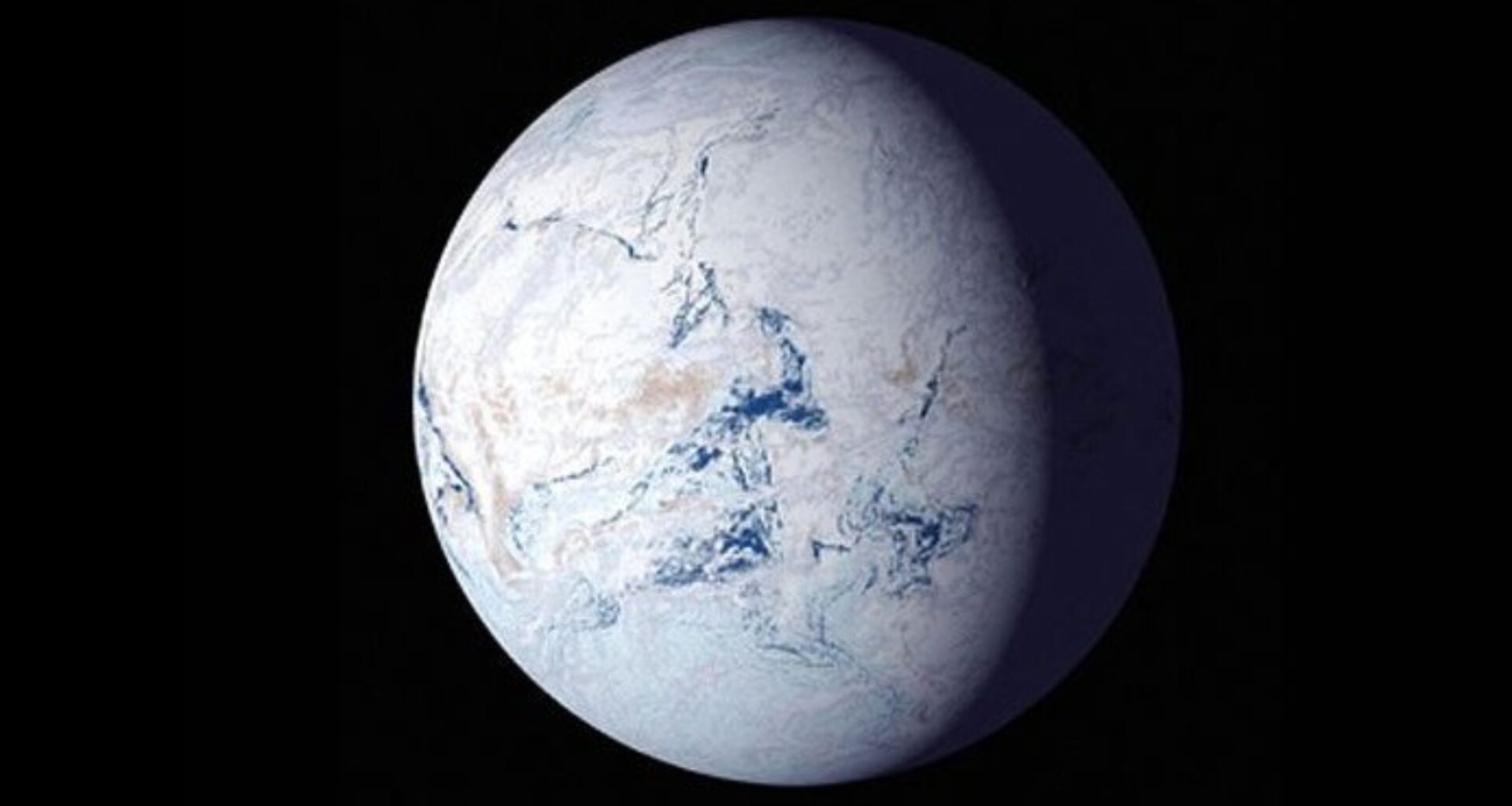
A planet locked in ice can still experience seasons, climate swings, and solar rhythms, according to new research. For decades, scientists pictured Snowball Earth as a long pause in climate history, with movement and change frozen in place.
Ice covered continents, oceans, and even tropical regions during one of the coldest chapters in Earth’s past, making meaningful climate variation seem almost impossible.

But a new study from the University of Southampton now paints a far more dynamic picture.
Ancient rocks from Scotland reveal repeating climate patterns that continued even during deep global freezing, showing that the climate system never fully went silent.
Rocks reveal hidden climate
Snowball Earth refers to extreme ice ages during the Cryogenian Period (about 720–635 million years ago), when glaciers spread to low latitudes and oceans nearly froze worldwide.
Scientists once believed these frozen conditions shut down air–ocean contact, suppressing seasonal changes and short-term climate cycles for millions of years.
Researchers tested that idea by analyzing finely layered rocks from the Garvellach Islands off western Scotland, formed during the Sturtian glaciation – a global freeze lasting about 57 million years.
Each thin layer, known as a varve, represents sediment deposited over a single year, creating one of the longest continuous annual climate records ever found from within a Snowball Earth glaciation.
By measuring 2,640 layers in the Port Askaig Formation, the team reconstructed year-by-year environmental conditions, revealing clear evidence that climate rhythms continued even during deep global freezing.
“These rocks preserve the full suite of climate rhythms we know from today – annual seasons, solar cycles, and interannual oscillations – all operating during a Snowball Earth,” said Professor Thomas Gernon.
“It tells us the climate system has an innate tendency to oscillate, even under extreme conditions, if given the slightest opportunity.”
Sediment layers track seasons
Microscopic study shows alternating light and dark layers. Light layers formed from coarse sediment during warmer melt seasons.
Dark layers formed from fine particles settling during colder months. Such structure matches seasonal freeze and thaw cycles.
Water stayed calm and deep beneath thick ice cover. Floating ice released sediment during partial melting. Ice also carried grains dropped into the water as melting began.
Such patterns strongly support yearly sediment formation rather than random events.
”These rocks are extraordinary. They act like a natural data logger, recording year by year changes in climate during one of the coldest periods in Earth’s history,” said Dr. Chloe Griffin, the study’s lead author.
”Until now, we didn’t know whether climate variability at these timescales could exist during Snowball Earth, because no one had found a record like this from within the glaciation itself.”
Climate cycles in rock
Statistical analysis of layer thickness revealed repeating climate cycles ranging from just a few years to decades and even centuries.
Many of these patterns closely match known solar cycles, including sunspot-driven rhythms, while others resemble ocean-atmosphere oscillations similar to modern El Niño-like systems.
Solar energy reaching Earth changes slightly over time as sunspot cycles alter the amount of incoming radiation. Even small variations can influence temperature, ice melting, and sediment movement.
The rock record shows strong signals corresponding to both decadal and century-scale solar rhythms, suggesting that sunlight continued to shape Earth’s climate even during intense global freezing.
Together, these findings show that climate variation did not disappear but continued at smaller scales beneath the ice.
Ocean-atmosphere interactions return
Climate models tested different Snowball Earth conditions. A fully frozen ocean suppressed most climate movement. However, even small areas of open tropical water allowed climate oscillations to return.
“Our models showed that you don’t need vast open oceans. Even limited areas of open water in the tropics can allow climate modes similar to those we see today to operate, producing the kinds of signals recorded in the rocks,” said study co-author Dr. Minmin Fu.
Open water allowed air and ocean energy exchange. Such interaction produced temperature swings and circulation patterns similar to modern climate systems.
Earth’s deep freeze break
Climate movement did not dominate Snowball Earth. Evidence points to short active periods lasting a few thousand years. Most of Snowball Earth remained extremely cold and stable.
“Our results suggest that this kind of climate variability was the exception, rather than the rule,” said Gernon. “The background state of Snowball Earth was extremely cold and stable.”
“What we’re seeing here is probably a short lived disturbance, lasting thousands of years, against the backdrop of an otherwise deeply frozen planet.”
Ancient rocks guide climate research
Garvellach Island rocks rank among the best-preserved Snowball Earth records worldwide. Their clear layering and minimal disturbance allow scientists to read the climate history of a frozen planet almost year by year.
“These deposits are some of the best preserved Snowball Earth rocks anywhere in the world,” said Dr. Elias Rugen. “Through them, you’re able to read the climate history of a frozen planet, in this case one year at a time.”
Understanding such extreme ancient climates helps scientists evaluate the resilience of planetary climate systems. Even near-total global freezing did not completely halt climate motion, offering important lessons for the future.
“This work helps us understand how resilient, and how sensitive, the climate system really is,” said Professor Gernon. “It shows that even in the most extreme conditions Earth has ever seen, the system could be kicked into motion.”
The study is published in the journal Earth and Planetary Science Letters.
Image Credit: NASA
—–
Like what you read? Subscribe to our newsletter for engaging articles, exclusive content, and the latest updates.
Check us out on EarthSnap, a free app brought to you by Eric Ralls and Earth.com.
—–