

Find your next quality investment with Simply Wall St’s easy and powerful screener, trusted by over 7 million individual investors worldwide.
Microsoft and other large tech firms are planning a record AI infrastructure spend of about $650b in 2026, concentrating an unprecedented amount of capital in a handful of platforms.
Investors are questioning the scale and timing of these commitments as concerns rise over AI returns, OpenAI exposure and Azure capacity constraints.
The shift in sentiment has coincided with one of the largest tech market sell offs since 2022, putting Microsoft’s AI and cloud spending plans under closer scrutiny.
NasdaqGS:MSFT last closed at $401.14, after a 17.0% decline over the past month and a 15.2% decline year to date. The share price has also declined 6.8% over the past week, even though the 3 year return stands at 56.1% and the 5 year return at 70.6%. That mix of long term gains and recent pullback is framing how investors judge the company’s current AI investment cycle.
For you as an investor, the key questions now center on how Microsoft balances record capital spending with margins, cash flow and its partnership exposure to OpenAI. The coming quarters are likely to focus less on new AI announcements and more on evidence of efficient use of Azure capacity and disciplined returns on that $650b industry wide AI build out.
Stay updated on the most important news stories for Microsoft by adding it to your watchlist or portfolio. Alternatively, explore our Community to discover new perspectives on Microsoft.
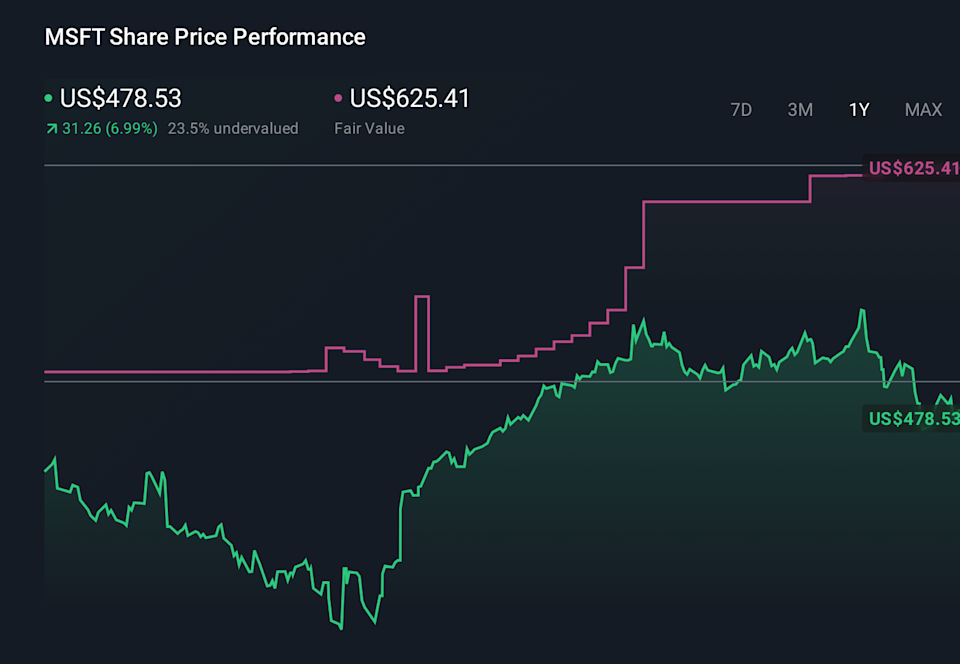 NasdaqGS:MSFT 1-Year Stock Price Chart
Why Microsoft could be great value
For you as a shareholder, the headline is not just the record AI capex figure, but that Microsoft is tying this spending to concrete customer use cases on Azure, from OT security with Dragos to grid edge AI with Itron and robotics with Richtech. These deals show how the planned data center and chip outlay is feeding into contracted workloads and partnerships, even as the market questions margin pressure, OpenAI concentration and how quickly Copilot style software can convert interest into high-attach, high-usage revenue.
The fresh AI-heavy client wins and Maia 200 rollout sit alongside existing narratives that see Intelligent Cloud as the growth engine and More Personal Computing, including Xbox, as more constrained. This helps explain why investors are scrutinising where each incremental AI dollar goes. The news also connects to the OpenAI and Anthropic exposure that some long term holders already flagged as a key variable. It reinforces the idea that Microsoft’s AI story is as much about partner mix and product-market fit as raw spending size compared with peers like Amazon and Alphabet.
⚠️ Very high AI infrastructure capex and Azure capacity constraints could pressure margins if usage ramps more slowly than expected or if OpenAI related commitments do not translate into durable, diversified demand.
⚠️ Competitive pressure from Amazon, Alphabet and Anthropic in both cloud and AI software raises the risk that pricing, workloads and developer mindshare do not consistently tilt in Microsoft’s favor.
🎁 Strong remaining performance obligations, new AI chip capabilities with Maia 200 and multi year client collaborations across sectors give some visibility that a portion of this capex is tied to contracted workloads.
🎁 Analyst commentary still highlights multiple rewards, including good relative value, solid earnings growth and potential upside if AI driven revenue outpaces current cautious expectations.
From here, focus on how quickly Microsoft converts its AI infrastructure build into broad based revenue beyond OpenAI, whether Azure supply tightness eases without sacrificing pricing, and how efficiently new chips like Maia 200 lower unit costs for AI workloads. If you want to see how different investors are stitching these moving pieces into a long term view, have a look at the community narratives on Microsoft’s dedicated page.
This article by Simply Wall St is general in nature. We provide commentary based on historical data and analyst forecasts only using an unbiased methodology and our articles are not intended to be financial advice. It does not constitute a recommendation to buy or sell any stock, and does not take account of your objectives, or your financial situation. We aim to bring you long-term focused analysis driven by fundamental data. Note that our analysis may not factor in the latest price-sensitive company announcements or qualitative material. Simply Wall St has no position in any stocks mentioned.
Companies discussed in this article include MSFT.
Have feedback on this article? Concerned about the content? Get in touch with us directly. Alternatively, email editorial-team@simplywallst.com