
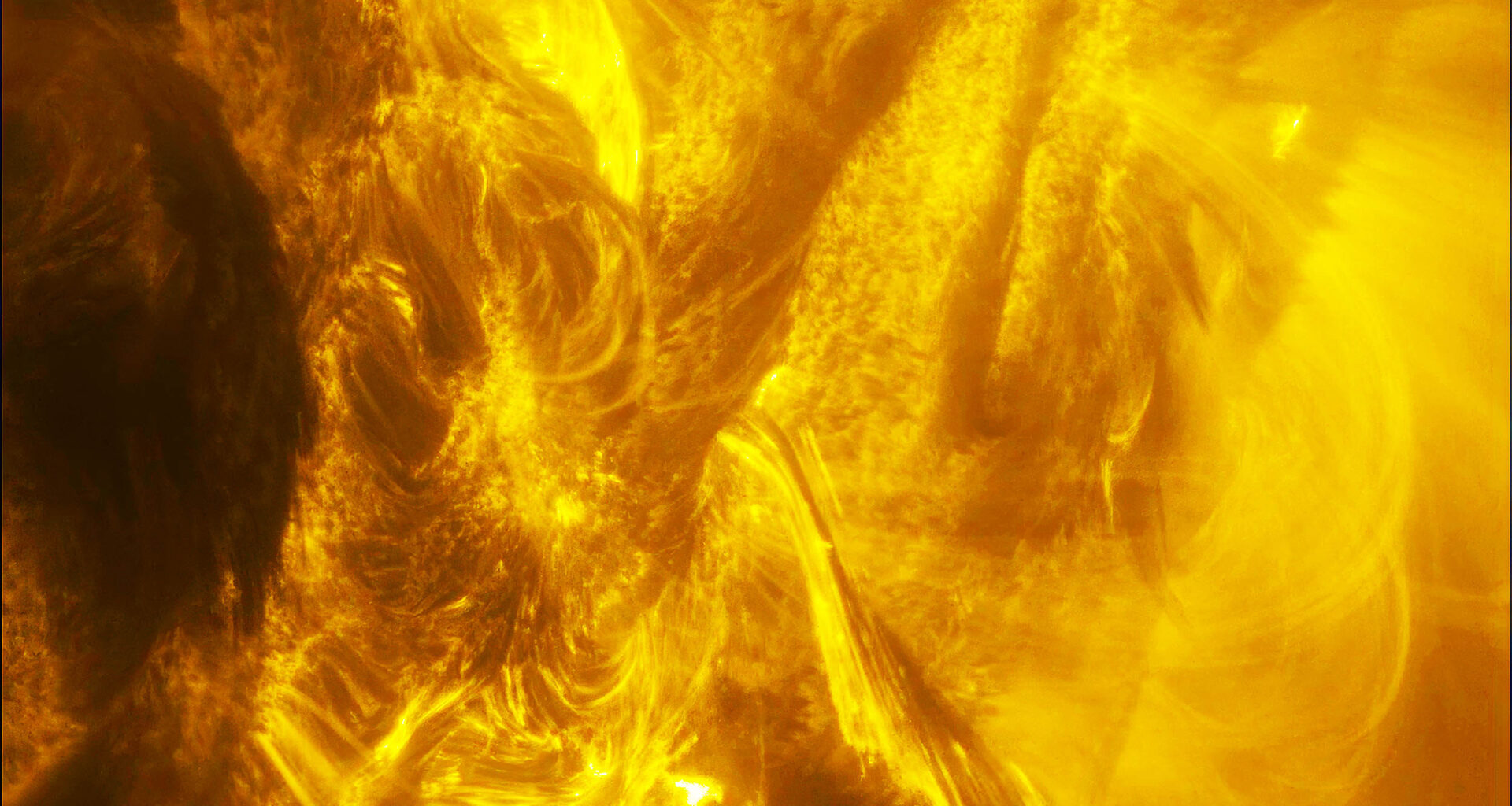
Solar flares don’t begin with a bang. They start small. In fact, until recently, scientists could barely see the early warning signs.
A new set of close-up observations of the Sun now shows that a massive solar flare can grow out of tiny disturbances that stack up fast and spiral out of control.

The slow start belied what was to follow. The Sun’s atmosphere turned into a chaotic scene filled with glowing plasma blobs that fell back toward the surface, even after the main explosion had passed.
The whole event looked less like a single outburst and more like a chain reaction that fed on itself.
Why solar flares matter on Earth
Solar flares are violent releases of energy caused by tangled magnetic fields that snap and reconnect. When they happen, the Sun can blast out heat, light, and fast-moving particles in minutes.
The strongest flares can shake Earth’s magnetic field, disrupt radio signals, and interfere with satellites. That’s why scientists keep a close eye on how these eruptions start and grow.
For years, researchers knew the basics but not the details. They understood that magnetic fields store energy and then release it, but the speed and scale of that release were hard to explain.
What triggers a flare to suddenly explode instead of fizzling out remained an open question.
A rare look at the action up close
On September 30, 2024, during a close pass by the Sun, the Solar Orbiter spacecraft captured one of the most detailed views of a large solar flare ever recorded.
Four instruments worked together, watching different layers of the Sun and tracking changes every two seconds in some regions. The data revealed how the flare slowly built up over about 40 minutes before reaching its peak.
Study lead author Pradeep Chitta is an expert at the Max Planck Institute for Solar System Research (MPS).
“We were really very lucky to witness the precursor events of this large flare in such beautiful detail,” said Chitta. “Such detailed high-cadence observations of a flare are not possible all the time.”
The reasons for this include the limited observational windows and the fact that data like these take up so much memory on the spacecraft’s onboard computer.
The spacecraft had to be in just the right place at the right time to catch the magnificent details of this flare.
A magnetic avalanche takes shape
When the spacecraft began watching the region, a dark, arch-shaped filament made of twisted magnetic fields and plasma was already there. Nearby, a cross-shaped pattern of magnetic lines slowly grew brighter.
Every couple of seconds, new magnetic strands appeared. Each one stayed contained, twisting tighter like a rope under strain.
Then the system tipped. The strands began to break and reconnect. One failure led to another. The reconnection events spread quickly across the region, releasing more and more energy.
The images showed sudden flashes growing brighter as the process sped up.
Solar flare tears loose and unravels
At 11:29 p.m. Universal Time, one brightening stood out. Soon after this, the dark filament tore loose on one side, shot outward, and unraveled at high speed. Bright sparks lit up along its length as the main flare erupted around 11:47 p.m.
“These minutes before the flare are extremely important and Solar Orbiter gave us a window right into the foot of the flare where this avalanche process began,” said Chitta.
“We were surprised by how the large flare is driven by a series of smaller reconnection events that spread rapidly in space and time.”
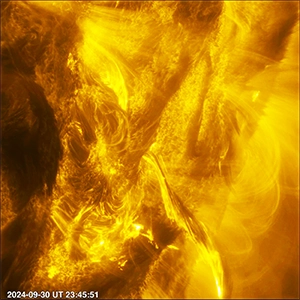 A snapshot taken a second before a powerful M-class solar flare was unleashed from the Sun in September 2024 – as seen in unprecedented detail by the ESA-led Solar Orbiter mission. Credit: ESA. Click image for video.A cascade of explosive events
Scientists have long suggested that solar flares might follow an avalanche-style pattern, where many small events combine to create a large one.
Until now, that idea was mostly based on statistics across thousands of flares. This observation shows it happening within a single, powerful flare.
Instead of one clean eruption, the flare unfolded as a cascade of interacting reconnection events. Each one added fuel to the next, pushing the system toward a full-scale outburst.
Plasma rain and extreme speeds
The same observations also revealed what happened to the energy once it was released.
Instruments measuring ultraviolet light and X-rays tracked where fast particles slammed into the Sun’s atmosphere. These impacts heated the plasma and sent bright streams racing downward.
During the peak of the flare, particles were accelerated to 40–50 percent of the speed of light, which works out to between 431 and 540 million miles per hour.
That kind of speed matters because particles that escape the Sun can pose radiation risks to satellites, astronauts, and technology on Earth.
“We saw ribbon-like features moving extremely quickly down through the Sun’s atmosphere, even before the main episode of the flare,” noted Chitta.
These streams of “raining plasma blobs” got stronger and stronger as the flare progressed. Even after the flare subsided, the rain continues for some time.
“It’s the first time we see this at this level of spatial and temporal detail in the solar corona.” explained Chitta.
After the storm passed
Once the flare’s main phase ended, the scene began to calm. The bright, cross-shaped magnetic pattern relaxed. The plasma cooled. Particle emissions dropped back toward normal levels.
Observations of the Sun’s visible surface showed a clear imprint left behind by the flare, tying together activity from deep below to high above the surface.
The energy involved still surprised the researchers. “We didn’t expect that the avalanche process could lead to such high energy particles,” said Chitta.
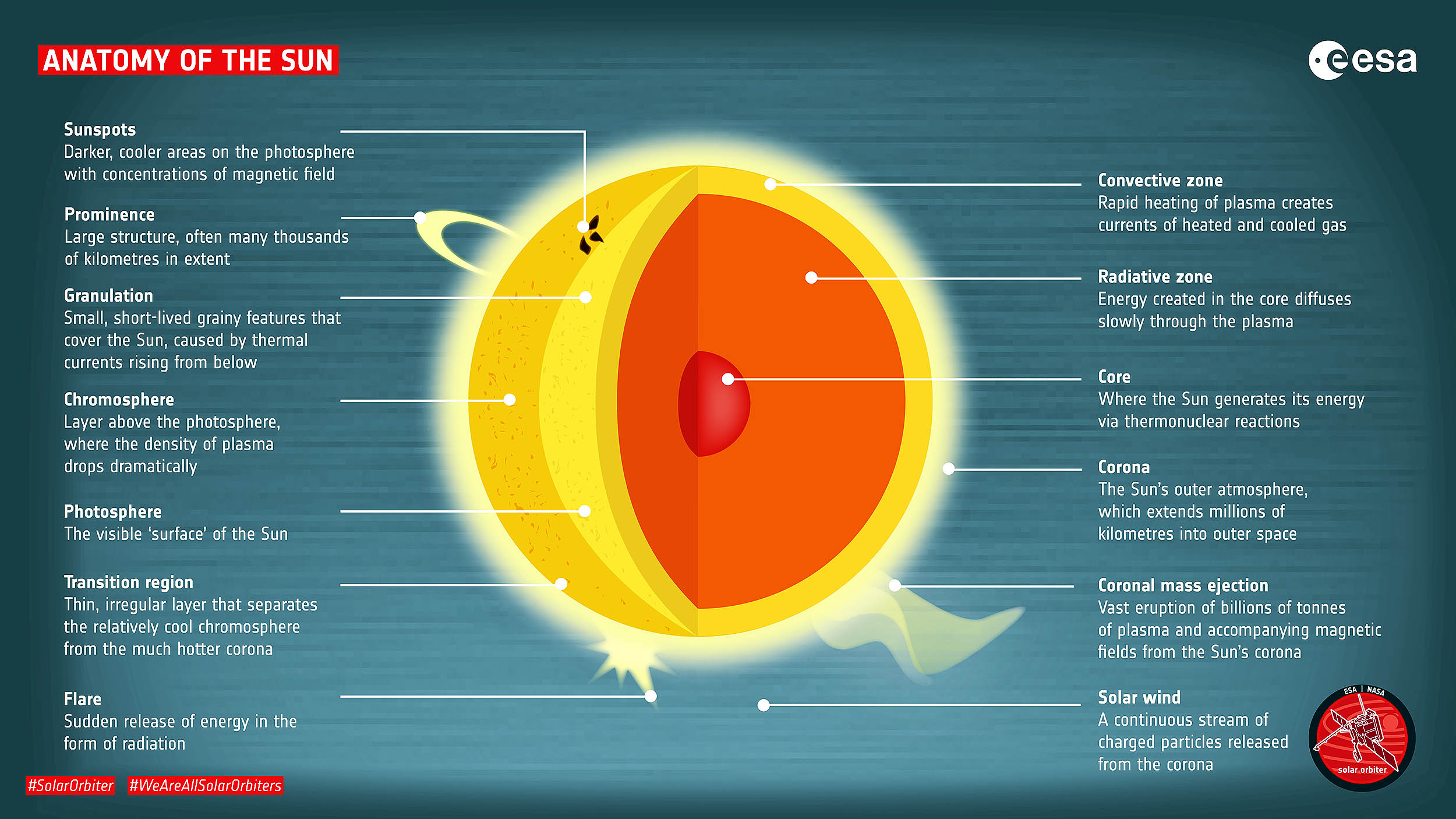 Anatomy of the Sun. Credit: ESA. Click image to enlarge.The bigger picture of how stars behave
The findings reach beyond one flare and even beyond our Sun. They suggest that avalanche-style energy release may be a common feature of flares on many stars.
“This is one of the most exciting results from Solar Orbiter so far,” said Miho Janvier, ESA project scientist.
“Solar Orbiter’s observations unveil the central engine of a flare and emphasise the crucial role of an avalanche-like magnetic energy release mechanism at work. An interesting prospect is whether this mechanism happens in all flares, and on other flaring stars.”
For now, the Sun has offered a rare and detailed lesson. Big space weather events may begin with small, quiet changes that quickly snowball into something far more powerful.
Information in this article was obtained from an online press release by the Max Plank Institute.
—–
Like what you read? Subscribe to our newsletter for engaging articles, exclusive content, and the latest updates.
Check us out on EarthSnap, a free app brought to you by Eric Ralls and Earth.com.
—–