
Astronomers are astounded as a supermassive black hole has unleashed an extraordinarily powerful jet, one so intense that it could potentially destroy planets located within a few light-years. This unprecedented eruption of energy, triggered by the disintegration of a star, has astronomers captivated. It’s a phenomenon they’ve never quite witnessed before, as the black hole continues to emit energy years after consuming its prey. The findings, published in The Astrophysical Journal on February 5, 2026, by astronomer Yvette Cendes and her team, highlight the immense power of this cosmic explosion.
This jet, known as AT2018hyz, is the result of a tidal disruption event (TDE) that shredded a star 665 million light-years away. What began as a relatively typical TDE has turned into one of the brightest and most energetic cosmic explosions on record. According to Cendes, the jet is now 50 times more luminous than when it was first detected, making it a unique object of study in astrophysical research.
A Jet Like No Other
Jets from black holes aren’t exactly rare, but nothing quite like this. The jet from AT2018hyz is an entirely different beast. It’s been traveling at nearly the speed of light, producing a stream of charged particles so luminous that it’s already 50 times brighter than when it was first detected.
According to Yvette Cendes, the lead astronomer on the study, the total energy from this event could reach as high as 5 x 10^55 ergs, far more than what’s usually observed in black hole activity. And the kicker? The energy output of this jet is still climbing and will likely peak in 2027.
“I am hesitant to give a final energy estimate — there are too many things that it will depend on that will become clear once we actually see the peak,” noted Cendes. “But we anticipate that it will be about twice as luminous at the peak than what it is now.”
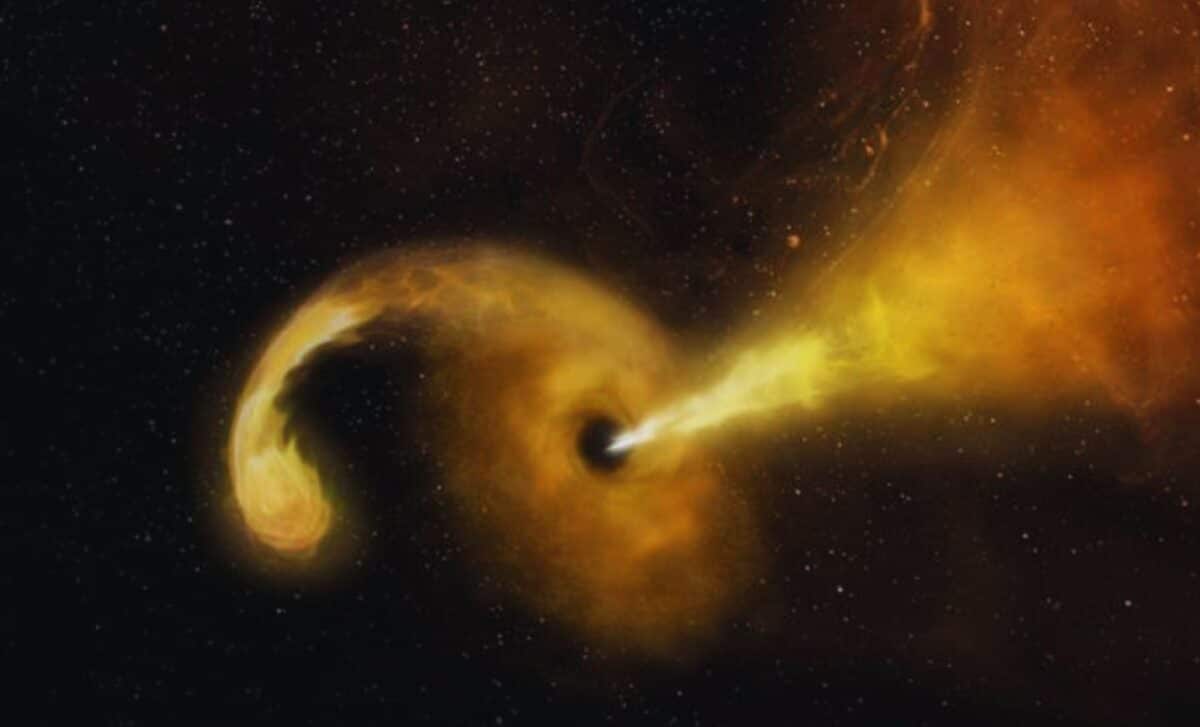
 A visual depiction of a tidal disruption event, where a black hole tears apart a star. Credit: DESY, Science Communication Lab
Why Is This Jet So Powerful?
So, what exactly makes this jet different from the typical ones? It all comes down to its speed and focus. Most jets are slow-moving and diffuse, but AT2018hyz’s jet is narrow and travels incredibly fast. The unusual thing here is that such high-energy jets are rare in TDEs, making this an even more extraordinary case.
According to Cendes, the energy is concentrated because the jet is highly collimated, meaning it’s funneled in a narrow beam. And the weird part is that, at first, the jet wasn’t aimed directly at us. Over time, as the jet slowed down, it started to broaden and finally aligned with our line of sight.
This shift in the jet’s direction makes it visible to Earth observers, but there’s still a lot we don’t understand about why this particular black hole is emitting such a powerful jet.
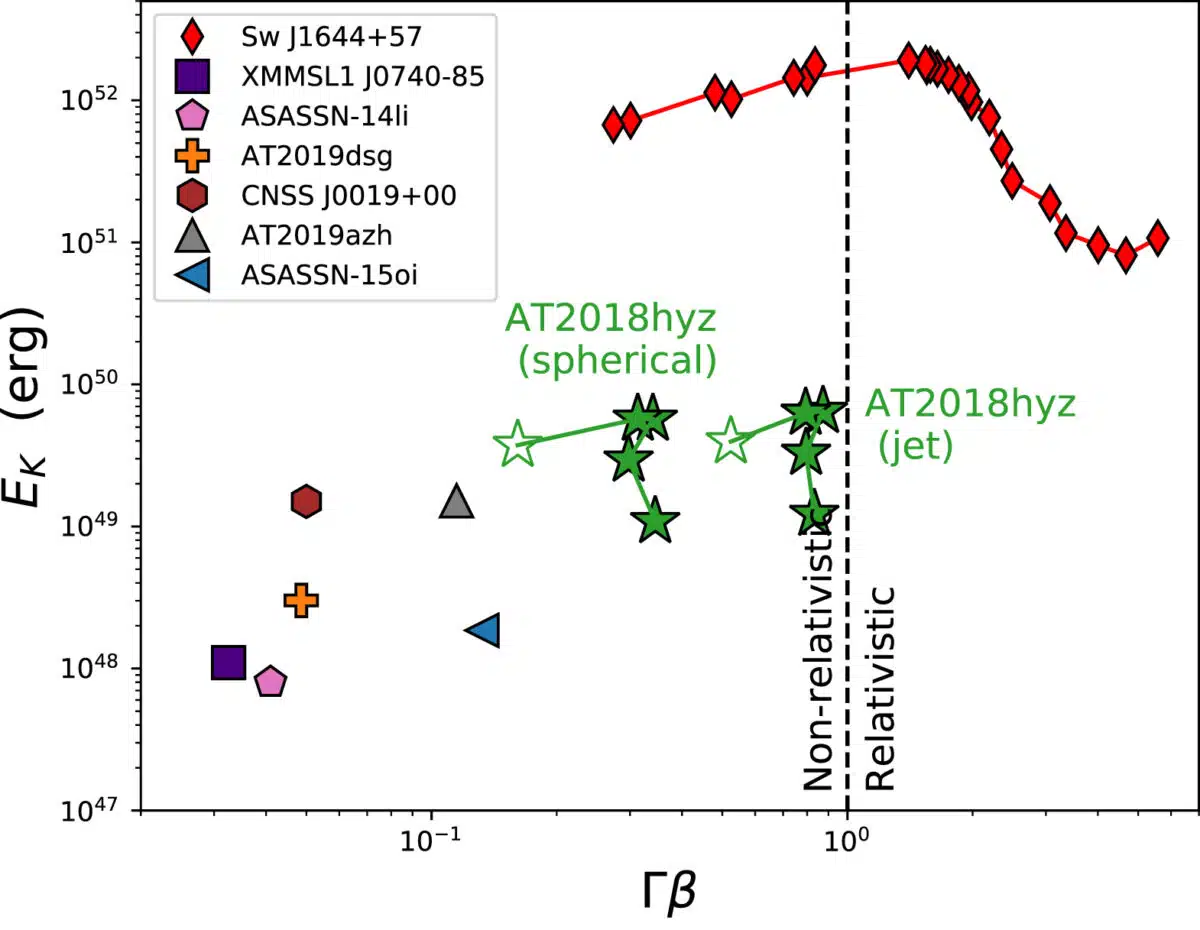 Graph showing kinetic energy vs. Lorentz factor for various cosmic events, including AT2018hyz’s spherical and jet emissions. Credit: The Astrophysical Journal
The Unexpected Lifespan of AT2018hyz’s Energy
When AT2018hyz was first discovered in 2018, it appeared to be an ordinary tidal disruption event (TDE), but it quickly deviated from the norm by remaining quiet for several years. It wasn’t until 2022 that the object flared up again, emitting powerful radio waves, likely caused by synchrotron radiation from the jet. This phenomenon is particularly remarkable because, unlike most TDEs, the energy from AT2018hyz didn’t fade after the initial event but remained active for several years.
This prolonged energy release is unprecedented and provides astronomers with new insights into the long-term behavior of black holes. The researchers, led by Yvette Cendes, published their findings in The Astrophysical Journal in February 2026 and are now looking for other similar events. With the upcoming launch of the Square Kilometer Array (SKA), they will have new tools to explore the radio sky with unprecedented precision, increasing their ability to discover other energetic jets.