
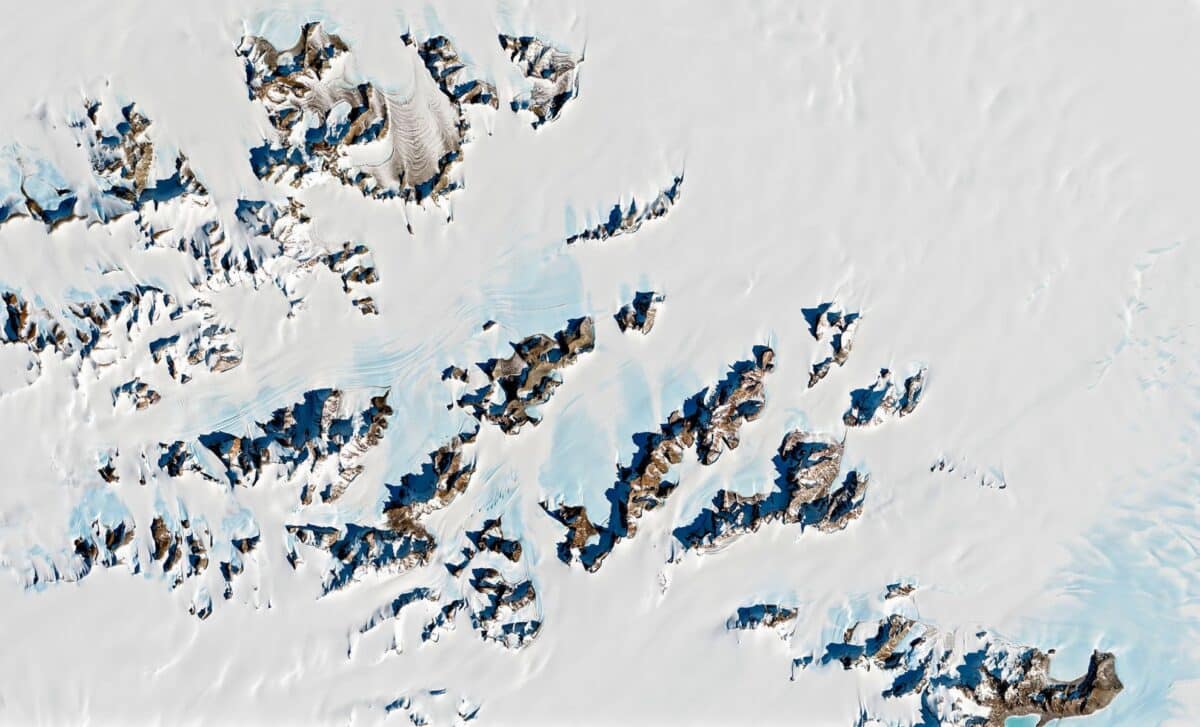
A Martian meteorite discovered in Antarctica has revealed features that suggest water once flowed through it. The findings have reignited scientific discussions about the potential for past life on Mars, based on textures and compositions similar to those shaped by microbes on Earth.
Scientists from NASA’s Johnson Space Center and the Jet Propulsion Laboratory studied the 13.7-kilogram meteorite, named Yamato 000593, using various analytical techniques. Their results point to physical and chemical characteristics deep within the rock that are commonly linked to aqueous activity and organic carbon, both essential ingredients for life as we know it.
This investigation follows a similar line of research initiated in 1996, when a separate Martian meteorite, ALH84001, was at the center of claims about potential biogenic structures. The new study stops short of confirming life, but the evidence found inside Yamato 000593 raises compelling questions that scientists continue to explore with caution.
Internal Tunnels and Carbon Structures Found
According to NASA, researchers identified two sets of features in the meteorite that stand out. The first includes tunnel and micro-tunnel structures that twist through the rock. These curved and branching shapes are similar to alteration textures seen in basaltic glass on Earth where microbes have interacted with volcanic material.
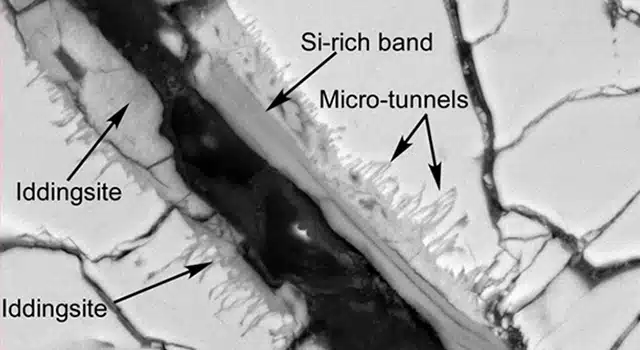 A polished thin section of a Martian meteorite, imaged with SEM, exposes tunnels and sinuous microtunnels. Credit: NASA
The second discovery involves small spherical features located between mineral layers. These spherules, ranging from nanometers to micrometers in size, were found to contain significantly more carbon than the surrounding material. A similar pattern had previously been reported in the Nakhla meteorite, which landed in Egypt in 1911 and is also believed to have Martian origin.
These features were embedded in or near iddingsite, a clay-like mineral that forms when water interacts with rock. According to the team, the arrangement of the spherules and their carbon content suggest that they may have formed during processes involving water and possibly organic materials.
Martian Origin Verified by Minerals
The meteorite was first recovered in 2000 by the Japanese Antarctic Research Expedition on the Yamato Glacier. Scientists later identified it as a nakhlite, a type of volcanic Martian meteorite. Its classification was based on the unique composition of oxygen isotopes and the presence of gases identical to those in Mars’ atmosphere.
The rock is believed to have formed about 1.3 billion years ago during a lava flow on Mars. Around 12 million years ago, an impact likely ejected it into space. After drifting through the solar system, it landed in Antarctica roughly 50,000 years ago.
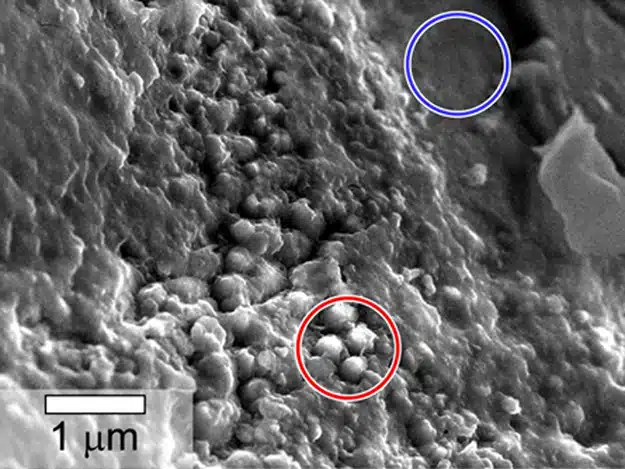 Martian meteorite SEM shows spheroids in iddingsite. Credit: NASA
As stated by the space agency, the similarities between the features in Yamato 000593 and those in Nakhla, which was collected shortly after its fall, support the idea that these structures are not the result of contamination on Earth.
The Science Isn’t Settled Yet?
Lauren White, lead author of the study and researcher at JPL, made it clear that the evidence does not confirm life on Mars.
“This is no smoking gun,” she said. “We can never eliminate the possibility of contamination in any meteorite. But these features are nonetheless interesting and show that further studies of these meteorites should continue.”
Everett Gibson, one of the co-authors from Johnson, emphasized the importance of studying Martian meteorites in laboratories on Earth. According to him, the clay minerals and carbon-rich features in the meteorite point to a dynamic Martian environment that once had water and potentially carbon-based chemistry.
“As more Martian meteorites are discovered, continued research focusing on these samples collectively will offer deeper insight into attributes which are indigenous to ancient Mars,” noted White.