
Unlock the White House Watch newsletter for free
Your guide to what Trump’s second term means for Washington, business and the world
Donald Trump said the US had “very good” talks with Iran and that negotiations would continue next week but warned that the consequences for Tehran would be “very steep” if they did not reach a deal.
The US president said it “looks like they want to make a deal very badly”, adding that Iran was “willing to do much more than they would have a year and a half ago, or even a year ago”.
Trump’s comments late on Friday came hours after his envoys Steve Witkoff and Jared Kushner held indirect talks with Iranian foreign minister Abbas Araghchi in Oman.
Araghchi had also said the talks, the first since the US briefly joined Israel’s 12-day war against the Islamic republic in June, had started well.
The discussions are taking place as Trump weighs military options against Iran in the wake of the Islamic regime’s crackdown on mass protests in which thousands of people were killed.
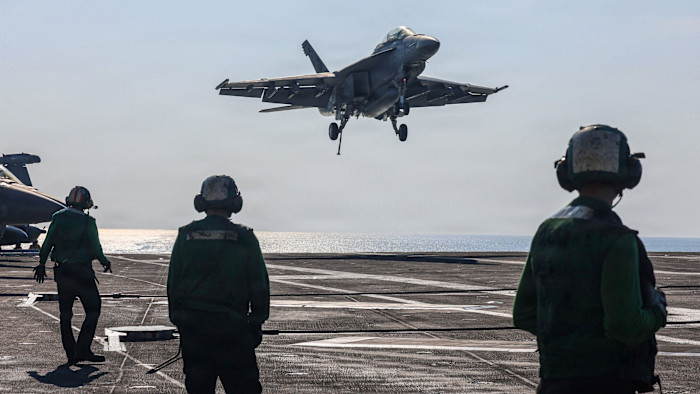
He has deployed an aircraft carrier strike group, fighter jets and air defences to the region and warned Tehran that time was “running out”, raising fears that another war could erupt in the Middle East.
Speaking on Air Force One on Friday, Trump said a deal that only covered Iran’s nuclear programme could be “acceptable”, hinting at a possible shift in Washington’s position.
“The one thing and right up front, no nuclear weapons,” Trump said.
US secretary of state Marco Rubio said this week that talks with Iran should address Tehran’s muscular ballistic missile programme and its support for regional militant groups. But Iran has repeatedly said the negotiations should focus on the nuclear issue — a condition repeated by Araghchi on Friday — and that its missile arsenal was not up for negotiation.
The possibility of a shift in the US position has triggered concern among Israeli officials. Benjamin Netanyahu’s office said on Saturday that he would travel to Washington next week to meet Trump and urge him not to soften his stance.
“The Prime Minister believes any negotiations must include limitations on ballistic missiles and a halting of the support for the Iranian axis,” his office said.
After the US bombed Iran’s main nuclear facilities in June, Trump said Tehran’s nuclear programme was “obliterated”.
But this week he claimed the Islamic republic was “thinking about starting a new site in a different part of the country”. There are also concerns about the fate of Iran’s stockpile of 408kg of highly enriched uranium.
Iran insists its programme is for civilian purposes even though it is enriching uranium at a purity that is close to weapons-grade levels.
Trump said on Friday night that while the US had “to get in position” militarily, he was in “no rush” to use the assets Washington has deployed to the region.
“We have plenty of time. If you remember Venezuela, we waited around for a while, and we’re in no rush.”
The Pentagon began its military build-up in the Caribbean in August but did not launch its operation to capture Nicolás Maduro until early January.
The US and Iran held indirect talks last year, but that diplomatic effort was upended when Israel launched its June war — 48 hours before a sixth round of negotiations.
Analysts said the latest diplomatic effort faced huge challenges. There is immense distrust between the two adversaries as well as diverging views on what should be discussed.
The Trump administration has insisted that Tehran agrees to permanently halt uranium enrichment. But Iran has rejected that demand, arguing it has a right to enrich uranium as a signatory to the non-proliferation treaty.
The challenges were apparent this week, when Iran sought to move the talks to Oman from Turkey, which had been set to host the negotiations. It also resisted the involvement of regional states, which had been expected to attend as observers.
The diplomatic push comes as Tehran is at its most vulnerable point in years as it faces an unprecedented confluence of domestic and international pressures.
Israel severely depleted its air defences and assassinated military commanders and nuclear scientists during its June war.
Recommended

Iran is also reeling from the deadliest civil unrest since the 1979 Islamic revolution after demonstrations over soaring prices erupted in December protests.
Tehran said more than 3,000 people were killed, including hundreds of members of the security forces. The US-based Human Rights Activists News Agency puts the confirmed toll at almost 7,000, while opposition groups abroad claim the number runs into the tens of thousands.
But Iran has sought to project defiance. Its officials have said that while Tehran was willing to find a diplomatic end to the crisis, it was also prepared for war.
“The deep mistrust formed during eight turbulent months after the 12-day war, compounding earlier mistrust, poses a major challenge to the talks,” Araghchi told Iranian state television. “We must first overcome this.”
Additional reporting by Abigail Hauslohner in Washington, James Shotter in Jerusalem and Malaika Kanaaneh Tapper in Beirut