
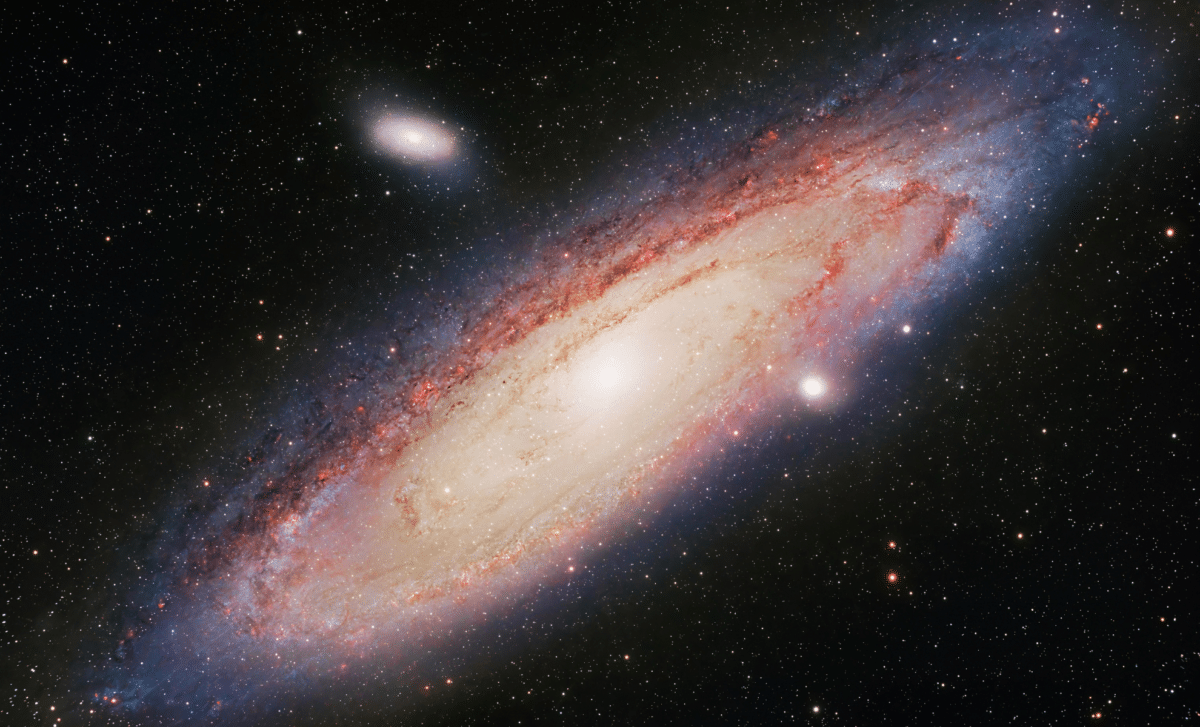
For years, astronomers have observed the strange motion of Andromeda, the Milky Way’s closest large galactic neighbor. While most galaxies in the universe are receding due to the expansion of space, Andromeda has been accelerating toward our galaxy at a speed of 68 miles per second. This observation puzzled scientists, as it contradicted Hubble’s Law, which states that galaxies should move away from each other as the universe expands. However, a new groundbreaking study published in Nature Astronomy has finally provided an explanation for this cosmic enigma.
The Key Discovery: A Flat Sheet of Dark Matter
Recent research has revealed that Andromeda’s unusual motion can be explained by the gravitational effects of a vast, flat sheet of dark matter surrounding the Milky Way and Andromeda. This dark matter, which makes up a significant portion of the universe’s mass, exerts a powerful gravitational pull on galaxies in the local group, including the Milky Way and Andromeda. The new study suggests that this sheet of dark matter is not evenly distributed in space but rather forms a flat structure stretching across tens of millions of light-years.
“The observed motions of nearby galaxies and the joint masses of the Milky Way and the Andromeda Galaxy can only be properly explained with this ‘flat’ mass distribution,” the researchers said in a statement.
This breakthrough offers a new way of understanding the local dynamics of galaxies and provides insight into how dark matter might be influencing the motion of galaxies in our cosmic neighborhood.
Why Is Andromeda Moving Toward Us?
Andromeda’s motion toward the Milky Way is directly influenced by this massive flat sheet of dark matter. The sheet’s gravitational pull affects the trajectory of nearby galaxies, causing them to behave differently than those farther away. As the study’s co-author, Simon White, explained:
“Thus, galaxies closer than [roughly 8 million light-years] are moving away from us slower than predicted by Hubble’s Law, whereas galaxies farther than [that] are actually receding faster than predicted.”
If the mass of dark matter and visible matter surrounding the Milky Way and Andromeda were distributed in a more spherical shape, the gravitational forces would behave differently. Instead of galaxies in the region moving away faster than predicted by Hubble’s law, they would experience a more typical gravitational pull that slows their motion.
Instead, the unique flat distribution of mass in this region counteracts the gravitational pull from the Milky Way and Andromeda, drawing other nearby galaxies away from us. This discovery explains why Andromeda, the closest massive galaxy to the Milky Way, is on a collision course with our galaxy. The dark matter sheet’s influence creates an environment where Andromeda is drawn inward while other galaxies are pushed outward.
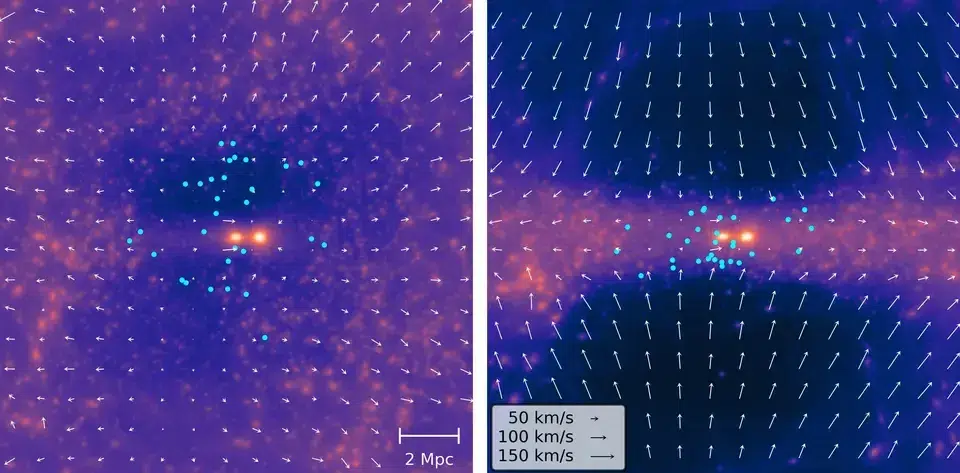 The average distribution of dark matter in the local universe, showing Andromeda and the Milky Way as the two bright-orange blobs at center and the 31 nearby galaxies outside the Local Group as cyan dots. The left image looks down on the flat sheet of dark matter and galaxies, while the right image views it from the side. (Image credit: Max Planck Institute for Astrophysics)
The Role of Cosmic Voids
The study also highlights the importance of “cosmic voids” vast, empty regions of space where galaxies are sparse or nonexistent. These voids, which are scattered throughout the universe, have expanded faster than the average regions of space, creating a situation where gravitational forces are concentrated in the “walls” that separate them. The researchers found that the cosmic walls, filled with galaxies and dark matter, are crucial in shaping the motion of galaxies in the Local Group.
“As a result these regions expanded faster than average, and their matter was ‘pushed’ outwards,” said Simon White.
The regions of space with lower matter density have, over time, concentrated most of their material into these walls, which are now playing a significant role in the movement of galaxies like Andromeda and the Milky Way.
Implications for Cosmic Understanding
This new model of galaxy movement provides a major advancement in our understanding of the universe. By showing how dark matter’s gravitational effects influence the motion of galaxies, this study refines existing cosmological models and offers a more accurate understanding of how the universe behaves on large scales. The simulations used in the research have also allowed astronomers to test their predictions against real-world observations, confirming that the mass distribution around the Local Group is consistent with the motions of nearby galaxies.
The results also suggest that dark matter plays an even more significant role in the evolution of galaxies than previously thought. In the future, these findings may guide further research into the nature of dark matter and its impact on galactic motion across the universe.