
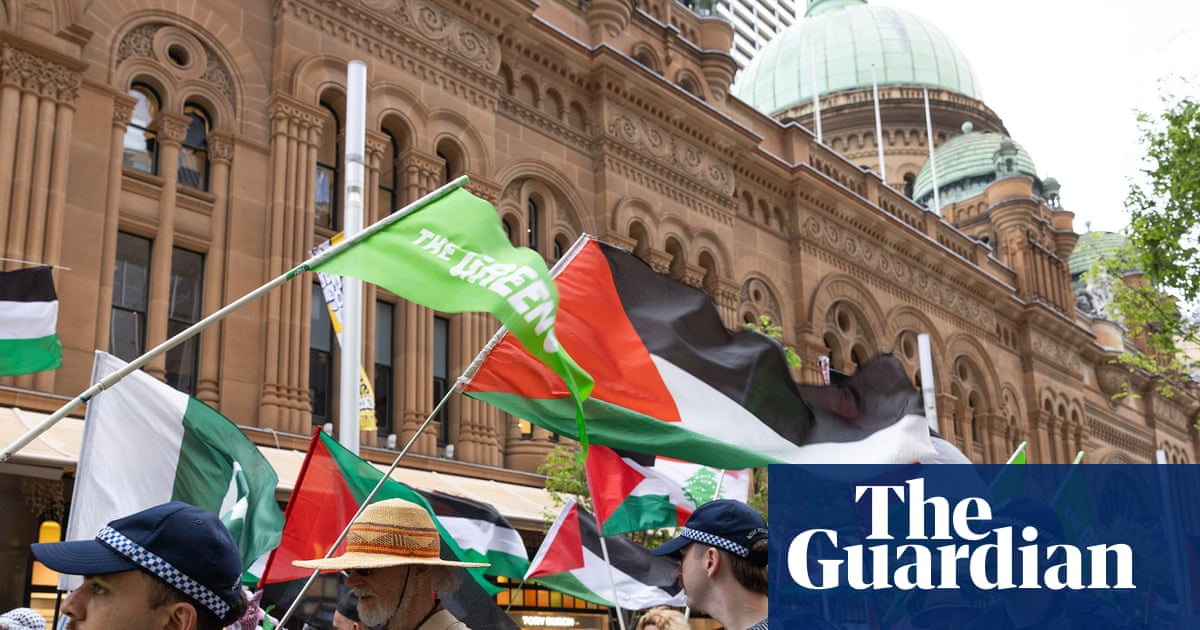
Thousands of Australians are expected to march on Monday in nationwide protests against a visit by the Israeli president, Isaac Herzog, to Australia after an invitation by the prime minister, Anthony Albanese, in the wake of the Bondi terror attack.
The visit has reanimated the issue of the right to protest, particularly in New South Wales where there is a new law that has led to a curtailing of the ability for protesters to march in certain areas. This law is now facing a constitutional challenge.
Is there a right to protest in Australia?
An express right to protest is protected in some individual jurisdictions, including Victoria, Queensland and the ACT.
However, there is no such explicit right under commonwealth legislation, although it’s covered in common law and by the Australian constitution – which the high court has found implies the right to freedom of political communication.
Governments cannot create laws that significantly impede this right. However, there are many laws that critics claim have eroded it.
Courts can overturn such laws if they are found to be constitutionally invalid, and have done so.
Tim Roberts, the president of the NSW Council for Civil Liberties, says a protest itself cannot be considered illegal.
However, an individual protester can be charged with an offence based on their conduct during the protest – for example, if they fail to comply with a move-on direction by police.
Do protests require approval?
Generally, they don’t.
But in NSW and Queensland, there are permit-style systems where organisers submit forms about a planned protest.
Protesters submit the forms to police outlining details such as which roads the protest intends to march along.
It is not mandatory for organisers to use this process. But if they do, and police accept the details on the form, protesters won’t be charged for offences such as blocking traffic or pedestrians.
In Queensland, the protest is deemed authorised so long as five days’ notice is given and no court order has been issued to block it.
If NSW police oppose the application, they don’t have the final say – a court does. This is why the Palestine Action Group went to the NSW supreme court to win permission for its march across the Sydney Harbour Bridge. The court later ruled against a similar protest at the Sydney Opera House on safety grounds.
Last year, the court sided with police and opposed a climate rally in Newcastle by Rising Tide. Organisers went ahead with the protest regardless. The court decision simply meant the protesters were not protected from being charged under protest laws.
In the wake of the Bondi terror attack, the Minns government passed a law which prevents the use of this system in designated areas.
The Victorian government opposes introducing a permit system, citing successive police chief commissioners not recommending them. However, it did pass tougher protest laws in December. The laws include a ban on using attachment devices to lock on to objects in a way that endangers the public as well as fines of more than $1,000 for those who fail to comply with a police direction to remove a mask.
In the ACT, protests are permitted without approval. However, the erection of structures in the parliamentary triangle does require permission.
When can police issue a move-on direction?
In Victoria, police have move-on powers in declared designated areas.
In NSW and Queensland, police don’t have the full suite of their move-on powers if the protest is deemed “authorised”.
Where there’s not a permit, the Law Enforcement (Powers and Responsibilities) Act in NSW states that police may issue a move-on order if protesters obstruct traffic or pedestrians, or pose a “serious risk” to someone else’s safety.
In Queensland, police can only order a person to move on during an unauthorised protest – although they “must not give a direction … that interferes with a person’s right of peaceful assembly” unless deemed necessary on the grounds of public order, safety or to protect other people. The move on powers cannot be used during an authorised protest.
What is the law impacting Sydney’s march?
The NSW premier, Chris Minns, recently passed legislation that effectively bans people from marching in designated areas in Sydney without the risk of being arrested.
This is done by allowing for the permit-style system to be restricted in certain areas. The police commissioner can put in place this restriction, known as a Public Assembly Restriction Declaration, for up to 90 days after a terror attack.
Three groups – Blak Caucus, Palestine Action Group and Jews Against Occupation – have launched a constitutional challenge against the restriction, arguing it burdens the implied right to freedom of political communication. It will be heard by the court of appeal on 26 February.
The proposed route of the Palestine Action Group march on Monday – from Town Hall to NSW parliament – falls within a restricted area.
Protests can still be held in these areas, and many have done so since the restriction was put in place. But police have their full suite of move-on powers if anyone obstructs traffic or pedestrians.
Three NSW Labor backbenchers have said they will attend the rally at Town Hall on Monday, with one scheduled to speak at the event. They have not yet said if they will march.
The Victorian government has also flagged plans to introduce legislation, similar to that in NSW, to give police powers to shut down or move on a protest within a certain time after a designated terror attack.