
I have a habit when I travel.
Whether I’m in New York, Berlin, Budapest, or Tel Aviv, I almost always strike up a conversation with my Uber driver. It’s an easy way to take the temperature of a place — what people are worried about, what names come up without prompting.
When politics enters the conversation, something interesting keeps happening.
In most countries, the answers vary. Different leaders, different parties, sometimes confusion.
With Israel, it’s almost always the same.
There is only one name everyone recognizes.
Benjamin Netanyahu.
Not an Israeli politician — the Israeli politician.
This isn’t just anecdotal. It shows up clearly in the numbers.
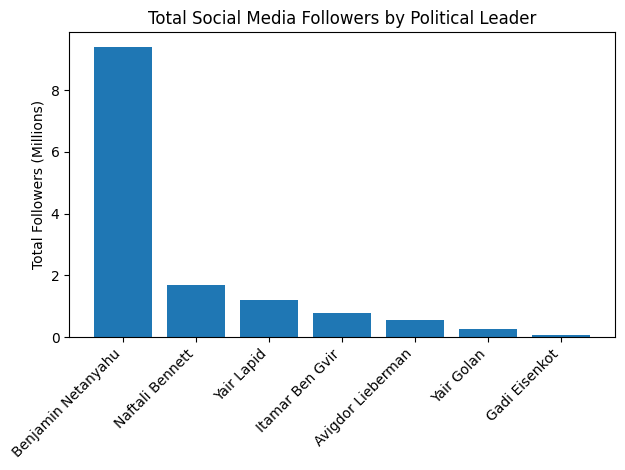
On social media, Netanyahu has nearly five times more followers than the next most prominent Israeli political figure, Naftali Bennett. That gap isn’t cosmetic. It reflects something much deeper: power, longevity, and dominance of narrative.
For almost three decades, Netanyahu hasn’t just led governments — he has defined Israel’s political brand. Internationally, Israel is Netanyahu, and Netanyahu is Israel. No other Israeli politician comes close.
There’s a moment that captures this imbalance almost too well.
When Donald Trump visited the Knesset, he publicly addressed the Israeli opposition — and couldn’t remember the opposition leader’s name. Yair Lapid became, in that moment, simply “Mr. Opposition.”
It wasn’t meant as an insult. It was revealing.
Netanyahu, by contrast, never needs an explanation. Presidents, prime ministers, journalists, investors — they all know exactly who he is. He is the only Israeli politician who has truly become an international political figure, operating on a global stage with global recognition.
With that level of power comes an unavoidable truth: responsibility concentrates.
When influence is this asymmetrical — when one individual towers over the system politically, electorally, and symbolically — responsibility cannot be diffused endlessly downward. Successes, failures, stability, fractures — they land first and foremost at the feet of the person who has shaped the system for so long.
This isn’t a moral judgment. It’s a structural reality.
And this is precisely why the fierce resistance to an independent state commission of inquiry after October 7 is so telling. A leader confident in his conduct, in his decisions, and in the system he built does not fear scrutiny — he demands it. Netanyahu’s repeated efforts to delay, weaken, or reframe an independent investigation signal something deeper than political caution. A truly independent committee would do what no slogan or press conference can undo: create a clear, documented record of long-term decisions, priorities, and warnings ignored at the very top. When power is this concentrated, accountability becomes unavoidable — and for those who have dominated the system for decades, it becomes threatening.
Power at this scale is rare.
And it is never neutral.
The question Israel keeps circling isn’t whether Netanyahu is strong.
The numbers already answered that.
The real question is what a democracy does when strength lasts this long — and what responsibility looks like when no one else is even close.
Elkana is an entrepreneur and business manager with a deep passion for education.
Since 2007, Elkana has been in the field of experiential education and social entrepreneurship, focusing on community building, social awareness, humanities, and Jewish identity.
Elkana currently resides in Eshhar, together with his wife, two daughters, and son.