
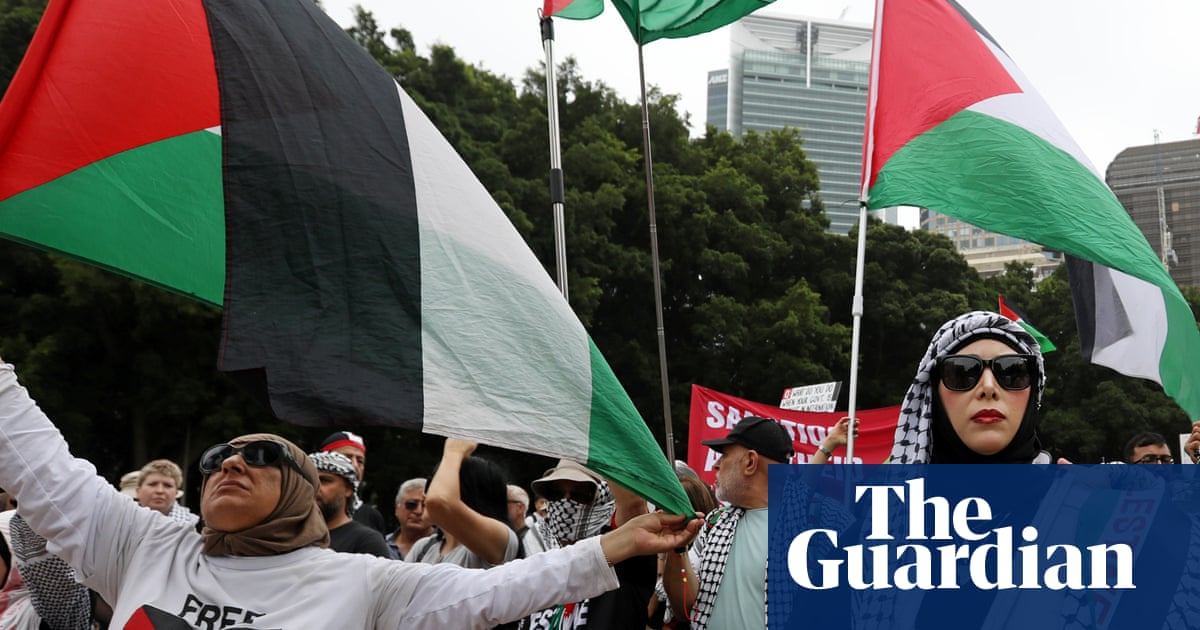
Protesters planning to march through Sydney’s CBD during the Israeli president, Isaac Herzog’s visit are being urged to take an alternate route, as the Palestine Action Group prepares to challenge the premier’s use of special powers before the rally.
The acting assistant commissioner of New South Wales police, Paul Dunstan, told reporters on Sunday negotiations were continuing with Josh Lees, from the Palestine Action Group, over the location of Monday night’s march.
The group plans to march from the town hall to the state parliament, in a breach of the public assembly restriction declaration extended by police on Tuesday.
Sign up: AU Breaking News email
The extension prevents the authorisation of protests under the form 1 system, effectively banning marches in designated areas without the risk of arrest. The current designated area includes the town hall and takes in the northern part of the CBD and the eastern suburbs, but excludes Hyde Park.
Dunstan urged the group to relocate to Hyde Park and march to Belmore Park instead, saying it would “safely facilitate a peaceful protest on the streets of Sydney”.
“I do have concerns about the size of town hall, and possibility of overflow into public areas, which could lead to conflict between police and protesters,” he said.
“For that reason, among many, I would ask them to consider relocating and to continue negotiating with us.”
Dunstan stressed Lees “went to great efforts to outline an intent and desire for a peaceful and safe protest”.
The premier, Chris Minns, said the alternate route “would have dramatically lowered tensions in the city”.
“It would have been a clear way of demonstrating that there’s protests that can take place … but also a respectful way of ensuring that those who are in the city, who are mourning after the worst terrorism event in the country’s history, won’t be subject to a confrontation on city streets,” he said at a seperate press conference on Sunday.
“So far, that opportunity hasn’t been taken up, but NSW police will continue to negotiate with the protest organisers right up until the last moment, and we hope that common sense prevails.”
Minns invoked the state’s “major event” legislation on Saturday, granting police additional powers to move people on, close specific locations and issue orders to prevent disruption or risks to public safety. Anyone who fails to comply with police directions may face penalties, including fines of up to $5,500.
Lees confirmed on Sunday the Palestine Action Group would urgently file proceedings in the NSW supreme court on Monday to challenge Minns’ use of the powers, which he said “threaten the civil liberties of everyone in NSW”.
“We are taking Chris Minns to court again. He has imposed sweeping search, exclusion and conduct restrictions across our city in an attempt to shut down dissent,” he said.
“The declaration gives police unprecedented authority across central Sydney for the duration of the visit, effectively criminalising political expression and assembly.
“These laws are designed to intimidate and deter people from speaking out against war crimes and injustice.
“Instead of defending human rights, the NSW government is using emergency-style powers to shield a visiting head of state from public scrutiny and accountability.”
A separate legal challenge by the group against NSW’s anti-protest laws, passed after the Bondi attack is also ongoing.
When asked about the possible challenge, Dunstan said it was a matter for the government, not the police.
He said more than 3,000 police officers would be deployed across Sydney during Herzog’s visit, with people to expect motorcades, clearway zones, and fencing and barriers to be up in the CBD over the next few days.
“With the tensions associated with this visit, you will see additional numbers, but people should feel confident to go about their business over the next few days as per normal,” Dunstan said.
He also advised that those planning to attend the city from 5.30pm onwards should be aware of the significant police operation and potential protest activity.
“We do not want conflict. We want to ensure that this is conducted in a peaceful and safe manner, and I’m confident that we can achieve that by working together with the Palestinian Action Group,” Dunstan said.
Minns urged “respect and calm as we get through the next four days”.
The prime minister, Anthony Albanese, invited Herzog after the 14 December antisemitic attack at Bondi, saying his visit was intended to foster “a greater sense of unity”. Major Jewish organisations and federal and state governments have welcomed Herzog’s visit as a moment of profound significance.
Other groups, including some Jewish Australian organisations, say the Israeli president should be barred from entering the country. They allege he incited genocide against Palestinians, pointing to a UN commission, which does not speak on behalf of the UN, which concluded in September 2025 that Israel had committed genocide in Gaza and that Herzog, the Israeli prime minister, Benjamin Netanyahu, and the then defence minister, Yoav Gallant, “have incited the commission of genocide”.
Israel’s foreign ministry rejected the commission’s report, calling it “distorted and false” and claiming it “relies entirely on Hamas falsehoods”.
Palestinian Australian Raneem Emad, who plans to protest against Herzog’s visit on Monday, said the visit felt “like a slap in the face”.
“So many of us have lost tens, if not dozens, of family members in Gaza, and no one understands that feeling like another Palestinian mother or someone else who has unfortunately had to face such traumatic loss,” she said.