
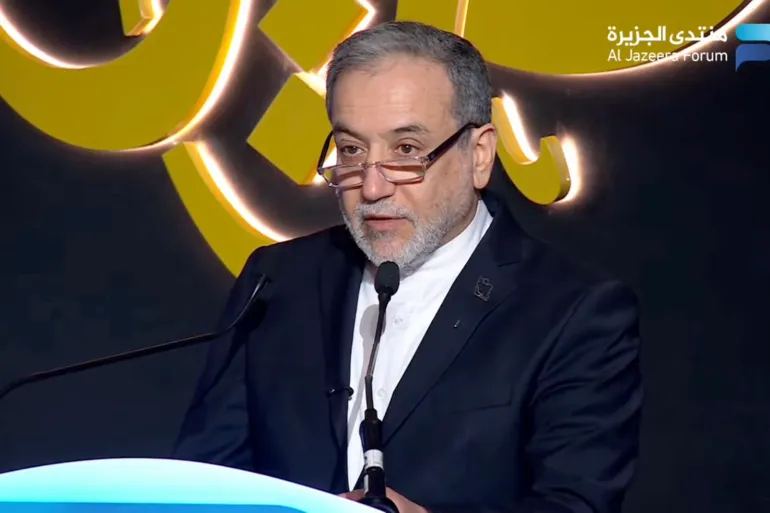
 Abbas Araghchi
New Delhi — Iranian Foreign Minister Abbas Araghchi mounted a forceful defence of Tehran’s regional stance against Israel and the United States, arguing that Iran’s policies are rooted in opposition to what he described as lawlessness and expansionism, not confrontation for its own sake, as tensions rise alongside a renewed US military buildup in the Persian Gulf.
Speaking to diplomats, analysts and media leaders at the Al Jazeera Forum in Doha, Araghchi framed the Gaza war and broader regional tensions as part of a deeper structural crisis in international law. He warned that allowing Israel to act “above the law”, backed by US military and political support, risks normalising force over rules and pushing the region toward wider instability.
“Let no one miscalculate: a region cannot be kept stable by allowing one actor to act above the law,” Araghchi said. “The doctrine of impunity will not produce peace; it will produce wider conflict.”
His remarks come as Washington has expanded naval deployments and air defence assets in the Gulf, citing deterrence and regional security. Tehran has criticised the buildup as provocative, while US officials argue it is necessary to prevent escalation and protect shipping lanes and allied interests.
Resistance, not escalation
Araghchi portrayed Iran’s posture as a reaction to what he called a long-standing imbalance in regional power, in which Israel operates with military and diplomatic immunity while neighbouring states face pressure for resisting its actions.
He said Palestine represents “the defining question of justice in West Asia”, arguing that the destruction in Gaza has become a test of whether international law is applied universally or selectively.
“What we are witnessing in Gaza is not merely war,” he said. “It is not a ‘conflict’ between equal parties; it is the deliberate destruction of civilian life on a massive scale. It is genocide.”
According to Araghchi, continued US backing for Israel, combined with expanded American military presence, signals that force is being prioritised over legal accountability. He warned that such a dynamic encourages escalation by removing incentives for restraint.
“This is not merely a Palestinian problem. It is a global problem,” he said, adding that international relations are increasingly being governed by power rather than law.
Linking Gaza to Gulf tensions
The Iranian foreign minister tied the Gaza conflict directly to the broader security environment in the Gulf. He argued that instability does not originate from Iranian defiance but from what he described as expansionist policies shielded by great-power support.
He accused Israel of seeking permanent military and strategic dominance while weakening neighbouring states and said that forced displacement or destruction in Gaza could pave the way for further annexation in the West Bank, developments he warned would inflame the entire region.
“If the world wants peace, it must stop rewarding aggression,” Araghchi said. “Palestine is not merely a cause for solidarity; it is the indispensable cornerstone of regional security.”
In that context, he said Iran’s resistance is inseparable from a broader effort to prevent the Middle East from being “reshaped by force”.
“This is not about confrontation,” he added. “It is about preventing the region from being reshaped by force.”
Call for coordinated international action
Araghchi urged Muslim-majority countries, Arab states and nations of the Global South to form a unified diplomatic front focused on legal accountability rather than military alignment.
“Expressions of concern are not enough,” he said. “There must be consequences for violations.”
He called for comprehensive sanctions against Israel, including an arms embargo and suspension of military and intelligence cooperation, alongside a political framework grounded in international law that includes ending occupation and establishing an independent Palestinian state with East Al-Quds as its capital.
While he did not directly threaten military retaliation, Araghchi’s speech underscored Tehran’s view that continued US military expansion in the Gulf, combined with unconditional support for Israel, risks entrenching a cycle of confrontation.
A warning about regional order
At the core of Araghchi’s message was a warning that the rules governing the region are at a breaking point. He argued that stability cannot be imposed through military superiority alone and that ignoring Palestinian grievances while escalating force elsewhere will deepen insecurity for all sides.
“The path to stability is clear,” he said. “Justice for Palestine, accountability for crimes, end of occupation… and a regional order based on sovereignty, equality, and cooperation.”
His remarks reflect Iran’s effort to frame its geopolitical rivalry with the US and Israel as a legal and moral struggle rather than a purely strategic contest, a narrative likely to resonate with audiences across parts of the Global South, even as Western governments reject Tehran’s characterisation.
As US forces continue to reinforce their presence in the Gulf, Araghchi’s speech signals that Iran intends to contest not only military pressure but also the political narrative surrounding the region’s future.