

Get insights on thousands of stocks from the global community of over 7 million individual investors at Simply Wall St.
Oracle (NYSE:ORCL) is expanding its AI presence in healthcare as Lumeo Regional Health Information System adopts Oracle tools to streamline clinician workflows and reduce administrative tasks.
The company is pursuing a large capital raise of about $45b to $50b through a mix of debt and equity to fund cloud infrastructure for hyperscale AI customers.
These moves highlight Oracle’s push into real world AI applications in healthcare alongside a sizable financing effort for cloud capacity.
For investors watching Oracle at a share price of $142.82, this combination of healthcare-focused AI deployment and a planned multi billion capital raise points to meaningful activity across both products and financing. The stock has seen a 27.0% decline year to date and a 17.3% decline over the past year, while its 3 year and 5 year returns of 69.9% and 142.4% present a very different picture over longer periods.
Looking ahead, investors may focus on how Oracle converts its AI tools in healthcare into broader customer adoption and recurring usage, and how efficiently it deploys the planned $45b to $50b for cloud infrastructure. The scale of funding aimed at hyperscale AI clients also raises questions about future capacity, pricing power, and the balance sheet impact of combining debt and equity to support this build out.
Stay updated on the most important news stories for Oracle by adding it to your watchlist or portfolio. Alternatively, explore our Community to discover new perspectives on Oracle.
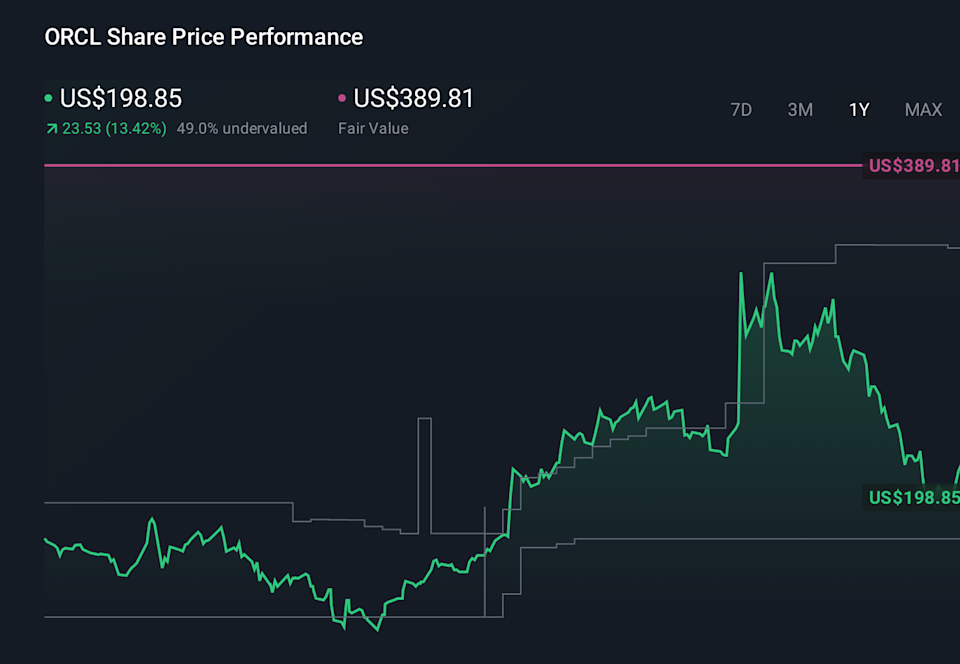 NYSE:ORCL 1-Year Stock Price Chart
Why Oracle could be great value
For you as an investor, the key takeaway is that Oracle is pairing very visible real world AI deployments in healthcare with a large scale funding plan that leans on both equity and long dated bonds. The Ontario and Saudi healthcare wins show Oracle trying to embed AI-powered tools directly into clinicians’ workflows, while the US$45b to US$50b capital raise and recent multi decade bond issues indicate a balance sheet reshaping to support data center buildouts for hyperscale clients like OpenAI, AMD, Meta and others.
This activity lines up closely with the existing narrative of Oracle repositioning as an AI infrastructure and full stack applications provider, not just a traditional database vendor. The push into AI-enabled healthcare agents, combined with long term AI data center financing, ties back to the idea that Oracle is trying to lock in multi year workloads while competitors such as Microsoft, Amazon and Alphabet also invest heavily in cloud and AI offerings.
⚠️ Heavier use of senior unsecured debt and equity issuance increases financial leverage and dilution risk. Investors also face concerns over large non cash earnings and high infrastructure spending.
⚠️ Concentration in a few large AI customers and the need to keep an investment grade rating create execution pressure if AI demand or funding conditions change.
🎁 The company has recently completed sizeable bond offerings and preferred securities. This indicates ongoing access to credit markets and support for its funding plan.
🎁 New healthcare AI deployments and life sciences platforms, alongside cloud infrastructure for big AI workloads, give Oracle more ways to turn contracted demand into usage based revenue over time.
From here, you may want to watch how quickly Oracle ramps actual usage on the new healthcare AI tools, how the mix of debt and equity evolves as more of the US$45b to US$50b is raised, and whether credit rating agencies and banks stay comfortable with its large AI data center exposure. If you want to see how other investors are connecting these moves to the longer term story, take a look at community narratives and detailed breakdowns for Oracle.
This article by Simply Wall St is general in nature. We provide commentary based on historical data and analyst forecasts only using an unbiased methodology and our articles are not intended to be financial advice. It does not constitute a recommendation to buy or sell any stock, and does not take account of your objectives, or your financial situation. We aim to bring you long-term focused analysis driven by fundamental data. Note that our analysis may not factor in the latest price-sensitive company announcements or qualitative material. Simply Wall St has no position in any stocks mentioned.
Companies discussed in this article include ORCL.
Have feedback on this article? Concerned about the content? Get in touch with us directly. Alternatively, email editorial-team@simplywallst.com