
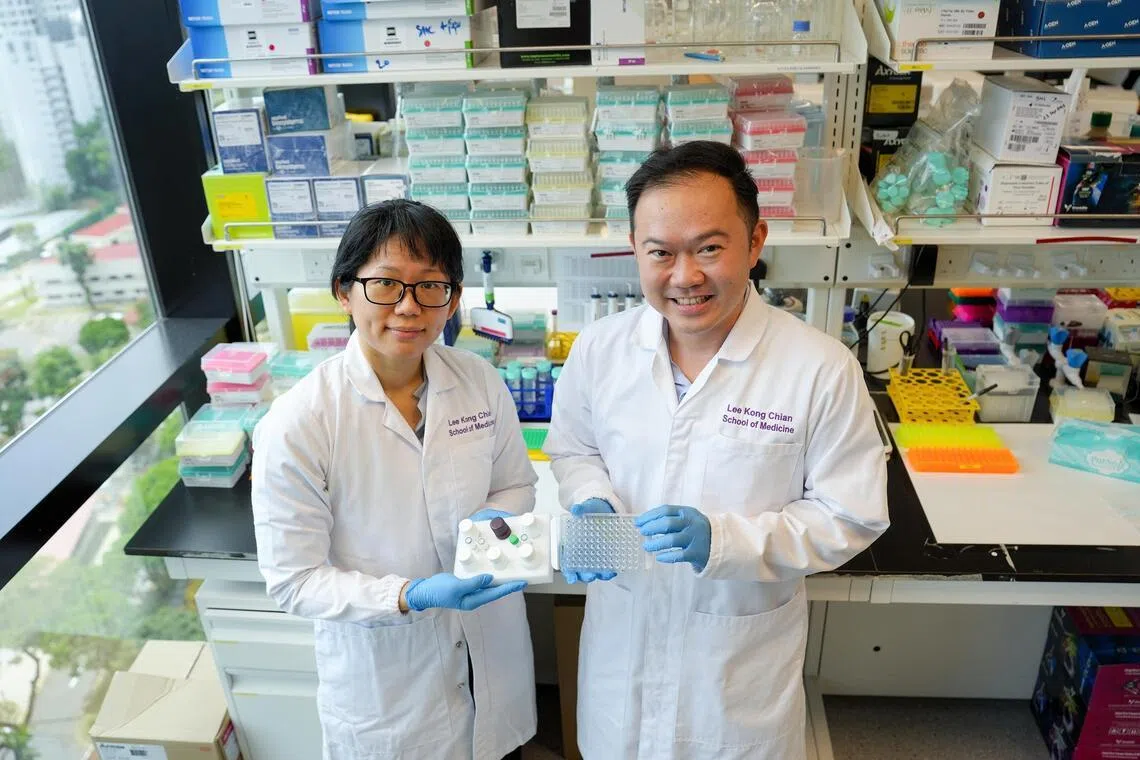
SINGAPORE – In the future, a take-home test kit can not only determine whether you have dengue, but also how severe the infection is likely to be, using nothing more than your urine.
Currently, the most common test for dengue is an antigen test. This requires a blood sample – typically collected via a finger prick or by drawing blood from a vein – to detect the non-structural protein 1 (NS1) of the dengue virus. It also requires that the results be sent to a laboratory for testing.
“In more remote areas or during large outbreaks, this can be very time limiting,” said Dr Chia Po Ying, head of the research office at the National Centre for Infectious Diseases.
Recent research by four researchers from various institutions, however, has found that NS1 is present in the urine of dengue patients, said Dr Andrew Teo, senior research fellow at Nanyang Technological University’s Lee Kong Chian School of Medicine (LKCMedicine).
Dr Teo, who led the research, added that two other proteins – neutrophil gelatinase-associated lipocalin (NGAL) and soluble urokinase plasminogen activator receptor (suPAR) – were also found in different concentrations in urine, depending on the severity of the dengue.
These biomarkers in the urine can be used not only to determine whether the patient has dengue, but also predict how severe the infection is likely to be, he told The Straits Times.
Knowing this, a doctor can then decide whether to send the patient to a hospital, or to allow the patient to stay at home to recover. This can help ease the burden on healthcare systems, Dr Teo added.
The study, which involved 125 dengue patients here, was published in the peer-reviewed scientific journal Open Forum Infectious Diseases on Jan 9.
Dr Chia, who is also an assistant professor at LKCMedicine, noted that the antigen tests that are currently used are unable to offer such prognoses, adding that patients currently have to be regularly tested for potential complications.
“It can be quite stressful for (dengue patients) because you’re having fever, you’re having aches and pains, and people are telling you to come down every day to the clinic (to be tested),” she said.
The next step for the research team is to work with researchers in other countries – such as those from the Institute of Allergology and Immunology at Sri Lanka’s University of Sri Jayewardenepura – in validating its findings.
In the longer term, the researchers hope to collaborate with partners on developing a test kit that people can use at home to find out if they have dengue, said Dr Teo – similar to those currently on the market that test for Covid-19 and influenza.
Such non-invasive test kits will be able to determine whether someone has dengue – as well as the severity of the disease – within four days of infection, before potential complications surface, added Dr Chia. Current antigen tests can confirm if a patient has dengue only four days after infection.
These test kits could be available to consumers in about five years, she said.
“People can actually take command of their health, especially in rural areas or places where access to healthcare is difficult,” Dr Chia noted, adding that such tests could also be conducted by community health workers in such regions.
Such tools can act as part of a two-pronged approach to tackle dengue, together with vector control measures used to prevent Aedes mosquitoes from breeding, she said.
This is especially necessary as climate change accelerates the spread of dengue in regions where the disease was previously unknown, she added.
According to figures from the National Environment Agency, there were 149 cases of dengue recorded in Singapore in January.
This follows a decrease in the numbers in 2025, which saw 4,036 reported cases – a 70 per cent drop from the 13,651 recorded in 2024.
The figures came amid a global decline in dengue infections, which fell from 14 million reported cases in 2024, to five million cases in 2025, according to data from the European Centre for Disease Prevention and Control.
Experts, however, have warned that
Singapore’s downward trend may not continue as other dengue strains, which people are more susceptible to, become more prevalent
.