
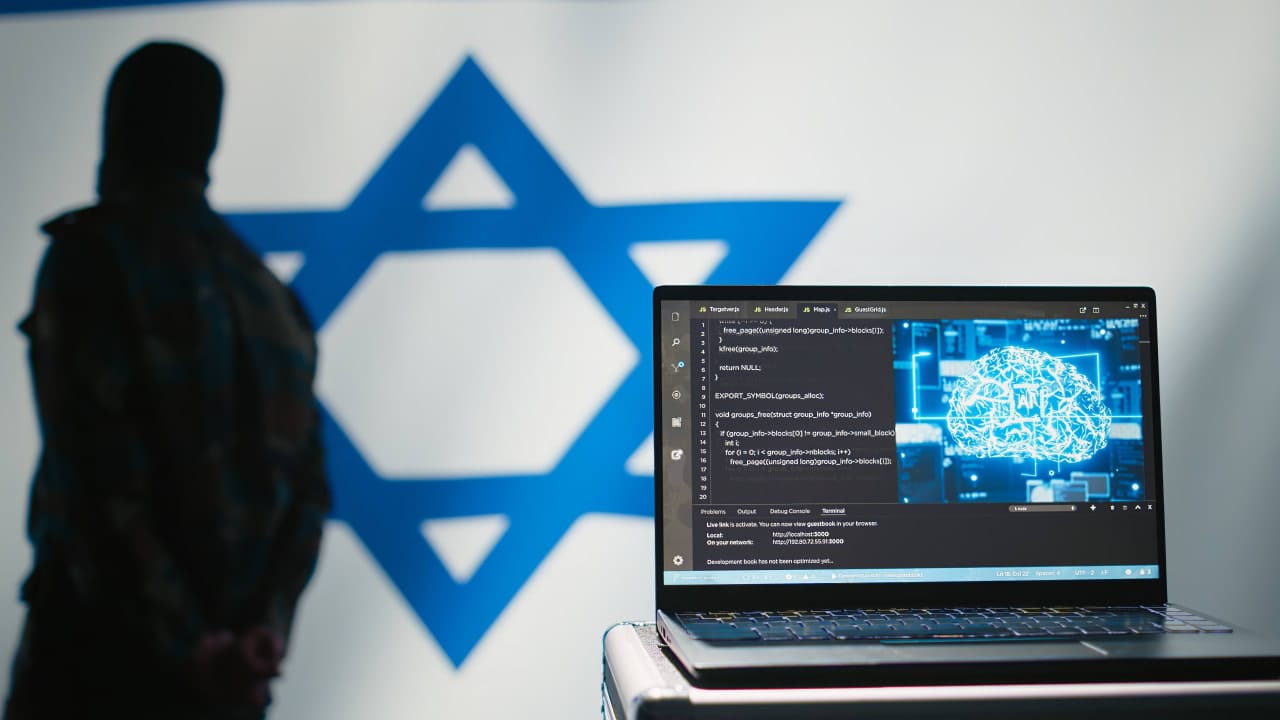
“There are also errors, and the wisdom lies in training and preparing both the operator and the machine to deal with them,” said Col. (res.) Yaron Sherig, head of the Defense Ministry’s AI and Autonomy Directorate at MAFAT, in an interview with Maariv last week.
The challenge facing the AI and Autonomy Directorate goes beyond developing machines and robots. It is focused on the ability to deliver these capabilities at an industrial pace to the operational edge. As preparations for a multi-front war are already underway, development time has become a critical resource.
To preserve the technological gap with the enemy, the directorate has enlisted dozens of startup companies, implementing the strategy of the Defense Ministry’s Director General, and former deputy IDF chief of staff, Maj. Gen. (res.) Amir Baram, summarized as “An accelerating work pace, aimed at ensuring that every sophisticated algorithm is quickly transformed into a tool in the hands of the fighter in the field.”
In a tower building in Gush Dan, the new directorate and digital brain of the defense establishment are expanding, with an office that feels like an advanced bunker suspended between sky and ground.
Security measures in the ministry may be seen in the form of chains of entry authorizations, phones left outside, and fingerprint scanners guarding armored doors, even within the workspaces.

In the workspaces of the Defense Ministry’s AI and Autonomy Directorate, developers of different ages sit side by side in the rooms, some serving as professional knowledge hubs. Alongside them are usually fighters and officers, some arriving directly from the field or from headquarters to advance development processes, learn, or provide real-time feedback on products.
At the head of the directorate, established in December 2024, is Sherig, 44, married and a father of three, an electrical and physics engineer.
Sherig began his service in Military Intelligence and spent most of his military career at MAFAT in the Defense Ministry.
Under him are around 100 employees, the vast majority engineers and researchers, including PhD holders. Some have operational backgrounds to help advance field implementation.
The directorate brings together a wide range of expertise: AI, data engineering, robotics, electrical engineering, mechanical engineering, software, communications, physics, operations, and integration. To accelerate processes, the directorate maintains ongoing ties with dozens of Israeli startups, mainly in robotics, some directly through tenders and others via open calls.
Sherig pointed to one of the PhDs responsible for developing operational applications, some of which have already saved lives and helped identify terrorists in destroyed terrain against all odds. “What are you doing here, when outside you could earn a much higher salary?” he was asked.
He answered clearly, “That’s a question I answered a long time ago. I save lives. Is there anything more important than that? I’m protecting my brother-in-law, who is fighting in the Gaza Strip. My friends analyze stock market trends, what’s better? I have a huge interest in what I do here every day. Look who’s standing outside to see what we developed.”
According to the developers, some of the IDF’s maneuvering platforms already have AI components embedded in them, upgrading force protection and attack capabilities in real time.
One of the lead application developers was asked what the greatest compliment he had received from fighters in the Gaza Strip was. As an answer, he noted, “Xs. A lot of Xs.”
He meant that the systems, innovative applications, and robots he and his colleagues at MAFAT are developing are making IDF fighters and their weapons more precise, faster, and deadlier than ever before. When they say “Xs,” they are referring to dead terrorists on the battlefield, in large numbers and at a high pace.
Two years’ worth of combat data fuels modern warfare development
The developers’ playground at the directorate long ago extended beyond lines of code. Computer screens or gadgets currently in the hands of maneuvering units, augmented reality glasses, smart controllers, and combat tablets, are only the visible tip. The real resource, the fuel of the development race and modern warfare, is the data accumulated over more than two years of fighting.
The available data covers from open and built terrain configurations to enemy behavior patterns, from which AI distills lessons and insights at record speed. These are not just lines of software; they are answers to the most complex battlefield questions, turning abstract ideas into operational advantage.
During the interview, Sherig recalled an inspiring conversation he had with his developers, not all of whom had previously experienced the sights of combat or the urgency of creating solutions from nothing. “Imagine this stands in the Gaza Strip, insane traffic, noise, and filth. Inside this chaos, you need to identify the abnormal figure, the terrorist, or the emerging threat. This task becomes far more complex when it involves a maneuvering force in Gaza’s streets,” he said.

In Sherig’s view, APCs and tanks generate enormous acoustic signatures and ground-shaking noise, making it difficult for sensors and drone operators to detect low-resolution details. This is where the machine comes in. It learns what a normal environment looks like, tags areas of interest, and filters out irrelevant “noise” for the operator, allowing them to see the enemy even when fully blended into the environment during a maneuver.
The machine’s role is to locate threats or indicators of threats where the human eye would struggle. “We received indications of a terrorist in the area, high-quality, focused intelligence, but in an environment where a regular person would have no chance of detecting movement,” Sherig explained. While the fighter scans the horizon, AI has already marked the targets. The system does not just scan; it sharpens what is truly relevant for the end user, identifies suspects, and distinguishes them from routine events.
The machine is not just an observation tool; it is a partner that focuses the fighter’s attention precisely on the point where the threat is hiding, even before the force enters an ambush.
As an example, Sherig talked about a force securing a heavy engineering team in the Strip, a routine event that seems simple on the surface but contains many complexities due to the changing environment and destruction. “We need to give them tools that help warn of threats in the area,” Sherig summarized. “That is also happening. In the realm of holding territory and maneuvering forces, our tools will become more sophisticated.”
The directorate’s primary focus is on ground forces, but it also maintains close cooperation with the Air Force and Navy.
According to Sherig, through AI, they are embedding a “brain” into various types of drones, focusing them only on what is relevant to the mission within their flight sector. Thus, the drone shifts from a passive camera to an intelligent scanner capable of identifying suspicious movement, specific sounds, or spectral anomalies.
“Instead of the operator drowning in a sea of video, the algorithm surfaces only the critical information, the kind that distinguishes background noise from the target that needs to be eliminated,” he explained.
The directorate is working to give systems new “eyes and ears” by upgrading optical, acoustic, and electromagnetic sensing, radar included. The goal is to compensate for “intelligence blindness” and basic surprise, as the IDF experienced on October 7 when Hamas attacked technological assets previously considered resilient.
Above all, the policy led by Defense Ministry Director General Baram is to do everything possible to enhance ground maneuvering, from detecting explosive devices or those laying them and opening routes, to upgrading lethality and logistical support, especially critical at distances far from the border.
But the directorate’s goals demand a big change in how the Defense Ministry manages projects. In light of past lessons from high-budget projects that failed the reality test, the directorate has placed oversight and accessibility at the top of its priorities, moving from “boutique products” to industrial-scale developments for all maneuvering units.
To this end, a senior forum was implemented to review strict adherence to timelines, budgets, and above all, operational requirements every quarter.
All this is meant to ensure that the investment is translated into accessible solutions for fighters. Baram’s goal is to build a “robust security decade,” significantly shortening the time between field demand and actual delivery.
“The IDF is connected to everything, even at the strategic level with the Planning Directorate,” Sherig said. “What are all these officers who came to visit doing here? Usually, it’s a discussion about adapting weapons systems. We also make sure to work in a ‘Netflix method,’ the systems learn the specific user or sector and surface exactly what they are looking for and need, just like the app that learns the user.”
‘Unified operational dialect’ ultimate IDF tech goal
Throughout the interview, Sherig tried to compress any thoughts about products and developments that have not yet matured. But at one point, he emphasized that the goal they intend to crack in order to become a true force multiplier is creating a “unified operational dialect.” This is a shared communication protocol meant to eliminate the digital “Tower of Babel” between the Air Force, Navy, and ground forces. This common language will allow systems from different manufacturers to “talk” to one another, enabling operations from air to ground and vice versa.
The goal is to turn the battlefield into a simple chat in natural language, where information flows without interruption and enables closing fire loops within seconds, with high resilience against enemy disruption.
Another revolution, which Sherig declined to elaborate on, involves the shift from an army of heavy platforms to an army of algorithms. By integrating smart models, a kind of “ChatGPT of the world of war,” it will be possible to operate multiple weapons systems simultaneously as they communicate with one another.
Within the directorate, the understanding has sunk in that the winner in battle will be the one who holds the smartest model inside the missile’s head, and no less importantly, inside the commander’s observation tools. He is the one who must identify, in the heart of a destroyed neighborhood, above and below ground, the threat lurking for him.
One hardened company commander with hundreds of combat days across all arenas in his operations log asked for simplicity. “I want real-time data fusion and synchronization between all forces, without saying a word on the radio,” he said, and concluded, “Give me normal human engineering for company and platoon commanders in the field, and an operational WhatsApp on my personal phone.”
This is the challenge of the AI and Autonomy Directorate: to take the most complex models in the world and turn them into simple, accessible working tools, ones that clear background noise for the commander and deliver the bottom line at the exact moment he needs to make a life or death decision.