
A powerful new supporting player has joined the ongoing battle of wits between medical research and the sophisticated causes of diseases: artificial intelligence. Its use is becoming increasingly widespread – in research, in clinical practice and in healthcare systems. At this stage, it’s already clear that what began in recent years as a “foothold” is on its way to becoming the backbone of the medicine of the future.
AI has repeatedly demonstrated abilities to decipher and solve complex biological systems, providing new and significant insights. At least some of these can be translated into saving lives, and into the development of new, individually tailored treatment approaches – in a manner that’s still hard to imagine.
An Israeli study published in December in the journal Nature Communications demonstrates these abilities in relation to a familiar and widespread family of viruses: herpesviruses (Herpesviridae). These viruses are commonly known as the cause of fever blisters (cold sores) on the lips (oral herpes), or diseases such as chickenpox and shingles, but they also include several herpesviruses, including ones that cause cancer.
The model operates in a manner similar to how search engines understand human language, but instead of words, it has learned to identify genetic control zones.
 Close
Close
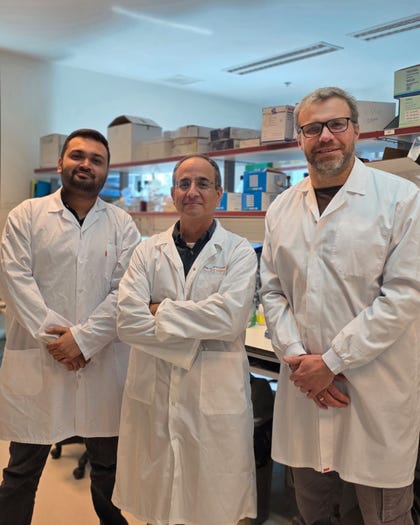
From right to left: Slava Gurevich, Prof. Meir Shamay, Nilabja Roy Chowdhury. The study’s findings have broader significance beyond the world of viruses Credit: Bar-Ilan University
From right to left: Slava Gurevich, Prof. Meir Shamay, Nilabja Roy Chowdhury. The study’s findings have broader significance beyond the world of viruses Credit: Bar-Ilan UniversityIdentifying genetic control zones
The vast majority of the population – 90 to 95 percent of adults – will be infected by at least one herpesvirus during their lifetime. Herpesviruses are considered the perfect “secret agents” of the biological sphere. They penetrate epithelial cells or immune system cells, replicate themselves, and cause an initial infection.
They then enter a “dormant” state, hiding in nerve cells or in the immune-system lymphocytes, where they wait for the right moment. The transition to an active state usually occurs during periods of stress, illness, reduced immunity or aging – all situations that involve a weakening of the immune system – when they cause various symptomatic illnesses.
Related Articles
The precise mechanism that causes herpesviruses to switch from a latent to an active state has remained a mystery, but the new study may change the picture. The research team, headed by Professor Meir Shamay, an associate professor of medicine at the Azrieli Faculty of Medicine at Bar-Ilan University in the Galilee, has developed a groundbreaking AI tool called ENHAvir.
The model operates in a manner similar to how search engines understand human language, but instead of words, it has learned to identify genetic control zones – regions of DNA that include specific sequences that “activate” genes in herpesviruses.
These short DNA sequences, known scientifically as “enhancers,” play a key role in the transition of herpesviruses from a latent to an active state. Accordingly, the researchers believe that locating and identifying these control genes could make it possible to intervene by “extinguishing” or “activating” them, thereby reducing their activity and preventing illness.
‘Based on the information that it learned and analyzed, it predicted additional enhancers that we weren’t familiar with.’
Prof. Meir Shamay, developer of the ENHAvir artificial intelligence tool
Professor Shamay studies herpesviruses in his laboratory, with an emphasis on two types of viruses that cause cancer in humans. One is Kaposi’s sarcoma-associated herpesvirus (KSHV), which causes a soft-tissue cancer originating from cells that line blood or lymphatic vessels, and primary effusion lymphoma (PEL). Another virus is Epstein-Barr (EBV). “This is a virus that, although present in more than 95 percent of the adult population, is sometimes involved in the development of cancers such as lymphoma and gastrointestinal cancer,” explains Shamay. “In the laboratory, we study how these viruses cause cancer, and to understand the molecular mechanisms underlying this process, so that in the future we’ll be able to develop medications and tools for early detection of those types of cancer.”
Beyond herpes
The detection and identification of these enhancers had already been achieved in earlier studies in Shamay’s lab, where they were identified as a key cause of changes in the viruses’ behavior. But locating them is an extremely challenging task. “Locating the relevant enhancers is a challenging task because they can be located at different positions relative to the gene they regulate, and this task is particularly challenging in the small genomes of viruses. In a previous study, we were able to identify six enhancers in the Kaposi’s sarcoma virus. So we thought maybe we can use the sequences from one virus to identify enhancers on other viruses,” explains Shamay.
The difficulty of finding these control switches of the herpesviruses in past studies using the “old” methods emphasized the dramatic contribution of AI in the current study. No less important, the study illustrates the rapid pace at which AI is developing as a research tool and in general.
“Instead of doing difficult, complex and prolonged work, we thought we should use an AI tool to solve this riddle,” says Shamay. “Usually, AI tools are introduced to millions of genetic sequences so they can train. We, on the other hand, introduced it to only six sequences,” explains Shamay.
“In the first stage, the AI discovered the known enhancers we already knew, which confirmed that the model was working. But then, based on the information that it learned and analyzed, it predicted additional enhancers that we weren’t familiar with. We went on to test the information it provided in lab experiments, and discovered that its prediction was correct,” says Shamay.
Based on an analysis of only six sequences, the AI model identified novel enhancers in various types of herpesviruses, including the Epstein-Barr virus and Cytomegalovirus (CMV), which causes damage to fetuses, as well as HSV-1 (oral herpes) and HSV-2 (genital herpes). These AI-driven discoveries will serve as targets for follow-up studies that will focus on treatment with drugs and preventive treatments of diseases caused by the herpesvirus – quite a long list of diseases.
“This study demonstrates the power of AI, whose use enabled us to reveal control regions by learning from only six sequences. Its findings make a considerable contribution to understanding the mechanisms of the herpesvirus, but they also have broader significance beyond the world of viruses.
“The control mechanisms of enhancers also exist in the human genome. By studying viral enhancers, we can also learn about human enhancers. This relates to evolution: viruses have existed for millions of years, and, genetically, they extract only the most essential sequences from human cells to survive. Researching viral genes by means of AI opens the door for understanding biological systems in the human body,” says Shamay.