
We were away for a couple of weeks, in a part of the world where there are simply no Jews. So we went a while without talking about Israel with anyone (and as I realized when we landed back at TLV and shared baggage claim with some Haredim, we’d also gone a few weeks without being enraged).
But we had also gone a few weeks without getting to see some of our friends from abroad who’re here, so we’ve been trying to make up for lost time (even as we try to help out our kids with a newborn grandson, born just three hours after we got back … talk about timing).
Perhaps it was the combination of not talking about any of “this” for a few weeks and then the quick series of conversations with Diaspora friends that sharpened so clearly my sense of how utterly different is the “Israel conversation” here and abroad. This is not meant in any way as a judgement of either side, but simply an observation—we’re not even talking about the same things.
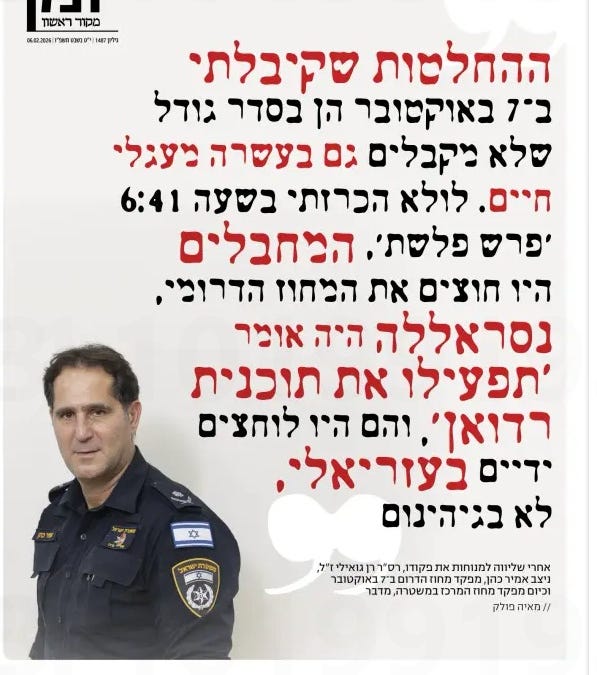
One of this weekend’s covers of the seemingly endless pile of “magazine sections” that floods your apartment on Fridays in Israel (especially if you get more than one newspaper) struck me as speaking volumes about the psyche of Israelis today.
Here’s the cover of Yoman, one of the sections of Makor Rishon.
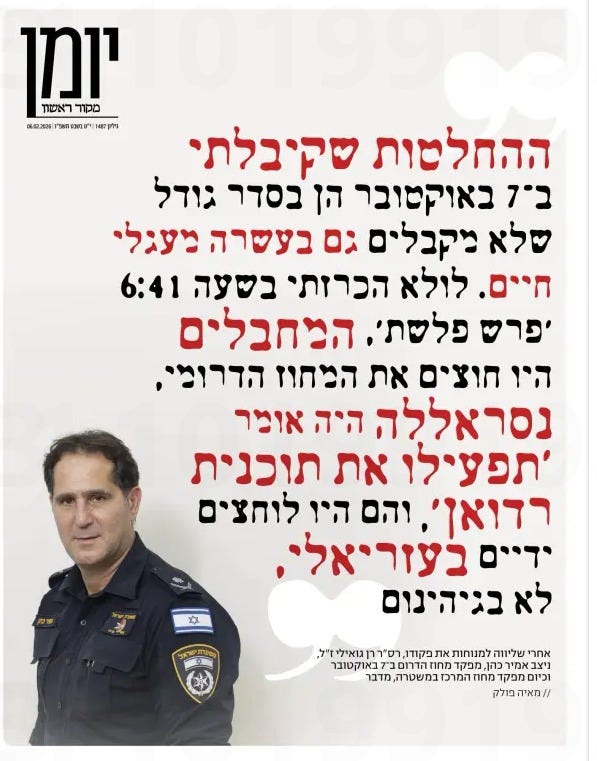
What does all that red and black say?
The decisions I made on October 7th are of a magnitude that one doesn’t make even in ten lifetimes. If it weren’t for my declaring at 6:41 AM, “Philistine Horseman”, the terrorists would have crossed the Southern District; Nasrallah would have said “activate the Radwan Plan,” and they would be shaking hands at Azrielli, not in hell.
Who is this guy?
He is Amir Cohen, who was the Commander of the Southern District on October 7th and is currently the Commander of the Central District of the Police. In his former role, Cohen was also the Commanding Officer of Master Sergeant Ran Gvili, z’l, the last hostage to be returned to Israel.
Now, what does all this mean? There’s code here that most Israelis understand, but that might be confusing to others.
“Philistine Horseman” (Pareshet Paleshet): This is the specific Israeli police code word used to signal a full-scale terrorist invasion. By declaring it early, Cohen initiated a massive mobilization of forces.
Radwan Plan: Refers to Hezbollah’s elite Radwan Unit’s plan to invade northern Israel. Cohen is suggesting that a failure to contain the south could have triggered a multi-front invasion from the north.
Azrielli is a reference to the multi-tower shopping and office complex known as the Azrielli Towers, now an icon of the Tel Aviv skyline. What Cohen is saying is that the country came very close to Hamas forces from the south and Hezbollah forces from the north meeting in Tel Aviv on October 7th, or perhaps a day or two later.
Now, Amir Cohen isn’t exactly encumbered by a sense of inadequacy. And he would certainly acknowledge that he’s hardly the only person who made critical calls on that horrific morning that prevented things from being much worse than the horror they were.
But what interested me about the cover wasn’t Cohen; the issue is that almost 2 1/2 years after October 7, Israelis are still being bombarded with stories about how close Israel came to being not just attacked and slaughtered, but perhaps being rendered unrecognizable by devastation that could have far exceeded what actually transpired.
And buried in all that, is this implicit question (that we’ll see below once again)—if the army didn’t know what it was doing then, why are we so certain that it knows any better now?
As far as I can tell, that discussion doesn’t doesn’t make it into too much of the English press. And ironically, what does seem to get discussed outside of Israel are, conversely, subjects that hardly ever come up here.
One of those latter subjects is the “genocide” subject. Catching up with those friends who’re in town whom we want to see before they leave, what’s struck me is this: even our American Jewish friends who are 1000% supportive of Israel invariably raise the issue of genocide. Not because they believe the accusation, but cause in their world, that’s the subject one has to address (many are Jewish professionals).
Here? You’d really have to scour the Israeli Hebrew press to find mention of even the word “genocide” anymore. Why is that?
A hint can be gleaned from Liel Leibovitz’ savagely critical piece about the Super Bowl ad that Robert Kraft and his team prepared to counter anti-Semitism. In his unique and admirable style, Leibovitz (who was raised in Israel, has written extensively about growing up as the son of Israel’s most famous bank robber and is an excellent barometer of Israeli sentiment) opens by pulling no punches:
No matter what happens in the Super Bowl this Sunday, we already have a loser: Robert Kraft. Even if his New England Patriots win, the team’s owner will go down in history as having created the single most embarrassing, idiotic, abominable, counterproductive, no good, very bad ad in the big game’s history. Have you seen it? If not, let us save you 60 seconds and hours of vague nausea and catch you up to speed …
You should take the time to read Leibovitz’ full assessment of why he believes the ad is so problematic. But for our purposes, what matters is what Leibovitz—who though he now lives in New York, was shaped as an Israeli—thinks the ad should have said:
Int. A kitchen in Beirut. Day.
Middle Eastern music is playing in the background, interrupted by the trill of a beeper bouncing around the kitchen table. A man approaches the table. We only see his midriff. He’s dressed in black and carrying an AK-47. He picks up the beeper, looks at it, and places it on his belt, next to his groin. We hear a loud explosion. The screen goes bright white. Loud music comes on. It’s “Tamid Ohev Oti.” Cut to:
Int. Fighter jet cockpit.
We see an Israeli Air Force captain flying his plane.
IAF captain:
“Tally Target 12 o’clock. Welcome to Tehran, boys.”
Int. Living room somewhere. Night.
A television screen is running a series of news reports about the killings of Hassan Nasrallah, Ismail Haniyeh, Mohammed Deif, Yahya Sinwar, and other murderous terrorists.
Ext. IDF base. Day.
A group of hot IDF soldiers is standing around, cleaning weapons, getting ready for action. Cut to:
Black screen. Caption: “Don’t Like Jews? Fuck Around, Find Out.”
I don’t know how serious Leibovitz really is when he says that’s the sort of thing that the ad should have said. His version probably wouldn’t go over great with the Super Bowl-watching crowd.
But Israelis, of course, don’t watch the Super Bowl. They don’t even know what it is.
What they do know is this—they simply don’t get the whining about the genocide accusation, even among those in the Diaspora who reject it and who care deeply about Israel. First, Israelis believe that it’s false. Second, they believe the claim is fueled by anti-Semitism, so who cares what anyone thinks? And if you asked them, “are you denying that thousands and thousands and thousands of Palestinians died in the war and that many more are still suffering?” they would said, “No, not denying that.”
“So why aren’t you Israelis even a bit ashamed?”
Because, Israelis would say if they were to paraphrase Leibovitz, “They shouldn’t have f*cked with us. That was the reason for creating this state.”
We, many would say, are not going to walk around the proverbial high school hallway like the Jewish dweeb in the ad. Not being like him—and not even knowing anyone who lives like him—is the whole point of living here.
That, admittedly, is a bit of an overstatement. There are Israelis who’re very concerned about what happened and is happening in Gaza, though almost none use the word genocide. But those Israelis are few and far between.
Mostly, Israelis are still grappling with how much worse things could have been. And with the fact that much has still not yet played out.
The other conversation unfolding about Israel—among a very different crowd, whom we’re also getting to hear from other friends who’re visiting—is the “we showed them” conversation. In that world, Israel won, and won big. Hamas is badly battered. Hezbollah had its hands blown off. Asad fled to Moscow. Iran got badly beaten, and if need be, “we [i.e., of course, they, the Israelis] will do it again.”
That’s great fodder for the story that some people want to tell, but aside from a relatively limited swathe in Israel (just like the limited swathe above), that’s also not the story that’s being told here.
So, then, what’s the story here?
More or less, I think, it is this: October 7th came very close to being much, much worse than the horror that it was [hence the cover above]. This might be far from over. And we might be utterly alone.
Let’s take a look at the press here over the past few days.
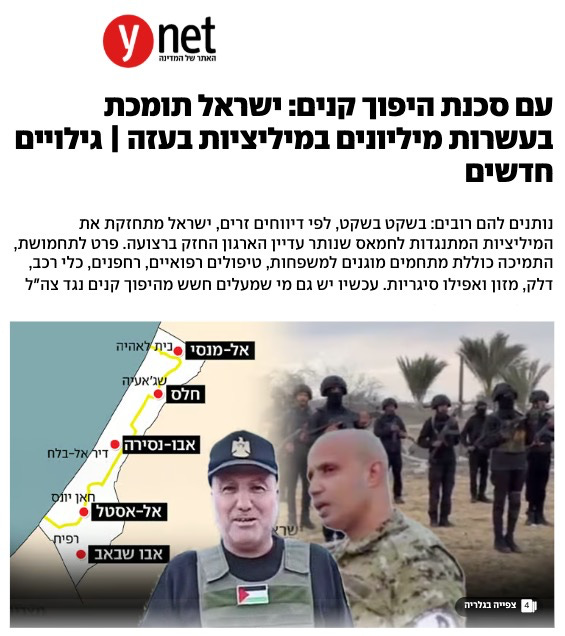
With the danger of barrels being turned: Israel is supporting Gazan militias to the tune of tens of millions | New Revelations
Giving them many rifles: Quietly, according to foreign reports, Israel is maintaining the militias that oppose Hamas, which still remains the strongest organization in the Strip. Aside from ammunition, the support includes protected compounds for families, medical treatments, drones, vehicles, fuel, food, and even cigarettes. Now, there are those who are raising concerns about the barrels being turned against the IDF.
It’s that last sentence that’s the most important. Of course, we’re being smart about funding Hamas’ enemies, right? Why? Because don’t they love us?
Remember how smart we were to let the Qatari’s fund Hamas?
The question behind the headlines: after 2 1/2 years, does anyone here really know what they’re doing?
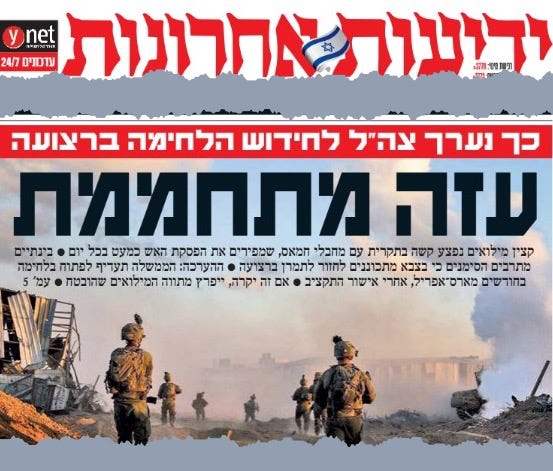
This is how the IDF is preparing for renewed fighting in the Strip.”

Top Banner (White on Red): “The American round [of talks] against Iran has ended; Netanyahu is leaving for Washington.”
Main Title (Large Bottom Text): THE URGENT VISIT (literally “The Panic Visit”)
Sub-headline (Center Right): * The impasse: According to reports, the Iranians rejected American demands.
The fear: Jerusalem is worried about the possibility that Trump will retreat from “red lines,” including restrictions on ballistic missiles threatening Israel.
The pressure: The Prime Minister will fly tomorrow for an urgent meeting with the President—at his [Trump’s] request.
These are teasers for various opinion pieces and reports:
Ben-Dror Yemini — Khamenei has gotten stronger
Raz Shechnik — Compromises on the table
Smadar Peri — Hezbollah’s making noise
Yohanan Plesner — Tensions in the Gulf
Yoel Guzansky — A clear threat
What does all this convey? It conveys a nervous country, a country that’s not sure that America has its back when it comes to Iran (and certainly with not with regard to Iranian ballistic missiles), a country that, the more it looks, the more it understands (however perverse it sounds) that we actually got lucky on October 7. It’s a country that made huge mistakes but will not investigate them. A country so desperate to defeat its enemies that its armies other enemies—as if that ever worked out well.
And it’s a country wondering whether the “leader” of the “free” world is still sane.
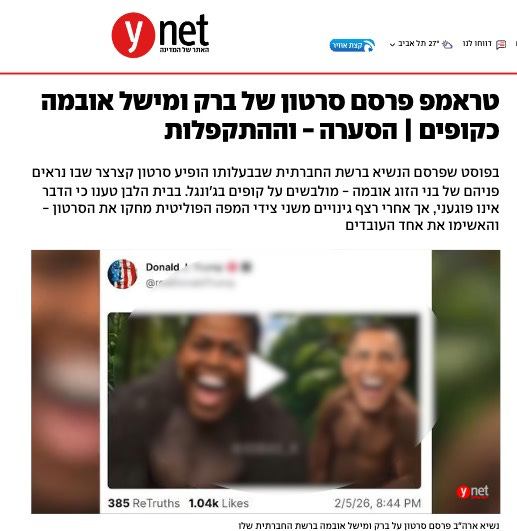
The story about Trump’s posted video of the Obamas (which I’ve blurred and which I won’t even describe because it’s so sickening) is also all over the press here. Why? Isn’t that outrage really an internal American issue?
Yes, but no.
Because here’s the rub. We are vulnerable—to a terrible deal in Gaza, to an Iran that is quickly rebuilding, to a Hezbollah that is flexing its muscles again, to a Congress that is tired of the MOU (which Israel is also tired of, admittedly). There’s only one guy on the planet who can help us address all this, or who—if it’s better for him—can also prevent us from protecting ourselves.
Here’s what some Israelis I spoke to this weekend asked out loud, once they’d heard the news from the States about the video: What if the guy on whom our most basic security depends has truly lost his mind?
How in the world is Bibi supposed to negotiate with that on Wednesday?
Who could have foreseen this coming? Trump posts a video, and for the first time in a very, very long time, a lot of Israelis suddenly have great sympathy for the predicament in which Netanyahu will soon find himself.
Because there may be nothing at all that Bibi can to do have this week’s meeting go well. And if he can’t, it won’t matter whether it was Bibi or any other prime minister, a PM we like or a PM we don’t.
Because, once again (think the weak Jewish kid in the Super Bowl video), the Jews are, well, the Jews.
And once again, the State of the Jews has become the Jew of the states.
