
It was days before the April 2019 election, and Prime Minister Benjamin Netanyahu was giving an interview to Channel 13 television. Why, asked right-wing journalist Sharon Gal, was he not launching a large-scale military offensive against Hamas in Gaza?
At the time, the Palestinian terror group was leading mass marches and rioting at the Gaza border under the banner of the “March of Return” — a return to Israeli land it said belonged to the Palestinian people.
The premier replied that Israel had to deal occasional blows to the terror group, but also had to keep the humanitarian situation in the Strip stable.
He boasted that over a year of mostly low-level unrest at the border, encouraged by Hamas, 300 Palestinians and no Israelis had been killed. “They wanted to storm the border, kidnap our soldiers, infiltrate our towns… they suffered blows,” he said.
“But your [voter] base expected more,” countered his interviewer Gal.
Get The Times of Israel’s Daily Edition
by email and never miss our top stories
By signing up, you agree to the terms
Netanyahu didn’t challenge that statement, answering that he was against starting “unnecessary wars” and adding that he was willing to pay a political price for his seemingly unpopular decision not to launch one.
“I want every mother and father in Israel to know that I am not sending their boys to an unnecessary war,” Netanyahu declared.
Noting he’d lost friends and comrades in past wars, the premier added, “I am willing to employ all the force necessary, but war is the last option.”
Prime Minister Benjamin Netanyahu is interviewed on Channel 13 on April 5, 2019. (YouTube/Channel 13)
Indeed, for all his hawkish rhetoric and self-cultivated image as “Mr. Security,” over the years, Netanyahu was repeatedly described by top officials who worked with him as decidedly cautious, even squeamish, when it came to taking significant military action.
Now, more than two years after Hamas’s mass invasion and onslaught of October 7, 2023, Netanyahu is seeking to portray himself as having sought far-reaching action against Hamas, while being thwarted by the objections of security chiefs and the lack of public backing for such a move.
On Thursday night, the longtime leader released a 55-page document of answers he gave to State Comptroller Matanyahu Englman as part of the ombudsman’s investigation into the Hamas attack. Among the selective citations from classified discussions over the years were quotes that appear aimed at pinning the failure to prevent the onslaught on current political rivals and security chiefs, while painting himself as more militant on Hamas than they were.
Despite leading the country and setting policy for all but one of the 14.5 years preceding the Hamas attack, Netanyahu has repeatedly minimized his responsibility for October 7. He and his allies have argued that the blame lies with defense officials and intelligence chiefs rather than him, while also pointing the finger at major moves made while he wasn’t prime minister, such as the Oslo Accords in the 1990s and the Gaza Disengagement in 2005.
The newly released document, though clearly carefully curated to serve the premier’s needs, indeed demonstrates that at key junctions over the years, the country’s top military officials and many politicians were unwilling to launch a full-on war in Gaza, believing that Hamas could be deterred and contained by carrots and sticks — all while the terror group was secretly planning its mass invasion.
It underlines that the false conception of Hamas as a force under control, one that could be kept at bay with a sustained calm and occasional, limited confrontations, was shared by almost all of Israel’s senior officials. It showcases the military’s disastrously false interpretation of preparations seen in Gaza for the imminent invasion as meaningless drills. It highlights that generals had discouraged the option of a full conquest of Gaza or the elimination of Hamas leaders on multiple occasions, including during Operation Protective Edge in 2014.
This includes current political rivals such as former IDF chiefs of staff Benny Gantz and Gadi Eisenkot — though they, as well as others, have argued that the document is misleading and creates a false narrative.

From right, Prime Minister Naftali Bennett, Foreign Minister Yair Lapid, Defense Minister Benny Gantz and Finance Minister Avigdor Liberman attend the first cabinet meeting, at the Knesset on June 13, 2021. (Yonatan Sindel/Flash90)
Netanyahu is also attempting to portray his hawkish rivals Naftali Bennett and Avigdor Liberman as having shared the same aversion to toppling Hamas and taking over Gaza, including in a July 2014 cabinet meeting during which, the protocols show, they said they weren’t calling for such options.
However, this appears to contradict countless public statements, including in a memoir released a year before the October 7 attack, in which Netanyahu said Bennett and Liberman had pushed for toppling Hamas, and stressed that Bennett in particular had urged “a full-scale ground invasion to ‘conquer Gaza.’”
“That could only be done with the wholesale destruction of Gaza, with tens of thousands of civilian deaths,” Netanyahu wrote in 2022’s “Bibi: My Story.”
“After destroying the Hamas regime, Israel would have to govern two million Gazans for an indefinite period. I had no intention of doing that,” he said. “I decided against a full-scale ground invasion.”
Netanyahu’s own recollections signal that even if, as he argues now, he had supported taking out Hamas, he did not push such action in closed forums. He certainly did not order it — despite his authority to do so over the security establishment’s objections.
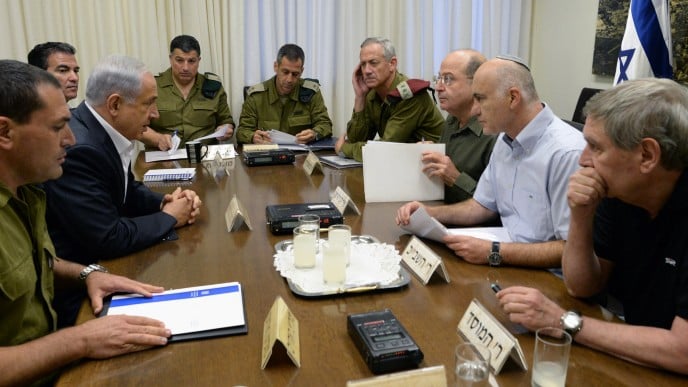
File – Prime Minister Benjamin Netanyahu meets with then-IDF chief of staff Benny Gantz, defense minister Moshe Ya’alon, Shin Bet head Yoram Cohen, Mossad director Tamir Pardo, and NSC head Yossi Cohen at the Defense Ministry in Tel Aviv, to discuss the disappearance of three Jewish teenagers near Hebron, in the West Bank, June 14, 2014. (Kobi Gideon/GPO/Flash90)
As Israel heads toward elections, Netanyahu holds an advantage over his rivals: being able to access the full minutes from years of top-secret discussions and declassifying those most flattering to him.
It will take a commission of inquiry with full investigative powers and access to the source materials for the public to truly draw conclusions about the positions taken by Netanyahu and others over the years.
In the meantime, Israelis will have to make do with media exposés about the matter, and with the many public statements made over the years. This includes Bennett, Liberman and others on the right who repeatedly urged Netanyahu to take tougher action against Hamas, with Liberman resigning as defense minister in late 2018 over the matter, which triggered the April 2019 election.
With the exception of 18 months in 2021-2022, Netanyahu has served as prime minister continuously since 2009, when he came to power with a promise to topple Hamas’s regime in Gaza.
Instead, over the years, he presided over a policy encouraging Qatar to send hundreds of millions of dollars into Hamas-run Gaza, which he publicly defended as essential to prevent a humanitarian catastrophe in the coastal enclave.
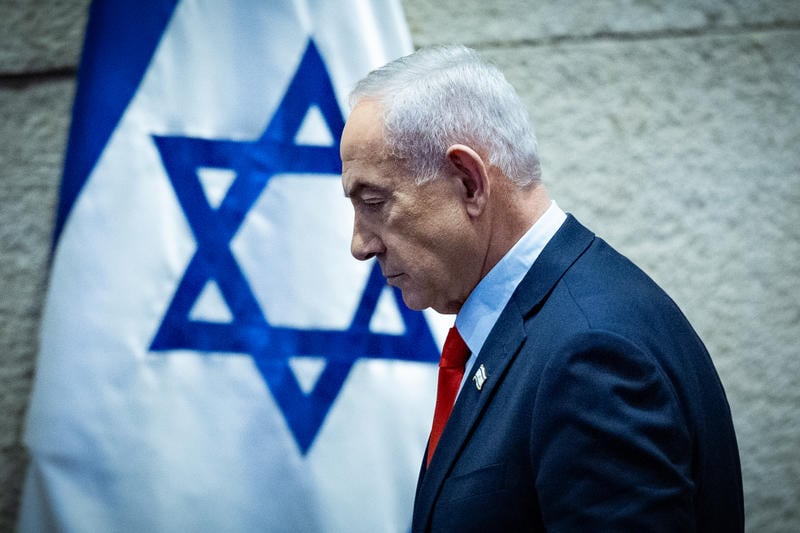
Prime Minister Benjamin Netanyahu at the Knesset, January 5, 2026. (Yonatan Sindel/Flash90)
Contrary to his current portrayal of events, Netanyahu took public ownership of his strategic policies on Gaza on many occasions, with the 2019 interview on Channel 13 hardly unique. He argued many times that Hamas was “totally deterred,” and took pride in the relatively small number of Israelis killed or wounded in violence emanating from Gaza under his rule.
In 2020, he told the Israel Hayom daily: “The quietest decade [in Israeli history], with the smallest number of losses, is this decade in which I have been prime minister. And this isn’t a coincidence. It is the result of sound policy that is both resolute and responsible. You use force, but avoid pointless wars that won’t have any benefit.”
The upcoming elections may well boil down to a referendum on Netanyahu, like many before it, and many on the right — as he himself put it — could seek to make him pay a political price for his consistent decision not to attempt to topple Hamas before the 2023 attack.
Thus far, his famous political wizardry and near-total control of his Likud party and its allies have been enough to keep him in power. Ahead of post-October 7 elections, though, remaining premier could mean rewriting everything that happened before that day.