
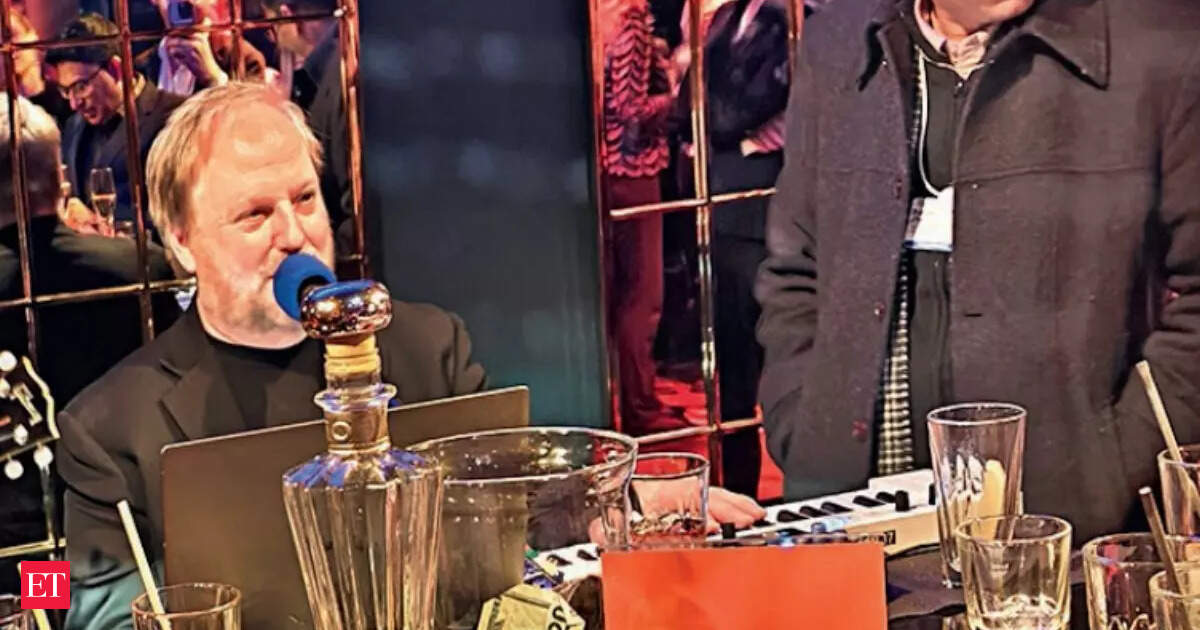
Davos: Sitting behind a baby grand piano in a black tee and an open suit jacket that makes him blend into the furnishing of the bar that bears his name, Barry Colson, with his apple cheeks, receding hairline and infectious smile, looks more endearing and avuncular than a troublemaking rock ’n’ roll troubadour.
For over three decades, CEOs, rock stars, royalty, world leaders, diplomats and dynasts have been dancing to his tune every night in Davos, the ski resort in the Swiss Alps, where the world congregates for power play in January. They would be singing, smoking, drinking, frolicking or simply relaxing after hours of networking and negotiating at the World Economic Forum (WEF).
To call Colson the most listened-to man of the Forum will hardly be a misnomer. The Canadian has managed to do what the WEF has increasingly failed to achieve: Bring people together and build a community.
And this year was no different. He played it loud and long.
Transcending the profundity, prattle and political diatribe, Colson is the one Canadian Prime Minister Mark Carney turned to, to practise his pauses, the night before his now famous 15-minute speech that reminded the world of the end of Pax Americana.
 Live Events
The following night, Carney’s predecessor Justin Trudeau showed up with his girlfriend and singer Katy Perry for a post-dinner nightcap. So did actor Sacha Baron Cohen. Elon Musk is rumoured to have sauntered in closer to dawn. US commerce secretary, the voluble Howard Lutnick, “an old friend” of Colson’s, dropped in too.
Says Colson: “In the past, Lutnick would stay on till the wee hours and then join me to have the world’s best chicken wings, nuggets and more alcohol at 7 am at the X Bar next-door. Once during President Donald Trump’s first term, he almost forgot he had a breakfast appointment with POTUS. Thank God, I reminded him an hour prior.”Such stories of raucous men and boldfaced beauties are commonplace—both from Colson’s earlier tenure at the Hotel Europe and at the current pop-up venue, The Cloudflare House, about 500 m down the Promenade, the main thoroughfare. There’s Randi Zuckerberg, tech entrepreneur and Mark’s sister, standing behind Colson singing through the night.
And actor-comedian Chris Tucker bringing the house down with a jaw-dropping vocal performance. Or, visualise Google cofounder Sergey Brin leaving a $100 tip or its former CEO Eric Schmidt cajoling Colson to play at Google’s own party, Zeitgeist.
One time, as Colson’s lore goes, former Australian PM Kevin Rudd walked in with Ian Bremmer of the consulting firm Eurasia Group, completely covered in snow, after sledging down the mountain on a toboggan after a long night of negronis at the Berghotel Schatzalp, and slaughtered “Down Under”, the foot-tapping hit from the Aussie band Men at Work.
“He just can’t sing,” blurts Colson ruefully. “But it was still a blast.” For every Peter Gabriel, Bono and James Cameron, who would just sit and soak in all the fun, there are several heads of states “who cannot be named under any circumstances” dancing dead drunk to the piano.
“I think I corrupted them,” says Colson, with a glint in his eyes. “I really did. I kept them up way past their bedtime, but it was crazy fun.”
THE FAM JAMThis deep bond is what makes people come back year after year. In fact, Barry’s Piano Bar is itself a product of a beautiful friendship between him and Matthew Prince, the billionaire-founder of Cloudflare, an online security company.
Back in 2019, Prince met a dishevelled Colson, then the “January pianist” at the Hotel Europe, looking visibly stressed, irritated and weary. “He had gained a bunch of weight and I could sense something was off,” says Prince, shouting over the voices in the room that just raised their pitch to sing the chorus lines of Robbie Williams’ “Feel”– the anthem of WEF, as Colson puts it.
Colson had been associated with Hotel Europe’s Tonic Bar, the original piano bar of Davos, since 1995, playing all of January, 10 pm-4 am on the trot. The first time he played a gig was in the August of 1993 when he “absolutely hated the weather”.
But even though the hotel’s management had brought him back, over the years, familiarity bred contempt. The “entertainer-in-chief” was reportedly paid 10,000 euros a month. “It was less than what they would earn in liquor sales in an hour and it was all because of Barry,” says Prince.
The note soured further when Colson, coaxed by Prince, asked the hotel’s management for a 2,000 euro raise.
They did not renew his contract and summarily sacked him.
Suddenly, Barry didn’t have a bar to play in.
Thankfully, the two friends have been planning some additional gigs for Colson, primarily for Cloudflare’s guests at their small set-up in Davos, on the third floor of a pizzeria a few buildings down. “They had a DJ in the house who also played the piano,” says Colson. “Matthew was okay to double my pay for six nights.”
Now what he needed was a more permanent establishment.
Prince, who had met his wife Tatiana, at the Tonic Bar in 2014, two years after he first met Colson at the same venue, could not just leave his “pal in the lurch”. His team started scouting for a place and, after the initial stonewalling from local landlords and realtors, found a space.
It had three issues. It was far out at one end of the Promenade. It didn’t have heating. And it didn’t have bathrooms.
The last two were easy to fix, said Prince. And as for the crowd, Colson was a strong enough magnet to pull them in.
Soon, the brand-new Barry’s Piano Bar was born at the Cloudflare House.
“For 51 weeks of the year, this is an abandoned space where sometimes the owner plays poker with his friends. But for one week, it becomes Barry’s space,” says Prince, wearing his pride on the sleeves.
Eighteen months after their first date, when Prince and Tatiana got married, they flew down Colson to Mykonos, Greece, to perform at their pre-wedding party. Theirs is a heartwarming story in sub-zero temperatures, a testament to what true friendship can achieve, say their mates.
“The great thing about Barry is not just the guy,” says Bremmer. “Make no mistake, he’s a tremendous act, but this is the only place in Davos where you are not judged by your designation, market capitalisation, wealth, or access. Everyone bonds over music around the piano. Here we are all humans.”
The WEF at Davos, argues another old-timer, is by no means representative of the world but Barry’s Piano Bar is. “It represents the true spirit of Davos which is fast getting lost,” he adds.
As Prince puts it: “With a legacy of over 30 years, Barry has been a witness of WEF’s peaks and troughs. He’s the only chain of continuity.”
MOUNTAIN MELTDOWN
One can draw a line from the honkytonk saloons of the 1800s America, where the player piano was invented, to the duelling pianos of Pat O’Brien’s Bar in New Orleans, to jukeboxes in bars. But in an age when everyone walks around with their own playlists, with music flowing through headphones and earbuds, what’s the role of a piano bar? From Manhattan to Tokyo to Mumbai, real estate today comes at a heavy premium and a restaurateur can cram three-four tables into the same footprint as a Fazioli piano.
Davos has changed, too. Thirty years ago, it was a far smaller but intimate gathering. Now the whole world jets into the village for a week. Back then, the number of delegates with white badges, the coveted status symbol of WEF invitees, was little more than a thousand. In 1992, before Barry’s first WEF gig, Nelson Mandela met the then South African president FW de Klerk.
In 1994, Israeli foreign minister Shimon Peres met Yasser Arafat, chairman of the Palestine Liberation Organisation, leading to a significant draft agreement on Palestinian self-rule in Gaza and Jericho, a key step towards the Oslo Accords, culminating in both Arafat and Peres, along with Yitzhak Rabin, receiving the Nobel Peace Prize that year for West Asia peace efforts.
This year, President Trump unveiled his idiosyncratic Board of Peace initially designed to cement Gaza’s rocky ceasefire but which he foresees taking a wider role akin to the United Nations. This year, there were an estimated 2,500-3,000 white-badge guests at WEF, by invitation or purchased for CHF 27,000 ( ₹31 lakh) a pop. With Larry Fink as chair, the Forum is also seen pushing the US agenda far more than the earlier European consensus.
“Back then, the Promenade had shops. Now for one week even the hair salon turns into a pavilion. Every square inch is taken over by corporations and monetised,” says Colson. The hard-drinking, cigarchomping Wall Street high rollers, with their tailored suits and $995 Chateau Latour, have also given way to the socially awkward, introverted and precocious Silicon Valley snowflakes who drink tequila and mezcal till dawn. Colson says they are bad tippers too.
“The tech crowd has tasted success very early on whereas many of the old-school blokes made their fortunes starting from boiler rooms. They knew how to lead their lives.”
TAKE IT FROM THE TOP
The secret sauce of a great piano bar is to make it come to life no matter the zip code, and Colson knows how to read the room. He does not have a set list but a long catalogue of over 1,000 songs, the lyrics of which are either in his mind or in the laptop as a backup. “It’s always spontaneous,” he says. “I never know what I’m going to sing.
There is no order for my show. It’s completely interactive, which often catches people off guard.”
Colson also uses a computer keyboard for bass sounds, much like Ray Manzarek of the Doors who would play a left-handed bass guitar along with the keyboards. To his right, there is a little box which is a drum machine for the beats. At times, he also plays the harmonica along with his cache of classic pop and rock anthems.
“Music of the ’70s and ’80s works for everybody. Doesn’t it?” he asks. Going by the bar’s decibel levels that were getting cranked up as if to fill the silence of a post-midnight town, I simply nodded in agreement. And it was only mid-week.
Colson refuses to be a Baby Boomer, although he is born in 1963 to a coal miner father and a singer mom in a family of musicians. “The 80s was my thing. I really became an adult then. I am more Generation X and everyone still loves to sing along to those songs,” he says.
Contemporary chart-toppers don’t interest him—those songs lack character or punch, or both, he says. “The songs now are so repetitive. No dynamics at all, with hardly any peaks or valleys.”
But he’s clear about one thing: “Whoever doesn’t know Billy Joel’s ‘Piano Man’ should just be banned. Absolutely” But being the ringmaster, referee and the regaler all rolled into one is not easy. In today’s polarised, highly woke environment, Colson needs to be extra careful as sometimes things get out of hand in a matter of minutes. Guests have blown cigarette smoke on his face, grabbed his microphone, spilled drinks on him and the piano.
Some celebrities have even stumbled up to him and asked for cocaine. He would never allow any guest to hijack the microphone for politics or protests. Just last year, a guest wanted Colson to congratulate an individual who had just been appointed to a government post. “I said, no, I’m not going to congratulate that person… That’s political and I’m not bringing that into this bar. Nope,” he says, shaking his head vigorously. “I simply switch off the microphone.”
PAPS VS PRIVACYBut do these VIPs really let their hair down? Isn’t the ubiquitous mobile phone camera the biggest killjoy? One wrong move, one out-of-turn comment can snowball into a social media maelstrom in seconds. Colson has been a hit because he never peddled the secrets that unfolded in his bar.
Back in the day, he says, “There was no such thing as video bloggers or phones and there was an unwritten rule with journalists and CEOs and prime ministers alike that whatever happened in that bar stayed in that bar and that was true. People respected the privacy of others and thus mingled freely.”
Today restricted access or entry solely by invitation is the way to retain “exclusivity”.
More importantly, Colson tries not to change. He gets philosophical while elaborating: “Human beings are human beings regardless of their background, bank balance, or nationality. It doesn’t matter to me.
I am the same person who plays for the billionaires at Davos and then at Little Italian Restaurant at Halifax, Canada. I am the same to everybody.”
The humble household he was born into shaped his character. “We were very poor but we were well loved,” he recalls. “I have learnt never to let things get the best of me or walk around with a big head.”
After the annual Davos sojourn, he travels to Bergen in Norway to play at a bar in a fish market for eight weeks—once in May and again in November. Every April and June, he is in the Canary Islands playing at a local bar called Black & White. Intermittent special projects aside, the rest of the year Colson loves to stay in Halifax, which he now calls home.
“During the week of WEF, I fill up my gas tank to the hilt—this one week is like my heroin fix,” he says.
Despite the ambient cocktail chatter, Colson manages to fall into a reverie as he sways above the keys, peering down at his fingers as if he were shuffling the pieces of an intricate jigsaw puzzle.
There’s a grace to what he does, his own craft operating at the highest of levels, night after every single night, wringing in every drop of the din of a crowded space swirling around him, the bar noise becoming, you could argue, a necessary part of his music.
See you at Barry’s next year?