
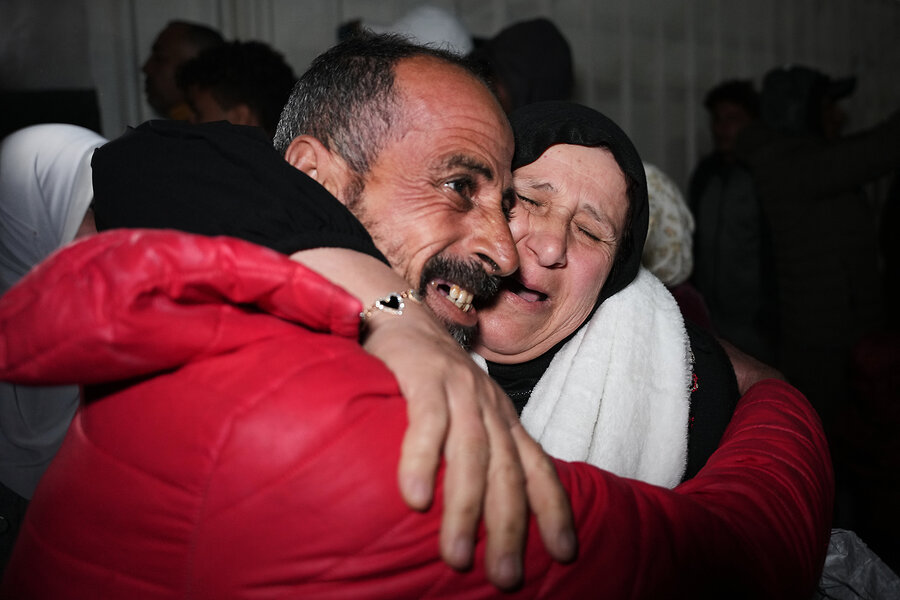
Navigating border restrictions, armed gangs, and airstrikes, the first groups of displaced Palestinians have returned to the besieged Gaza Strip after nearly two years, passing through the Rafah crossing from Egypt.
Yet the crossing, currently Gaza’s lone portal with the outside world, remains a choke point, with few allowed to pass in either direction.
Last week dozens of Palestinian residents of Gaza who had sought medical care in Egypt finally crossed through and returned home to the war-torn Strip.
Why We Wrote This
Gaza’s Rafah border crossing with Egypt had been closed to Palestinian returnees since Israel’s seizure of the site in May 2024. Its reopening is a cornerstone of the Israel-Hamas ceasefire, but its test operation during an Israeli “pilot” is so far imposing hardships.
Although the full opening of the Rafah border to the entry and exit of peoples and goods was a cornerstone of the October ceasefire between Israel and Hamas and of the Trump administration’s 20-point peace plan, Israeli and apparently some Egyptian restrictions remain four months on.
The Israeli military entity tasked with governing the occupied territories, COGAT, said in a statement last week that a partial opening to passengers began last Sunday as “a pilot” to “test and assess the operation of the crossing.”
Rafah had been closed to returnees since Israel’s seizure of the land crossing in May 2024.
As of Thursday, a total of 77 Palestinians in Egypt have been allowed to re-enter Gaza since Rafah’s partial reopening. Israel is so far imposing a daily limit of 50 passengers entering Gaza and 150 leaving.

Eatedal Rayyan, a Palestinian mother of three, looks out from a tent set up inside her war-damaged home in the northern Gaza Strip, Feb. 6, 2026. She returned home from medical treatment in Egypt, after nearly two years away.
After being processed by Egyptian and European Union border staff, who were deployed as part of the Israel-Hamas ceasefire agreement, returnees are then vetted and inspected by the Abu Shabab militia, a loose group of Gazan gunmen with former ties to militant or criminal groups that oppose Hamas and are backed by Israel.
They then face interrogation by the Israeli military, returnees say.
Palestinians returning to Gaza are restricted to one bag of clothing and the equivalent of $640, according to rules placed on the Rafah crossing on the Egyptian side of the border.
Thousands of Gazans are also looking to leave for Egypt via the Rafah crossing, but only dozens have been allowed to go so far – well below the daily numbers set by Israel.
An estimated 22,000 severely ill Palestinians require medical treatment outside Gaza, since Gazan hospitals have been gutted by fighting and Israeli strikes.
“They are depriving many of the wounded and other humanitarian cases from leaving, including children who need treatment, cancer patients, the wounded, amputees – people are dying every day,” says local journalist and activist Kary Thabet, who is documenting the reopening of the border.
“The narrow opening for passage has denied Gazans their right to safely exit and travel. It is another step in which Gazans are being stripped of human rights.”
A family’s arduous return
On Monday, Sabah Ismail Alrigib and her four daughters were among the first dozen Palestinians to return to their homeland in nearly two years.
The family had fled to Egypt in February 2024 to receive medical treatment for one of her daughters.
First the family went through the EU checks, including iris scans, passports, names, and IDs.
Then they faced the Abu Shabab gang. The gunmen interrogated family members and, they said, attempted to recruit them to join their militia.
“They told me: Why have you come? We will help you travel and give you money for you and for your daughters,” Ms. Alrigib said. “I was afraid of them all time.”
Finally, after hours of interrogation, the gunmen let them through to Israeli military forces stationed inside Gaza.

People wave to returnees as they arrive in a bus at Nasser Hospital in Khan Yunis, southern Gaza Strip, Feb. 4, 2026, after a group of 40 Palestinians was allowed into Gaza from Egypt through the Rafah border crossing.
It was then, Ms. Alragib says, that Israeli officers handcuffed and blindfolded her, and demanded “information about Hamas.” After asking her why she was returning to Gaza, Ms. Alragib says, the Israeli military offered her funds and visas to repatriate to a third-party country. Multiple returnees gave similar testimony to the Monitor and other international media outlets.
The Israeli Defense Forces disputed the accounts by Ms. Alragib and other Gaza returnees, saying in a statement to the Monitor that “no incidents of inappropriate conduct, mistreatment, apprehensions, or confiscation of property by the Israeli security establishment are known” to have occurred during security screening at the crossing.
It said the security screening is being conducted “in accordance with the security policy that was coordinated in advance with Egypt and EUBAM [European Union Border Assistance Mission to Rafah], and in accordance with international law.”
Lamia Hamato Rabi was also part of the first batch of returnees.
Ms. Rabi had left Gaza for Egypt with her husband in order for him to receive cancer treatment in early 2025. She returned to Gaza this week alone, having buried her husband in El-Arish, in the northern Sinai.
After boarding a bus at 2:30 a.m. and passing through the European and Abu Shabab checkpoints, Ms. Rabi finally entered Gaza at 5:00 p.m. – more than 14 hours to cross a few hundred yards.
A homeland without landmarks
Having undergone the same strict search and attempts of coercion by the Abu Shabab gang and the Israeli military, she says she feels defiant upon her return, refusing to give up her homeland.
“Even if I was away for 10 years, this remains my country. This is where my family is,” says Ms. Rabi, who has since been reunited with her children in Khan Yunis.
“I am really happy to be reunited with my family, my parents, my siblings, my child, my grandchildren,” said Ms. Alragib, who met her son’s child, who was born while she was in Egypt, for the first time. When her children tell her of their months of displacement and hunger, she says becomes sad and cries.

Trucks carrying aid and supplies head from Egypt toward the Gaza Strip through the Rafah border crossing, in Rafah, Egypt, Feb. 4, 2026.
She says her native Khan Yunis is unrecognizable. She and the other returnees now face the difficulty of navigating the desolate landscape with no landmarks or familiar features.
“It is fully destroyed. It is like a ghost city,” says Ms. Alrigib, who now lives in a tent in the Al Mawasi displacement camp.
Having lived in El-Arish, 28 miles west of the Gaza border, the war, and worries for their family, never left them.
“We used to hear all the bombing and airstrikes in Gaza,” Ms. Alragib added.
And the airstrikes have not stopped.
Israeli forces said they came under fire Wednesday, prompting Israeli airstrikes that killed 23 Palestinians, the deadliest day since the October ceasefire.
A series of Israeli strikes have killed more than 40 Palestinians in Gaza, including children, since the Trump administration’s Jan. 14 announcement that the ceasefire had entered its second stage.
“When I left, buildings were still standing. On my return there is complete destruction,” Ms. Rabi said, “but it is still my Gaza.”