

The position of most countries in the Middle East and Africa (MEA) on Ookla’s Speedtest Global Index™ had changed little in 2025. However, a few markets saw significant improvements in fixed or mobile download speeds, notably in Northern African countries, Bahrain, and Oman, which lifted their ranking. This article examines the most significant changes in country rankings in MEA on the Index and analyzes the underlying regulatory and operational factors that drove these shifts.
Key Takeaways
The Gulf Cooperation Council (GCC) countries maintained their pole position in MEA. The UAE, Kuwait, Qatar, Saudi Arabia, Bahrain, and Oman are the consistent winners, leading the MEA region in both fixed and mobile network performance, with most in the top-10 globally for mobile throughout 2025. South Africa is the consistent leader in the Sub-Saharan Africa (SSA) sub-region and is one of only three SSA countries in the global top-100 list for mobile in Q4 2025.
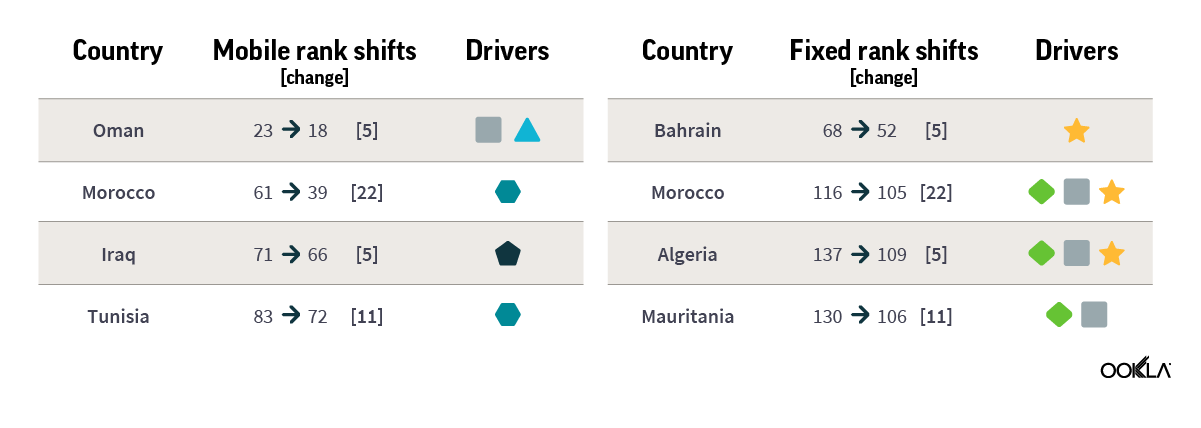
While the position of most MEA countries changed only slightly on the Index, a few saw significant jumps. For example, Morocco recorded the largest move, jumping 22 places on the mobile Index, followed by Algeria and Tunisia, as these countries launched 5G in 2025. Oman also moved up five places to 18th, thanks to network investment, network refarming, and the activation of new carriers. On the fixed side, Algeria saw the largest jump, moving up 28 places, followed by Mauritania, which rose 24 places. Bahrain and Morocco improved by 16 and 11 places, respectively.
5G and the modernization and expansion of existing infrastructure were the main levers for improving a country’s ranking in the MEA region. The North African sub-region, particularly, was a confluence of two events that shaped its performance in 2025: the launch of 5G and the continued expansion of fiber and accelerated adoption. In Bahrain, raising the minimum speed resulted in an increase in fixed median download speed.
While urban concentration creates favorable conditions to deliver higher download speeds, it does not generally determine mobile network performance. Urbanization is necessary but not sufficient for higher mobile download speeds. It explains the upper bound of performance, but not the actual outcome for many countries. Structural elements like the pace of network modernization, investment capacity, spectrum access timeline, political stability, and market conditions often override demographic factors.
The two charts below show the monthly change in the ranking of the top 20 MEA countries in the Speedtest Global Index for mobile and fixed, as well as corresponding rolling quarter median download speeds in Mbps.
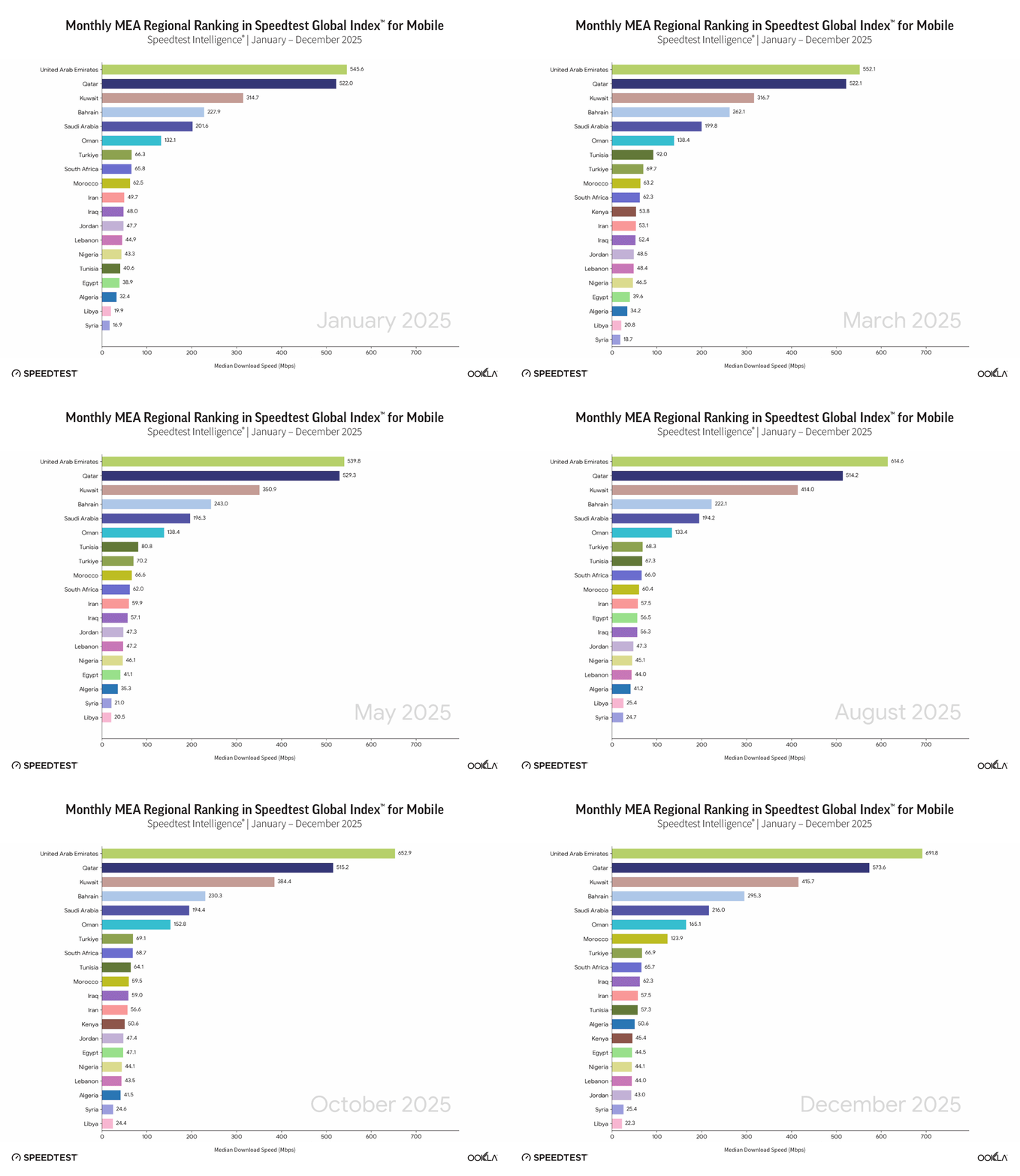
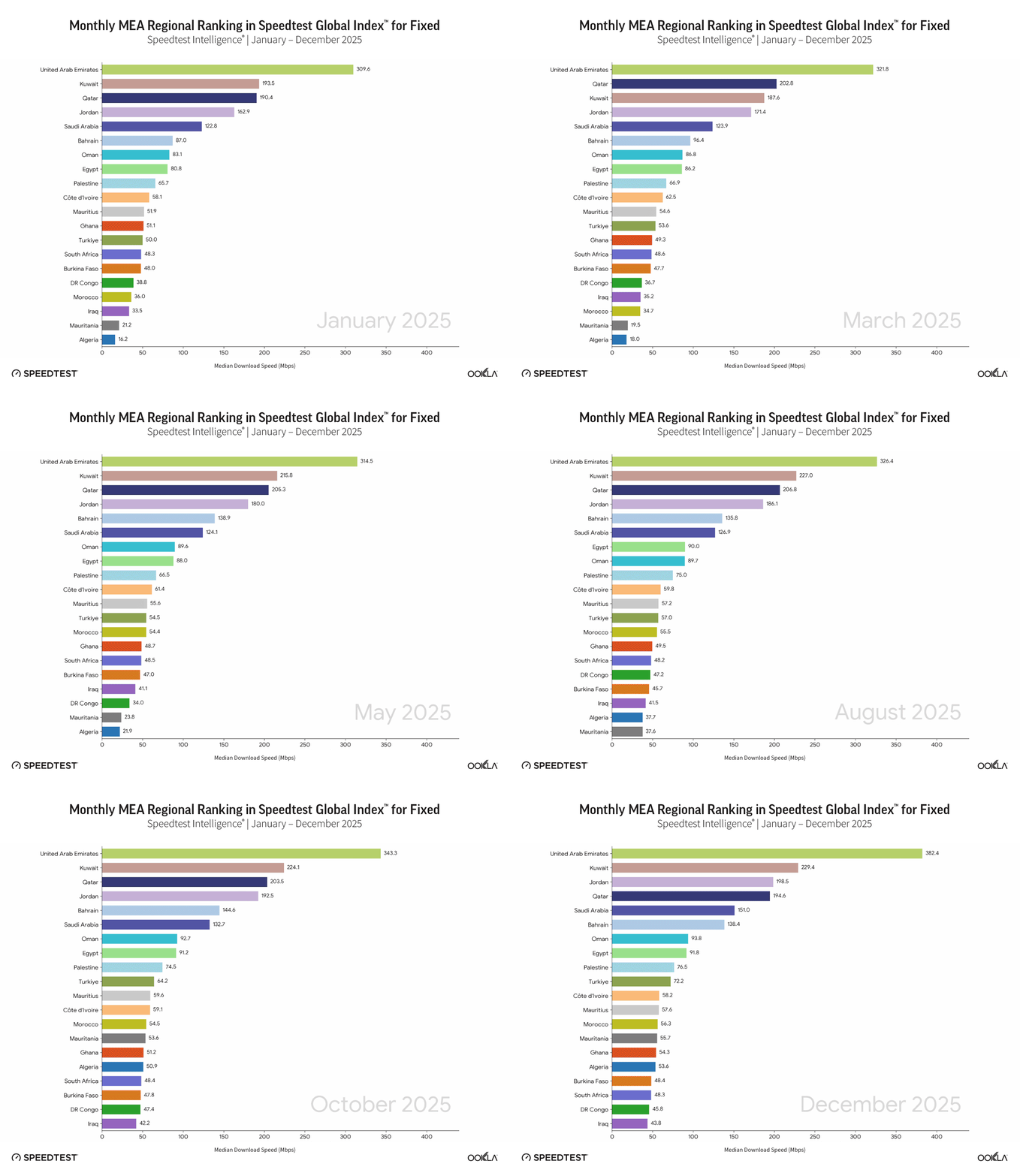
The GCC leads in terms of fixed and mobile network performance, followed by the Levant and North Africa sub-regions
The MEA region (including Türkiye) is characterized by a high contrast in geographical landmass, population density, and disposable income levels. These factors influence the level of investments in infrastructure and the level of adoption of telecom services, which in turn affect network performance. We can distinguish four sub-regions in MEA:
Gulf Cooperation Council (GCC), which includes Bahrain, Kuwait, Oman, Qatar, Saudi Arabia, and the UAE. These are the most advanced and mature fixed and mobile markets in the region, characterized by high spending power, a high smartphone penetration level, and government-led digitalization mandates.
The Levant, which includes countries such as Jordan, Iraq, and Türkiye. A mixed-maturity sub-region with a strong 4G network and emerging 5G services. Türkiye acts as a sophisticated anchor market similar to Europe, while other markets face geopolitical and economic volatility that hampers consistent growth.
North Africa, which includes Algeria, Egypt, Libya, Morocco, and Tunisia. Generally, a strict regulatory environment with government-backed incumbents often dominates the markets, with low to moderate ARPU. Infrastructure in transition phase migrating from 4G to 5G in mobile and DSL to fiber in fixed.
Sub-Saharan Africa, which includes countries such as Ghana, Kenya, Nigeria, and South Africa. The sub-region relies mostly on mobile infrastructure, with a huge usage gap between urban and rural areas. Infrastructure reliability is plagued by electricity shortages.
Despite economic and geopolitical headwinds in some parts of the MEA region, it remains dynamic and appealing to telecom groups thanks to a young and rapidly growing population and demand for digital and financial services powered by telecom infrastructure. As a result, all sub-regions are pushing ahead with investments and regulatory initiatives to expand current network coverage, upgrade network technologies, and encourage competition to keep telecom services affordable. These initiatives helped most countries to maintain a consistent position on Ookla’s Global Speedtest Index throughout 2025. However, a few saw their ranking decline, and fewer countries saw their ranking significantly improve.
Most Gulf countries maintained their top-10 positions in mobile throughout 2025, except Oman, which ranked 18th. However, it recorded the largest move in this sub-region, moving five places between January and December 2025, thanks to accelerated investments from the operators, activation of new carriers, and the refarming of 3G spectrum for 5G. The three-month moving median download speed between October and December 2025 ranged from 165.07 Mbps for Oman to 691.76 Mbps for the U.A.E. in Q4 2025. The upgrading of 5G infrastructure to 5G SA and 5G Advanced, and the use of multi-carrier aggregation, significantly boost throughput.
On the fixed side, the UAE, Kuwait, and Qatar ranked 2nd, 25th, and 38th globally, respectively, in December 2025, and in the top-3 across MEA. Bahrain jumped 16 places during the year as a result of government regulation pushing ISPs to increase minimum speeds (from 100 Mbps to 300 Mbps in March 2025), coupled with ISP efforts to make faster plans more affordable.
Country Ranking in Speedest Global Index, GCC
Source: Speedtest Intelligence® | January – December 2025
In the Levant region, most countries that made it to the top 100 of the Index saw their position shift downward, except for Iraq, which moved up five places to 66th by the end of 2025, and Syria, which moved to the 99th (up three places), after recording a close to 9 Mbps increase in rolling quarter median download speed. Türkiye leads this sub-region, taking the 61st position globally with a median download speed of 66.91 Mbps. We expect its rank (and median download speed) to improve in 2026 as the country plans to introduce 5G services in April 2026, following the spectrum auctions held in October 2025. Jordan is the only market among the ranked countries in this sub-region with commercial 5G (since 2023); despite that, it ranked lower than at the beginning of 2025, with its median download speed dropping to 43 Mbps.
However, Jordan leads the sub-region in fixed broadband performance, ranking 34th globally with a median download speed of 198.54 Mbps in December 2025. The success stems from significant fiber-optic network deployment and uptake. According to the telecom regulator, TRC, the country had 637,408 active fiber lines in Q3 2025, representing 77% of all fixed broadband subscribers, and 66.4% of them were on plans offering speeds of 200 Mbps or higher. Türkiye improved its position globally by two places but remains far behind Jordan at 99th. The rest of the Levantine countries rank even lower.
Country Ranking in Speedest Global Index, Levant
Source: Speedtest Intelligence® | January – December 2025
Four of the five North African countries launched 5G services in 2025. Tunisia and Egypt were the first to enter the 5G foray in February and June 2025, respectively. However, 5G had a varying impact on national performance and global ranking. Tunisia had a good start to the year, peaking at 47th position in April 2025, before dropping to 72nd in December (but still moving 11 places up in the year), with a median download speed trending down to 57.3 Mbps. This suggests that the infrastructure has not kept up with the growing demand. On the other hand, Egypt, which launched 5G in June, only jumped three places to 83rd in December 2025 (down from its peak of 68th in June 2025), with a median download speed of 44.51 Mbps, only slightly higher than pre-5G times. The limited increase in speed could be the result of operators using only 20 to 30 MHz bandwidth in the 2.6 GHz band, shared between 4G and 5G, limiting its capacity to serve an increasing number of 5G users.
Morocco and Algeria were the last to introduce 5G in November and December 2025, respectively. The recency of the 5G launch, coupled with strong consumer interest in the new technology, led to an increase in higher-speed 5G test samples collected over the past two months, which in turn contributed to the uplift in the median download speed. For example, Morocco’s rank jumped in the mobile Speedtest Global Index to 39th, up 22 places since the beginning of 2025, regaining its leading position in North Africa. Algeria also saw its position significantly improve, rising 11 places to 78th, and moving to third position in the sub-region, ahead of Egypt. We expect Algeria and Morocco to fall back a few places in 2026 due to the decrease in the share of 5G tests, reducing their impact on the median download speed. Finally, Libya trails the sub-region, dropping four places in 2025.
On the fixed side, fiber deployments accelerated in 2024 and 2025, with Egypt still leading in broadband performance, dropping one place on the Global Speedtest Index at the end of 2025. Algeria jumped 28 places to the 109th position, and Morocco by 11 places to the 105th. They achieved a median download speed of 53.62 Mbps and 56.27 Mbps, respectively, in Q4 2025.
Country Ranking in Speedest Global Index, North Africa
Source: Speedtest Intelligence® | January – December 2025
Sub-Saharan African countries lag behind leading countries in MEA, except for South Africa
According to the mobile Speedtest Global Index, only three countries made it to the top-100 list in December 2025: South Africa (64th), Kenya (80th), and Nigeria (85th). The positions of South Africa and Nigeria dropped five and seven places, respectively, in 2025, with median download speeds of 65.7 Mbps and 44.14 Mbps by the end of the year. Kenya ranked 80th, recording a median download speed of 45.37 Mbps.
On the fixed side, the picture is more diversified, reflecting the great progress made by SSA in terms of fiber deployment and adoption. Côte d’Ivoire is the highest-ranking country in SSA, taking the 103rd position in December 2025, with a median download speed of 58.17 Mbps. Omdia estimates that 10% to 15% of all country premises are covered with FTTP. While this is lower than other countries such as Senegal, South Africa, and Kenya, it outperformed them in median download speed. This could be because the user base is concentrated on relatively higher‑speed connections. In fact, Orange, the leading ISP, offers entry-level fixed broadband packages starting at 50 Mbps.
Six other countries in SSA are in the top-120, with Mauritania recording the largest jump in 2025, moving 24 places to the 106th with a median download speed of 55.66 Mbps, just below Morocco. The country expanded its backbone, adding 5,500 km of fiber, and planning to lay a total of 8,000 kilometers of additional lines by 2025 and beyond as part of the Mauritanian government’s Digital Agenda 2022-2025. Interestingly, South Africa is the only country in the region where wholesale-only FTTP networks are common.
Country Ranking in Speedest Global Index, Sub-Saharan Africa
Source: Speedtest Intelligence® | January – December 2025
Saudi Arabia achieved a strong standing among G20 nations, whereas both Türkiye and South Africa lagged behind
The G20 groups major economies across 19 countries and the European Union, and they represent nearly 80% of the global GDP. Saudi Arabia, South Africa, and Türkiye are the only MEA countries that are part of this group, but they exhibit significant differences.
Saudi Arabia ranked 9th globally in December 2025 in mobile, which corresponds to the third position among G20 countries, ahead of the U.S.A., China, Australia, Canada, and Japan, and European countries. On the other hand, Türkiye sits at the 13th position ahead of Japan, before even launching 5G. Despite having 5G since 2021, South Africa is ranked slightly lower at 15th, suggesting there is room for improvement. On the fixed side, Saudi Arabia stands at 10th place among G20 nations. In comparison, Türkiye and South Africa rank in the bottom quarter of G20 at 16th and 18th, highlighting challenges in fixed internet infrastructure and fiber adoption.
Saudi Arabia, South Africa and Türkiye Rankings in Speedest Global Index Compared to Rest of G20
Source: Speedtest Intelligence® | December 2025
5G launch and fiber expansion are the most significant levers for improving countries’ mobile and fixed ranking in MEA
Improvement in fixed and mobile network performance can result from several factors and initiatives led by telecom operators and supported by regulators. These can be categorized into seven groups, as shown in the table below, with examples relevant to the fixed and mobile markets.
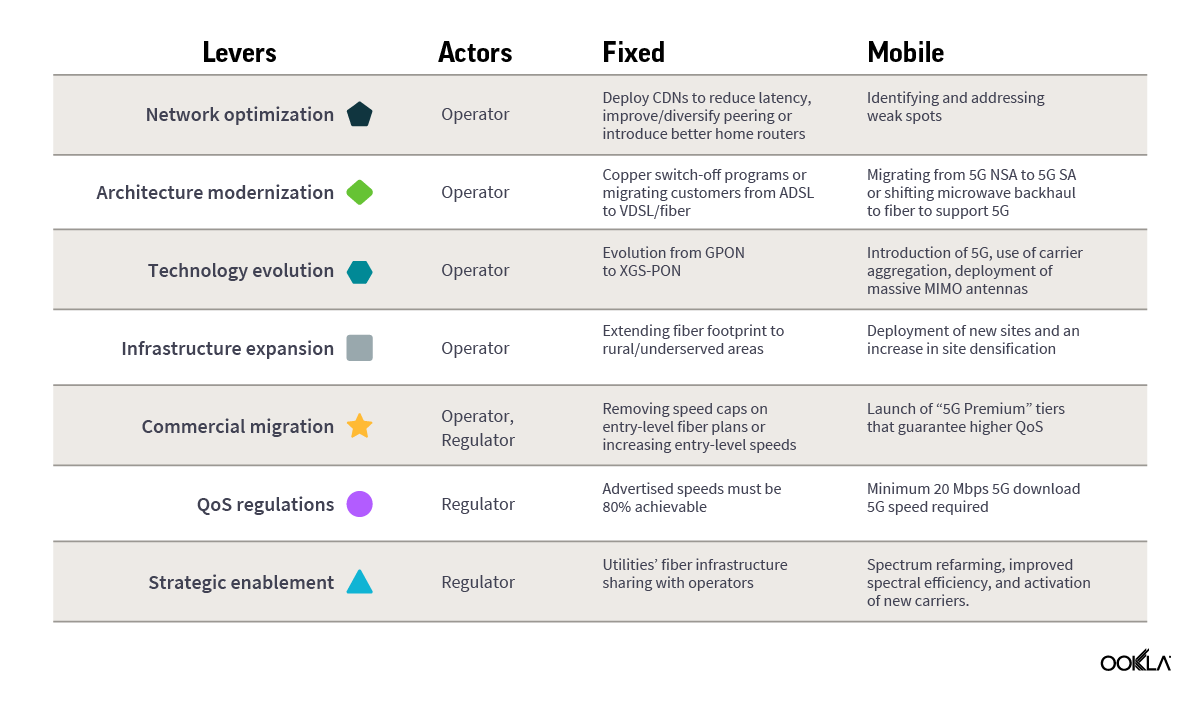
Reviewing the biggest movers across MEA in 2025, we can attribute their shifts in the Index to the different drivers shown above. It is clear that a 5G launch was the main driver for improvement in mobile network performance, especially in North Africa. On the fixed side, it is a combination of network expansion, migrating customers to more modern technologies, and increasing entry-level download speed.
Urbanization level contributes to mobile performance improvement, but it is not the sole determinant
Some MEA countries, particularly in the Gulf region, enjoy a very high level of urbanization, which facilitates the deployment of infrastructure, allows shorter cell distances, and higher fiber penetration, which contribute to strong network performance. However, urbanization alone does not determine mobile network performance. Several countries with a high (or relatively high) share of urban population exhibit lower-than-expected median download speed, according to data from Speedtest Intelligence (for network performance) and the World Bank (for urban population). In some cases, dense cities can even exacerbate performance issues if network expansion does not keep pace with traffic growth.
The chart below shows the median download speed among the top MEA countries in the Speedtest Global Index in Q4 2025 by share of urban population. While Gulf countries have a very high level of urbanization (>80%), which supports better mobile performance, the correlation breaks down for several countries.
Nations such as Türkiye, Jordan, and Lebanon cluster closely in terms of urban population share, yet differ markedly in median download speeds. This divergence points to structural factors beyond demographics, including the pace of network modernization, such as the delayed introduction of 5G.
Some countries are outliers where median download speeds are substantially lower than urbanization would suggest, and these reflect broader market and country conditions. For example, the poor performance in Lebanon, Libya, and Syria is likely the result of political instability and limited investment appetite (or capacity) in these countries, but also shows the potential for speed uplift given the relatively high level of urbanization.
On the other hand, Egypt and Nigeria secured a place in the leaderboard despite being the most populous nations in the region with relatively low levels of urbanization. The launch of 5G in 2025 and 2022, respectively, and the improvement in 4G coverage and capacity helped to boost their median download speed.
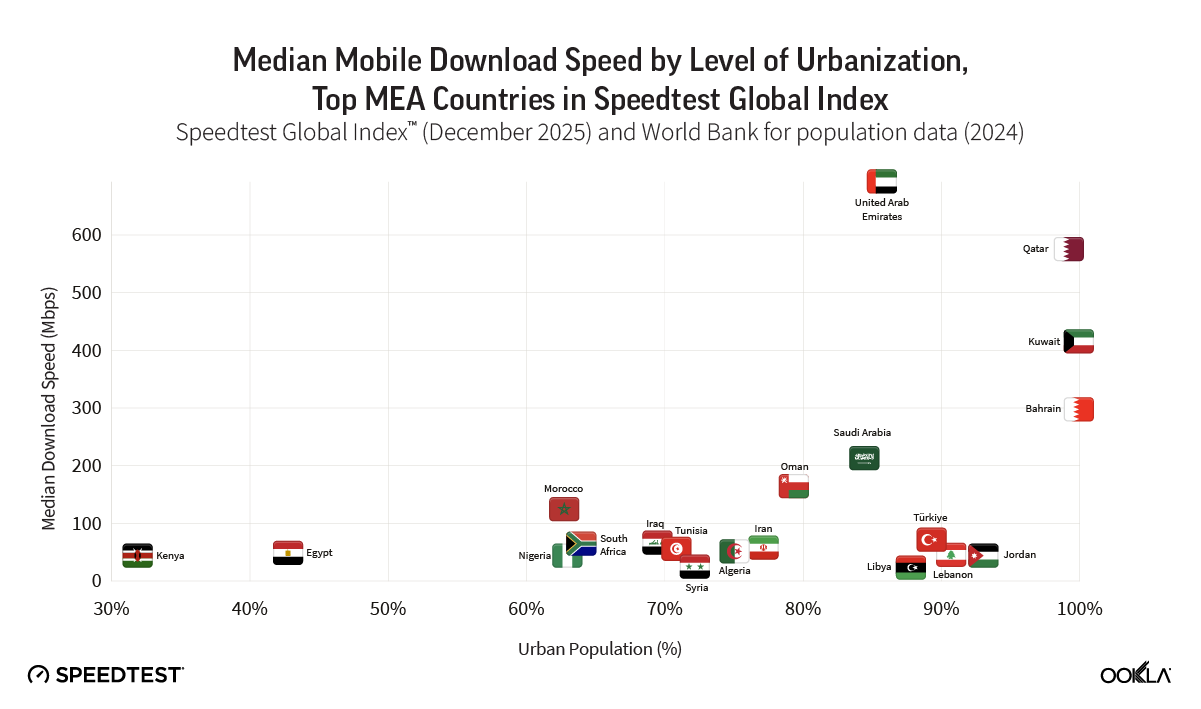
A high level of urbanization appears to help the countries that already have a developed infrastructure and a mature mobile market to unlock the next level of performance at a lower cost and faster than less urbanized countries. In most cases, mobile performance is driven by a complex interplay of factors. Structural elements like the pace of network modernization, investment capacity, political stability, and market conditions often override demographic factors. The delay in the spectrum auction can act as a barrier to 5G deployment, as we saw across Africa and Europe in recent years. That is why timely spectrum allocation and proactive policies should be a priority for other countries in MEA that are considering jumping on the 5G wagon to improve their network performance.
In conclusion, Ookla Speedtest Global Index data for 2025 reveals a dynamic landscape in MEA’s mobile and fixed network performance. While Gulf nations continue to dominate in terms of speed and infrastructure, significant progress was observed in North Africa, driven primarily by the rollout of 5G technology and the expansion of fiber optic networks. It shows that the combination of operators’ continued investment in network modernization, with regulatory initiatives, such as auctioning 5G licenses, mandating legacy network switch off, and raising minimum download speed on fixed, are key levers for improving connectivity across the region.