
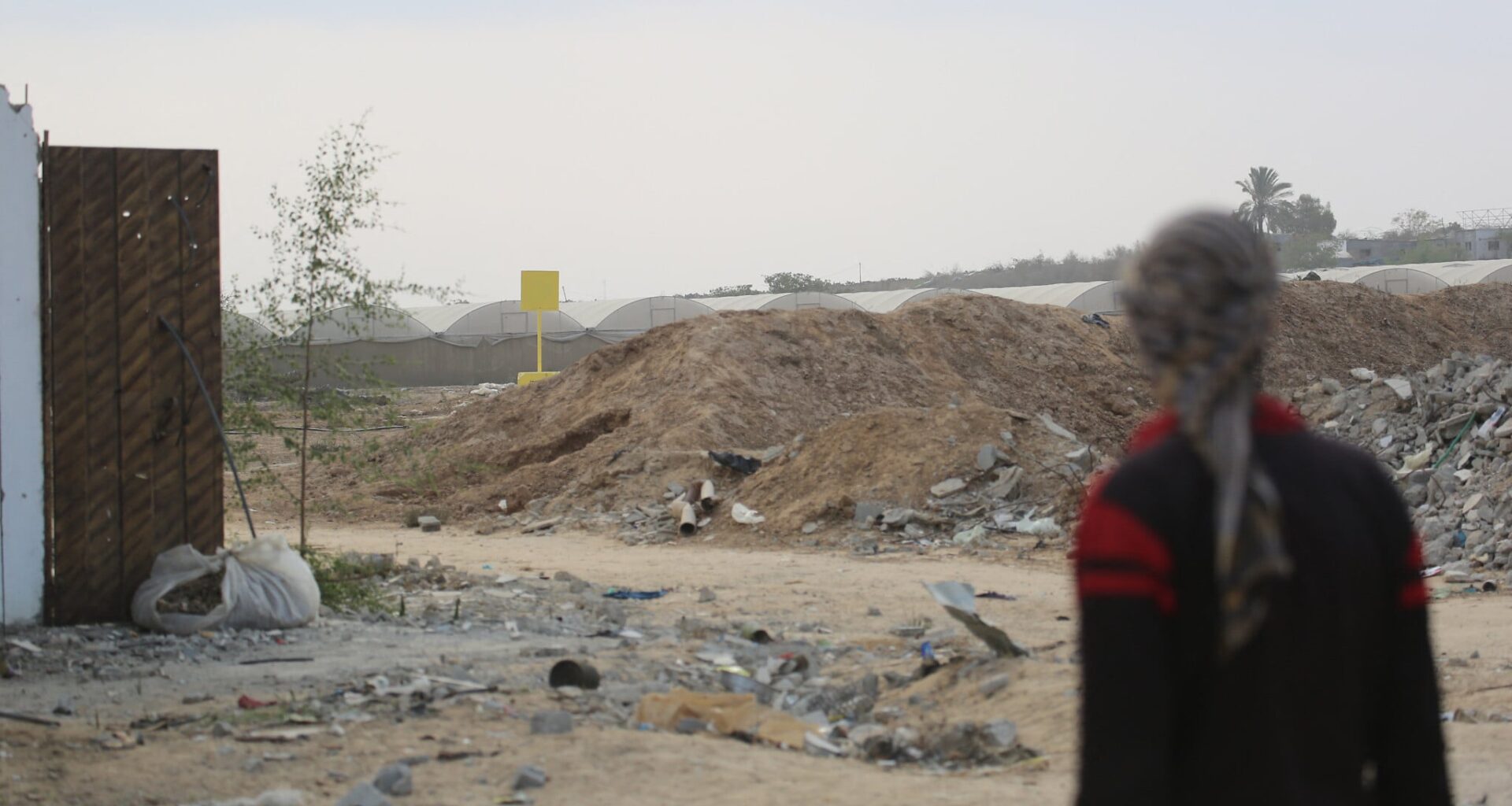
Nearly four months after the Gaza ceasefire took effect, the Palestinian enclave remains divided nearly in half, with Israeli forces and Hamas fighters separated by what is known as the Yellow Line, a temporary seam that may be on its way to hardening into a new de facto frontier.
The line, laid out in US President Donald Trump’s “Comprehensive Plan to End the Gaza Conflict,” was presented as a provisional security boundary during the initial phase of the 20-point peace framework, pending a full, phased Israeli withdrawal once specific conditions were met, including the disarmament of the Hamas terror group.
Last month, US special envoy Steve Witkoff announced the launch of phase two of the plan, describing it as the transition “from ceasefire to demilitarization, technocratic governance and reconstruction.”
At the World Economic Forum in Davos days later, US President Donald Trump’s son-in-law Jared Kushner, who works closely with Witkoff, presented plans for a “New Gaza” in which the Strip’s demilitarization paved the way for an almost-complete Israeli withdrawal and the redevelopment the entire enclave into neat blocks of residential zones, industrial areas, parks, and even a seaport and airport.
Planners had considered plotting out a “free zone… and a Hamas zone,” but had instead decided to build a vision for “catastrophic success,” he said.
Get The Times of Israel’s Daily Edition
by email and never miss our top stories
By signing up, you agree to the terms
But for now, those ambitions — and even much more modest ones — remain largely theoretical.
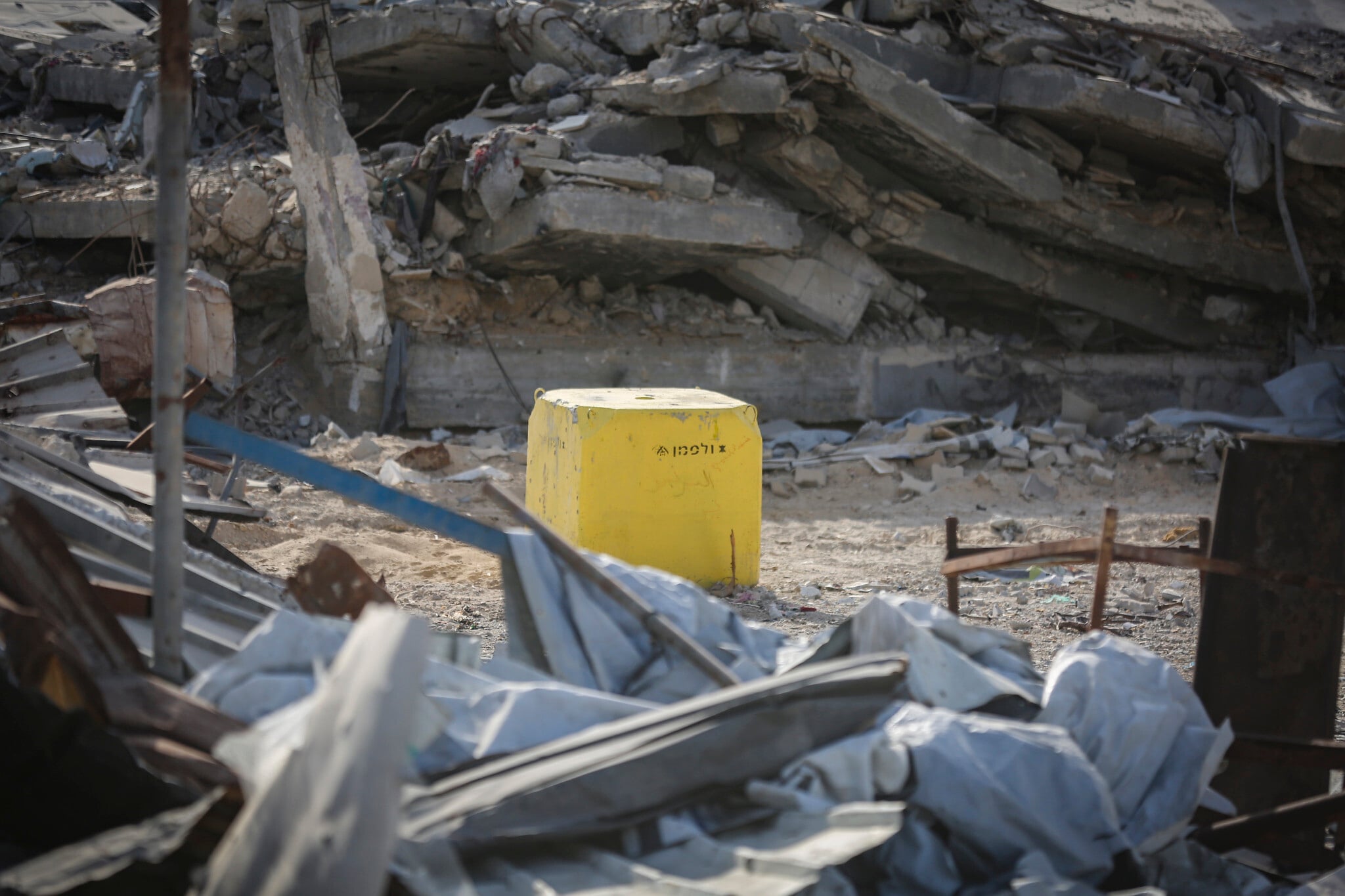
A yellow concrete block demarcating the ceasefire line, east of Jabalia in the northern Gaza Strip, November 2, 2025 (Fathi Ibrahim/Flash90)
Under the framework, Israel is prohibited from occupying Gaza, and the IDF is required to “withdraw based on standards, milestones, and timeframes linked to demilitarization that will be agreed upon” between the Israeli military, a prospective International Stabilization Force, the bodies overseeing Gaza’s transition via the Trump-controlled Board of Peace, and the United States.
“Practically, the IDF will progressively hand over the Gaza territory it occupies to the ISF according to an agreement they will make with the transitional authority until they are withdrawn completely from Gaza, save for a security perimeter presence that will remain until Gaza is properly secure from any resurgent terror threat,” the plan outlines.
A roughly sketched map released alongside the plan marked the Yellow Line that Israeli troops retreated to once the ceasefire took hold in October, which left 47% of the enclave in the hands of Hamas. A Red Line included in the map marks the area where troops would be expected to pull back to once the ISF deploys, expanding the area outside IDF control to roughly two-thirds of the Strip.
Even in a full withdrawal scenario, Israel would still retain an approximately one-kilometer- (0.6 mile-) wide buffer zone along Gaza’s perimeter, including the Philadelphi Route on the Egyptian border, which Israel says has long served as a major smuggling corridor.
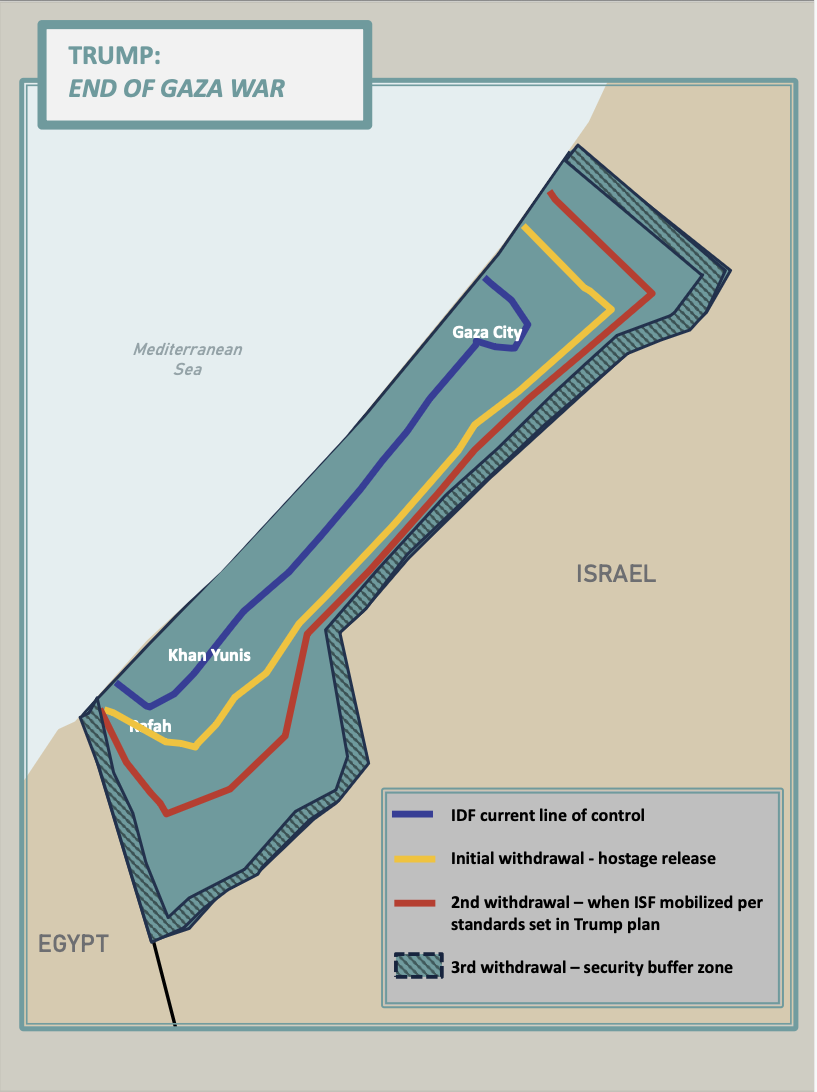
A map of a proposed withdrawal of IDF troops as part of a deal to end the war in Gaza, published on September 29, 2025. (White House)
Yet, so far, only one of the plan’s benchmarks has been fulfilled: the return of all hostages held in Gaza, completed last week with the recovery of the remains of Ran Gvili.
Hamas, however, remains armed and firmly in control of most areas west of the Yellow Line.
“As long as our enemies inside Gaza are still… planning to regain their power… we are doomed to carry on staying with ground forces surrounding Gaza,” Orit Miller-Katav, a researcher at Ariel University’s Institute for Middle Eastern and Asian Studies, told The Times of Israel.
Meanwhile, the ISF has struggled to materialize. In December, The Wall Street Journal reported that the US State Department had formally approached more than 70 countries to contribute troops, funding or logistical support. While 19 reportedly expressed some willingness to assist, any actual deployment appears far off, with many governments reluctant to commit forces absent a clear mandate and security framework.
Israel has also repeatedly voiced strong opposition to allowing countries such as Turkey and Qatar — both of which have expressed interest in participating and sending ground troops into Gaza — to take part in the force, further complicating efforts to assemble an international contingent.
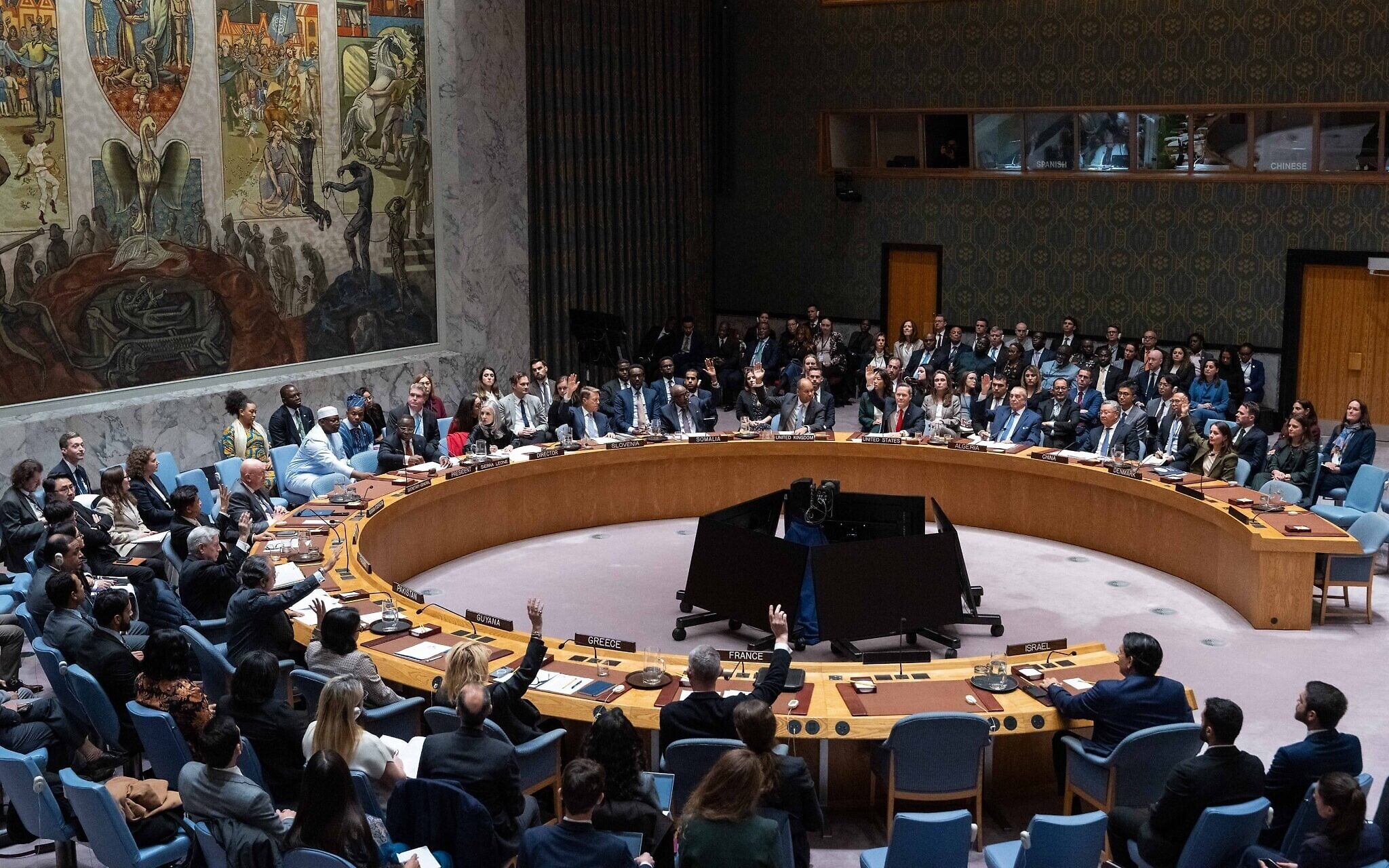
Members of the UN Security Council raise their hands to vote in favor of a draft resolution to authorize an International Stabilization Force in Gaza, on November 17, 2025 at UN headquarters in New York City. (Adam Gray/Getty Images/AFP)
And even if the ISF forms, analysts have questioned whether it would be willing or able to forcibly dismantle Hamas’s military infrastructure — a task Israel increasingly suggests could take years. A senior Israeli official said last week that while the IDF could deprive Hamas of its weapons, the process would be lengthy.
“We really don’t know what’s going on in [the Hamas-controlled section] of Gaza,” Hillel Frisch, professor emeritus at Bar-Ilan University and former senior researcher at the Begin-Sadat Center for Strategic Studies, said.
“We have to assume that what is happening there is very similar to what happened in Gaza for the last [two decades] or even before that,” he said, referring to Hamas’s rule in the Strip since it seized power in 2007 — years in which the group developed extensive terror infrastructure, including its vast tunnel network, and steadily built up its weapons arsenal ahead of the shock October 7, 2023, attack.
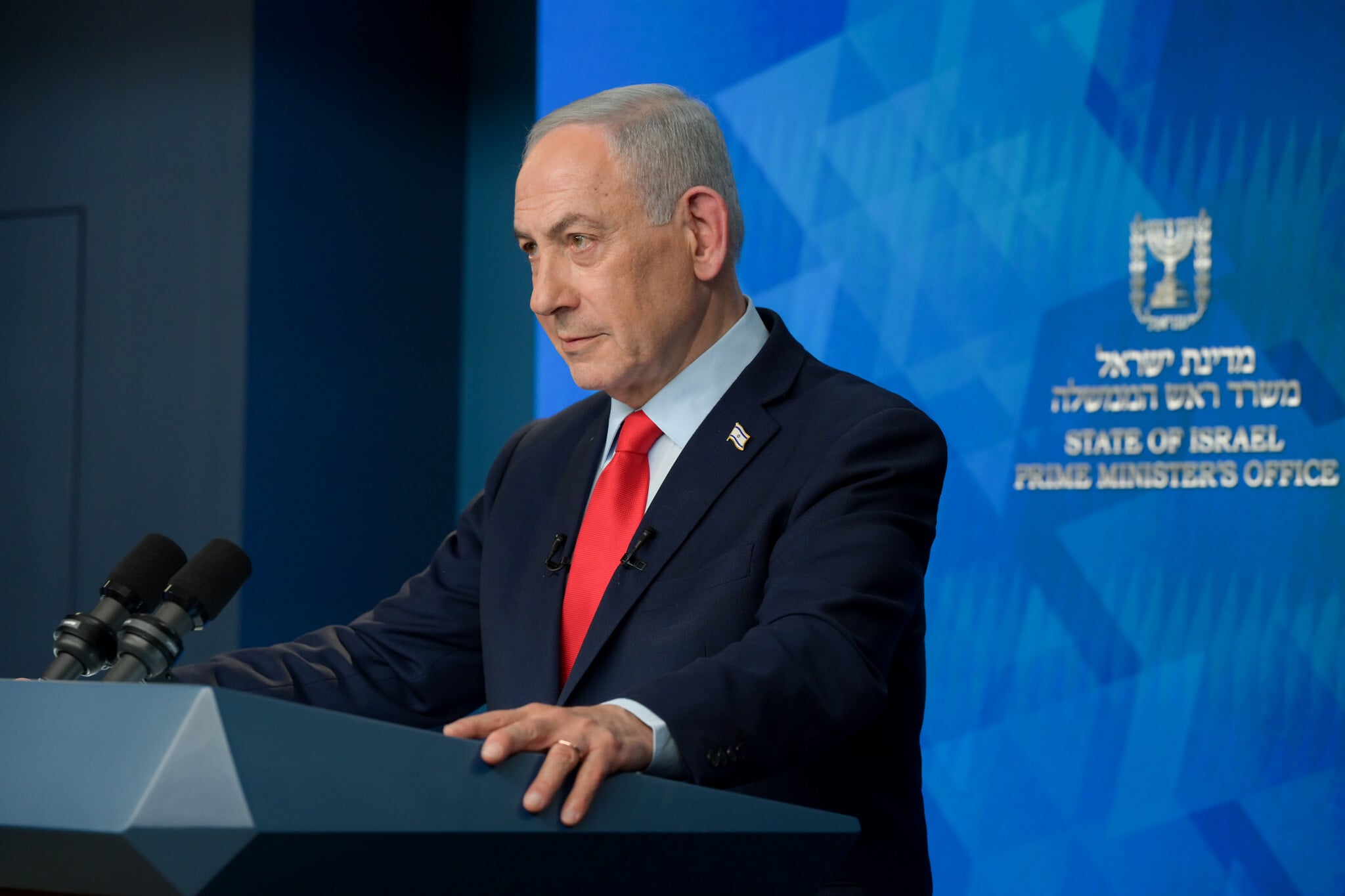
Prime Minister Benjamin Netanyahu holds a press conference in Jerusalem on January 27, 2026. (Maayan Toaf/GPO)
That possibility underscores why Israel remains unwilling to retreat further without clear evidence of Hamas’s disarmament.
At a press conference following Gvili’s return last week, Prime Minister Benjamin Netanyahu insisted Israel was “focusing on completing the two remaining missions: dismantling Hamas’s weapons and demilitarizing Gaza of arms and tunnels.”
Israel will maintain security control “from the Jordan River to the sea,” including in Gaza, he added, making clear that withdrawal, in Israel’s view, cannot proceed in parallel with Hamas’s continued rule.
‘New border’
Even with fighting officially halted, the ceasefire boundary has become a frequent source of friction. Alleged violations are reported almost daily, as Israeli forces target armed suspects — and at times unarmed civilians — who cross into Israeli-controlled areas.
Israeli strikes over the weekend reportedly killed 32 Gazans, with the army saying the attacks were in response to a ceasefire violation in which Hamas gunmen emerged from a tunnel in the southern Gazan city of Rafah, which is outside the Yellow Line.
At the same time, Israel has been accused of quietly shifting the line deeper into Hamas-controlled territory by moving the concrete barriers that mark it — allegations the IDF denies.
The evolving reality along the line has brought renewed attention to what its future may be — whether it is merely a temporary ceasefire marker or a more lasting military boundary.
During a visit to the Strip in December, IDF Chief of Staff Lt. Gen. Eyal Zamir appeared to signal the latter.
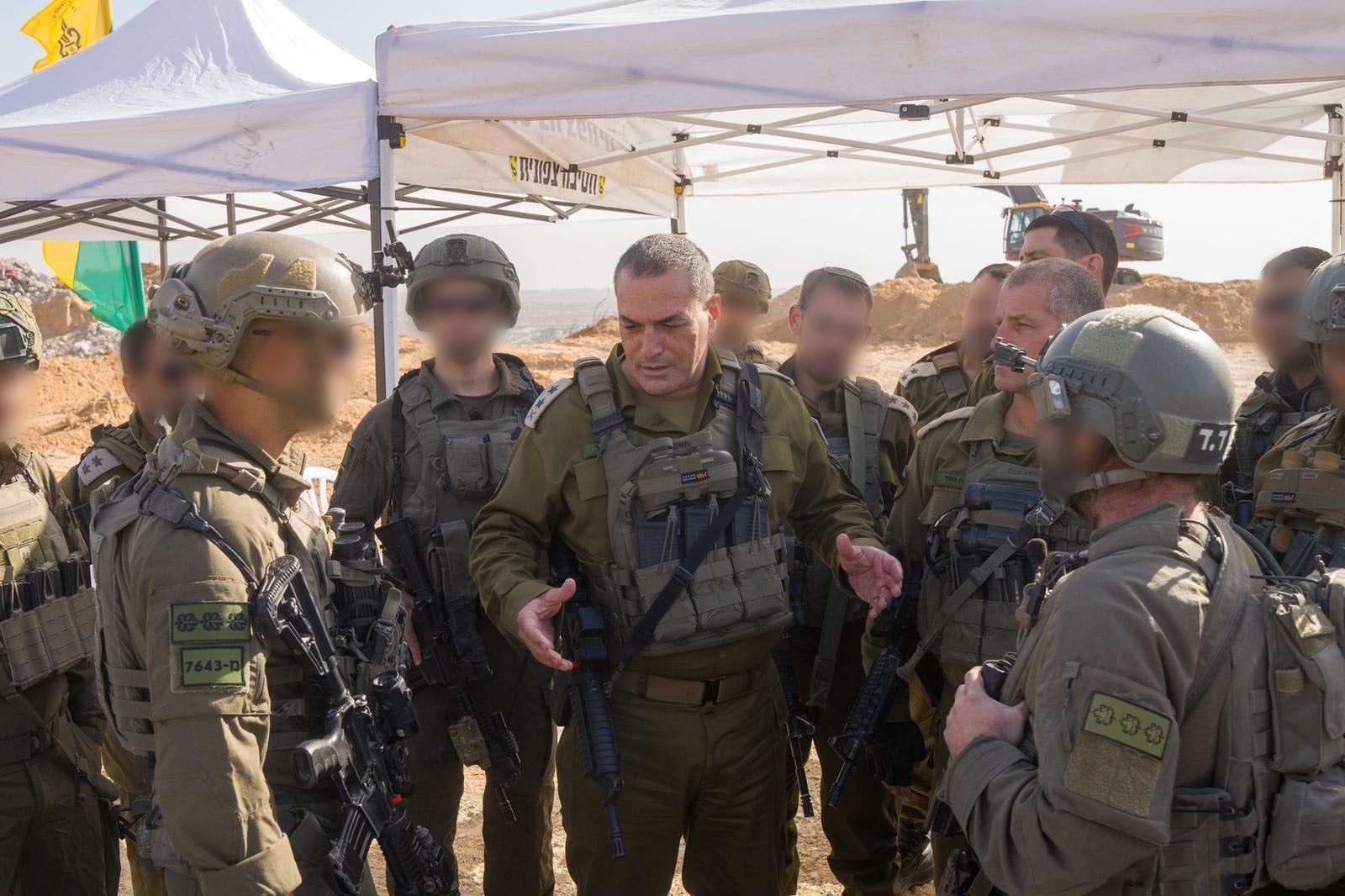
IDF Chief of Staff Lt. Gen. Eyal Zamir (unblurred) speaks to troops in the Gaza Strip, December 7, 2025. (Israel Defense Forces)
“We will not allow Hamas to reestablish itself. We control large parts of the Gaza Strip and stand along [strategic] lines,” Zamir said during a tour of Beit Hanoun and Jabalia.
“The Yellow Line is a new border line, a forward defensive line for the communities and an offensive line,” he added.
Coloring inside the lines
Miller-Katav said the debate over the Yellow Line reflects a broader historical pattern: interim security lines can take on political weight when the conditions meant to dissolve them fail to materialize.
Israel has seen temporary demarcations endure before. The Green Line, drawn as a 1949 armistice line and never intended as a permanent border, became the default framework for Israel’s engagement with territory beyond it when no final settlement emerged.
But the Yellow Line differs from the Green Line in key ways. The latter represents the rough contour of a future border but as of now in practice is often rendered invisible by Israel’s presence on both sides of it.
“We were on both sides of the Green Line [in 1967]. This is not true of the Yellow Line today,” said Frisch.

An illustrative photo of an IDF guard post in the West Bank. (Matanya Tausig/Flash90)
Rather than mark a political or administrative division, the Yellow Line is an actual deployment boundary deep inside non-Israeli territory, beyond which lies an armed hostile force, making it somewhat more akin to the demarcation between the West Bank’s Area A and the rest of that territory.
While Israel has military control of most of the West Bank, Palestinian population centers are technically under the PA’s security forces and often home to entrenched terror operations, making IDF incursions more fraught.
In Gaza, the Yellow Line separates a Hamas-free and largely depopulated territory where the IDF has free rein on one side, from a densely populated area still under Hamas’s guns on the other; any future Israeli move beyond the line would carry heavy operational and political consequences, according to Frisch.
“The cost of penetrating Gaza is totally different from [the West Bank],” he said.
The cost of holding the line
There are also dangers that come with keeping troops inside Gaza, even if only on the eastern side of the Yellow Line, said Miller-Katav.
“I think the government wishes to withdraw from [the Yellow Line]. No one wants to keep the army staying alert within this territory,” she said.
Marked only by a string of large yellow concrete bollards, on the ground the Yellow Line is unfenced and freely traversable aside from the physical presence of troops. Friction along the seam is ever-present.
Soldiers have been attacked on multiple occasions and dozens of Gazans have been shot and killed when approaching the line, which in many places cuts through dense urban landscapes, including alongside rubble-strewn residential buildings.
The IDF currently has two divisions deployed to the Strip, amounting to tens of thousands of troops. Should the situation stabilize and soldiers pull back to the buffer zone, the move would reduce the deployment to a single division, as it was pre-October 7, albeit with more personnel.
Aside from keeping troops in relative danger, the extra deployments carry a manpower cost for the already stretched army, which has forced many reservists to put families and careers on hold for extended periods. The toll has gone beyond personal: reservists account for an estimated 20% of Israel’s tech workforce, widely seen as the backbone of the economy, amplifying the broader economic impact of a prolonged deployment.
The financial burden is also significant. According to the Institute for National Security Studies, maintaining a full long-term military occupation of the Gaza Strip would cost an estimated NIS 25 billion ($8.1 billion) annually, though maintaining a deployment along the current lines would presumably cost less.
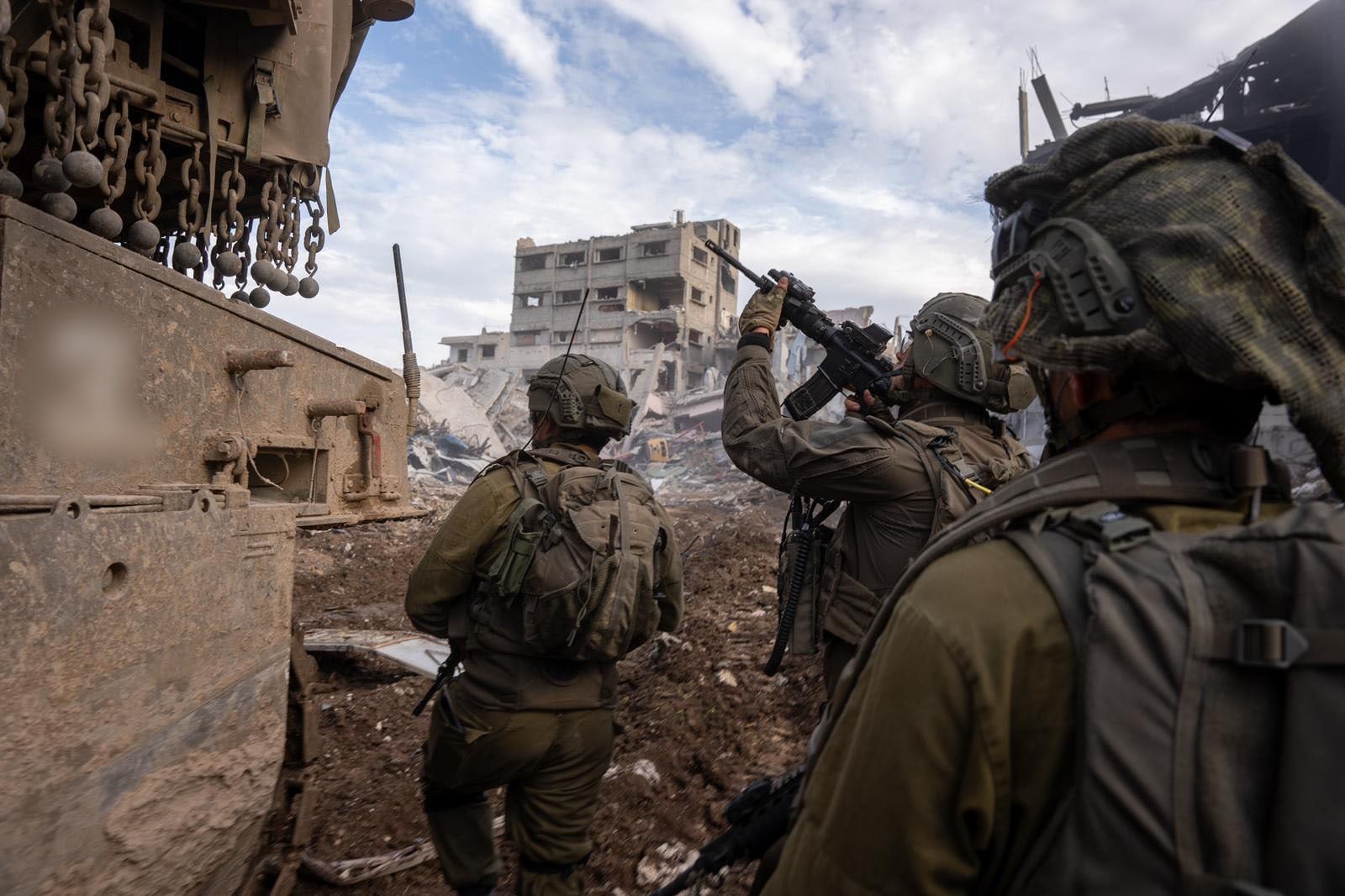
IDF troops operate at a cemetery in Gaza City during a search for the body of Master Sgt. Ran Gvili, in a handout photo issued on January 27, 2026. (Israel Defense Forces)
There is also a human toll. Since troops pulled back to the Yellow Line, four soldiers have been killed in attacks.
Even so, experts cautioned that withdrawal remains unrealistic so long as Hamas remains intact.
“Whatever happened within the Gaza Strip is totally under [Hamas’s] responsibility,” Miller-Katav stressed, referring to the widespread destruction and humanitarian crisis after more than two years of war. “Therefore, leaving it to be rebuilt [by] those who created this situation in the first place is a critical mistake.”
Somewhat paradoxically, though, it seems that any hope of leaving the Strip for good hinges on Israel returning to the whole of the enclave and relaunching the war.
Go big to go home
According to Frisch, the central challenge moving forward is “how to get rid of Hamas.”
Contrary to the US push for a multinational force to ensure Hamas’s disarmament, Frisch argued that the IDF is the only actor capable of carrying out that mission.
“If anyone needs proof of that, you can just [look to] the 12,000-man UN force… in Lebanon since 2006,” he said, in reference to the United Nations Interim Force in Lebanon (UNIFIL), which was tasked with monitoring the ceasefire after the Second Lebanon War and preventing Hezbollah from reestablishing an armed presence near the border.
Instead, Frisch said, the UN force “did nothing. Forty-six countries [contributed to UNIFIL], and it didn’t prevent a movement of one single Hezbollah terrorist.”
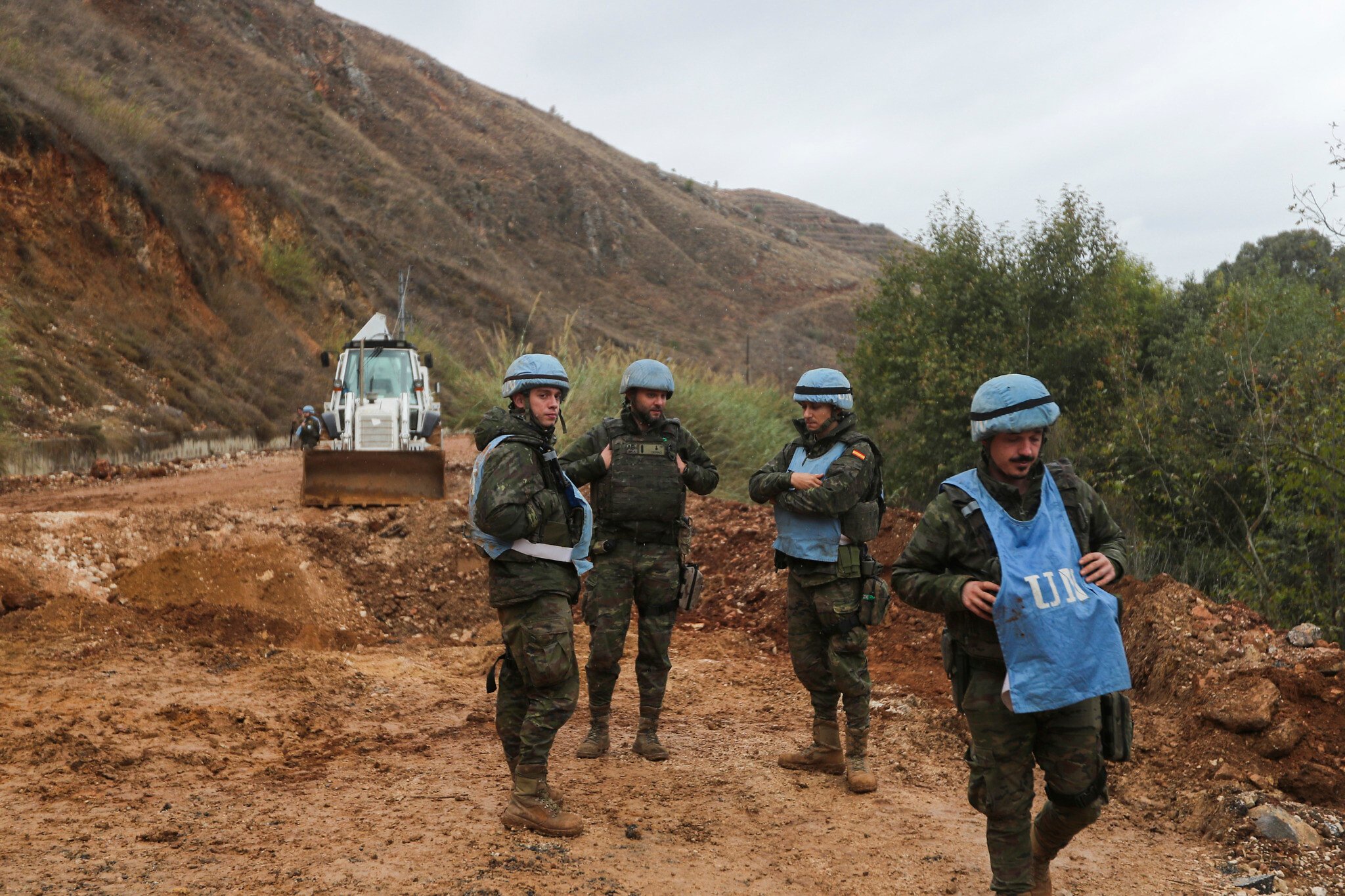
UNIFIL peacekeepers secure the area in Khardali, southern Lebanon, following a ceasefire between Israel and Hezbollah on November 27, 2024. (AP Photo/ Mohammed Zaatari)
Nearly two decades after the Second Lebanon War, Hezbollah remains a central test case for the limits of international monitoring missions. On October 8, 2023, the terror group joined Hamas in launching rocket fire into Israeli territory, triggering the evacuation of some 60,000 residents from northern communities and exposing the extent to which UNIFIL had failed its mission.
Israel launched a 2024 ground operation in southern Lebanon to significantly degrade Hezbollah’s capabilities, and has attempted to avoid repeating history since, keeping troops deployed in limited numbers at strategic points along the border inside Lebanon and continuing to carry out strikes on members of the terror group, which it says is once again working to rehabilitate its military infrastructure and rebuild its strength.
While Israel is seen as the only one capable or willing to disarm Hamas to a level that would pave the way for a full IDF retreat from the territory, Frisch noted that it is constrained by the need for a green light from Trump — a scenario he views as unlikely.
The Soufan Center, a nonprofit think tank, has argued that the administration’s recent push to advance phase two of the Gaza peace plan was intended to “reassure Israel of the US commitment to the plan and pre-empt Israeli consideration of restarting combat against Hamas.”
With Hamas in power and no realistic prospect for removing it to Jerusalem’s satisfaction, Frisch predicted that the Yellow Line would remain a de facto border in Gaza for the foreseeable future.
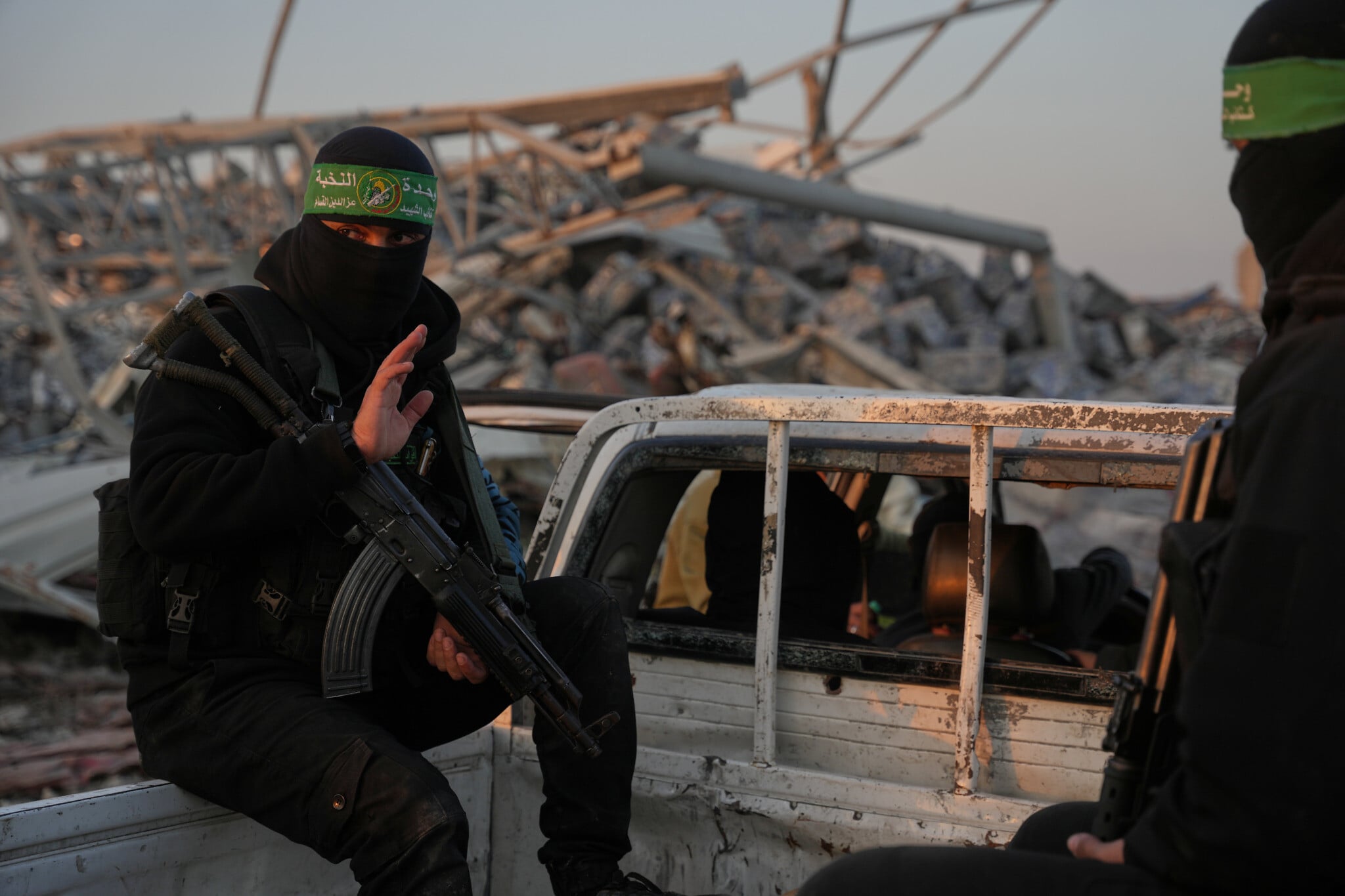
Hamas operatives ostensibly searching for the remains of Israeli hostage Ran Gvili in the Zeitoun neighborhood of Gaza City, January 7, 2026. (AP/Abdel Kareem Hana)
Frisch echoed the point, arguing that Gaza’s future hinges above all on who governs it.
“Gaza has tremendous potential,” he said, “but it all depends on who rules.”