
The rise and fall of Oculus: How Meta’s VR ambitions once began
What began in 2009 as the hobby project of a 17-year-old developed into the catalyst for a new VR era within a few years. Oculus was more than just a company – it was a symbol of the rebirth of virtual reality. But with Facebook’s entry, there was a break with the community and renowned partners, strategic course changes, and finally the complete withdrawal of all founders. Today, the Oculus brand only exists as part of Meta’s VR gaming division and could soon disappear completely due to the recent cost-saving measures. What remains is a story of innovation, conflict, rapid change, and the failure of a vision.
A Teenager with Foresight
Palmer Luckey was just fifteen years old when he first became involved with VR hardware. He analyzed old research reports, military patents, and medical VR systems before buying used technology cheaply on eBay and experimenting himself. At seventeen, he built the first VR prototype, called “PR1” – a heavy, uncomfortable, but functional VR headset. His goal: an affordable, high-performance VR headset for the gaming market.
In early 2012, the time had come: the sixth generation of his prototype, now called “Oculus Rift,” was ready for the public. To this end, Luckey, along with programmer Brendan Iribe, software architect Michael Antonov, and Jack McCauley, who was instrumental in developing the “Guitar Hero” instruments, founded the start-up “Oculus VR.” The hobby project quickly developed into a serious tech start-up. However, the crucial personnel addition came with id Software legend John Carmack.

Meta Quest with controllers.
(Image: Meta)
Oculus Triggers a VR Hype
Carmack was enthusiastic about Luckey’s prototype and presented the device at E3 2012 with a VR version of “Doom 3.” A small hype quickly ignited in the gaming scene, and Oculus used the momentum for a Kickstarter campaign. Valve founder Gabe Newell also publicly recommended supporting the campaign, and so the goal was to raise a total of 250,000 US dollars by August 1, 2012. Within 36 hours, the amount was reached, and in the end, over 2.4 million dollars were raised from around 9,500 supporters. The enthusiasm was immense: finally, VR seemed no longer just a research and tinkering topic, but tangible for consumers. Carmack joined Oculus as Chief Technology Officer in 2013.
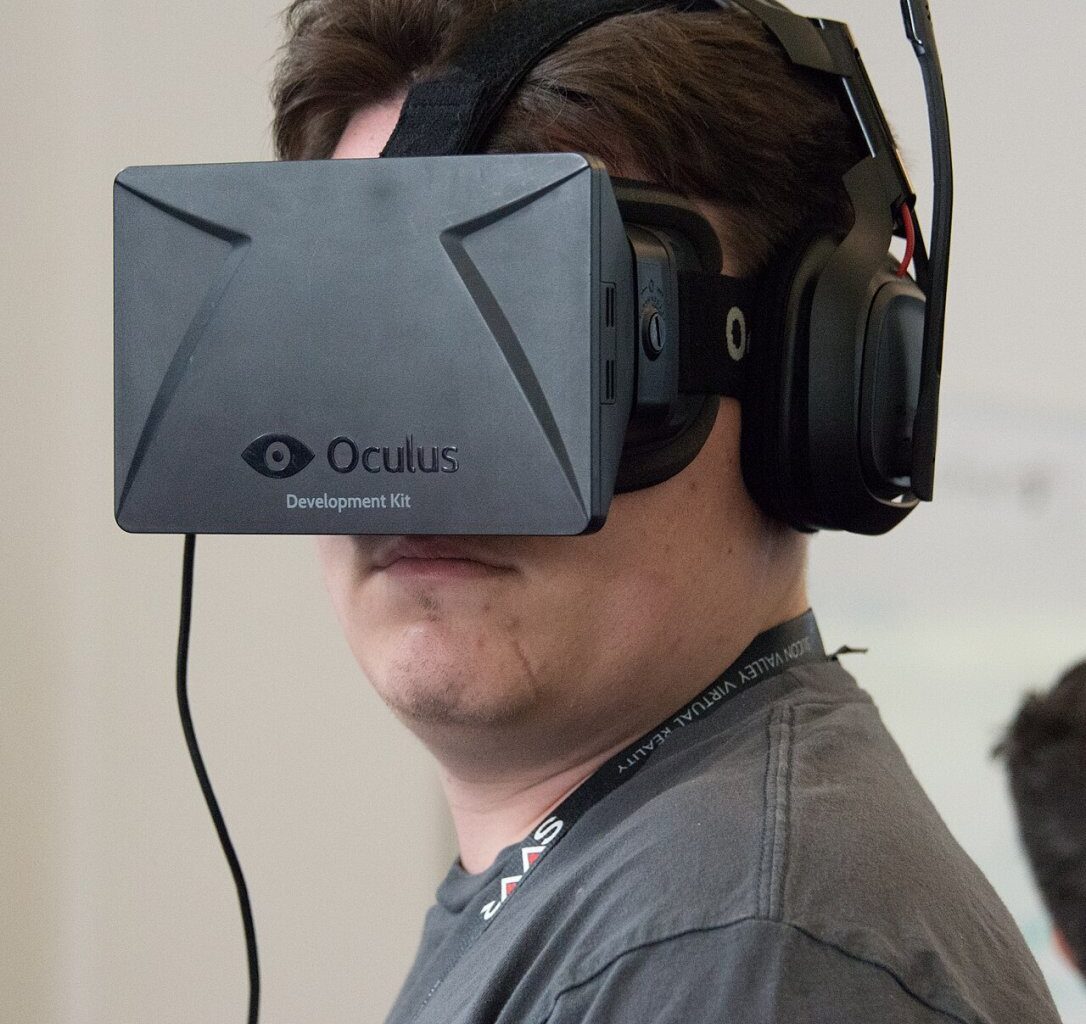
As early as March 2013, Oculus delivered the first Development Kit (DK1), which was still far from the final product but allowed developers to create their own VR games for the first time. Shortly thereafter, a 16-million-dollar financing round followed, and in December 2013, another 75 million were added. The breakthrough was to come with the “Crystal Cove” prototype, presented at CES 2014. It offered room tracking for the first time and a low-latency OLED display. This was crucial for reducing motion sickness, which was a serious problem for many early VR systems. In March 2014, pre-orders for the DK2 began. Oculus partnered with Unity and Epic Games, who provided their engines free of charge to Rift developers. Valve also shared a lot of know-how and personnel with Oculus and believed in a common goal. The VR world was on the verge of a breakthrough.
What’s missing: In the fast-paced world of technology, we often don’t have time to sort through all the news and background information. At the weekend, we want to take this time to follow the side paths away from the current affairs, try out other perspectives and make nuances audible.
Facebook Changes Everything
On March 25, 2014, Facebook announced the acquisition of Oculus for around two billion US dollars, surprising many. Mark Zuckerberg spoke of a coming platform that would enable new forms of communication, education, and collaboration beyond gaming. For the social media billionaire, the dream of his own, self-controlled hardware was finally to come true – his very own iPhone moment. Twelve years later, we know that Zuckerberg’s VR bet has not paid off, despite the name change and billions in investment.
The VR community was immediately divided. Many supporters were emotionally invested in the “Oculus” project. They saw themselves as part of a movement led by a tech prodigy who developed revolutionary technology in his garage – for the community, not for a tech corporation. But reality was different. Oculus had always been a success-oriented company with great potential, which also received funding beyond Kickstarter. An acquisition was therefore only a matter of time.
However, after the start-up, perceived as likeable, became part of an unpopular corporation known primarily for data collection and platform control, many Kickstarter supporters felt betrayed. One of them was Minecraft creator Markus Persson, who immediately ceased his discussions with Oculus about a VR implementation of his successful game. A few months later, however, Microsoft acquired his company, and Minecraft was eventually released for the Oculus Rift in 2016. The acquisition also led to a rift with Valve, which subsequently partnered with HTC and eventually released the Valve Index a few years later.
The First Oculus Rift and the Birth of the Quest
Despite the criticism, product development continued, and thanks to the Facebook billions, it progressed much faster than planned. The first commercial Rift headset (CV1) was released in March 2016 for 599 US dollars. It offered 1080 × 1200 pixels per eye, 90 Hz, 360-degree tracking, and for the first time, the specially developed Touch controllers for VR. In parallel, Oculus worked with Samsung on Gear VR, an affordable mobile solution based on Galaxy smartphones. In 2018, the Oculus Go followed, which worked without a PC or smartphone for the first time, but only supported three degrees of freedom (3DoF).
Palmer Luckey personally handed the first Oculus Rift to the first pre-order customer.
(Image: Palmer Luckey)
A year later, Facebook and Oculus changed course: With the Quest, an autonomous VR headset with 6DoF tracking and inside-out cameras was released for the first time. The connection to an expensive gaming PC was no longer necessary, thus removing another barrier to entry. With the Quest 2, Meta lowered the price to 299 US dollars in 2020 and doubled the performance. The devices sold millions of units, partly thanks to software like “Beat Saber,” which still tops the list of best-selling Quest games of all time.
Quest Becomes a Closed Platform
Since the Facebook acquisition, the platform philosophy has fundamentally changed. From a relatively open developer platform, it became a controlled ecosystem. Facebook increasingly demanded exclusive contracts, closed the store for experimental projects, and from 2020 onwards, linked Oculus devices to Facebook accounts – a move that led to a temporary sales ban of Oculus VR headsets in Germany.
Developers felt excluded, users complained about data protection issues, and sideloading tools like SideQuest emerged to bypass restrictions. Oculus founded its own studios under Facebook and funded exclusive titles. From 2020 onwards, Facebook acquired several well-known development studios, including Beat Games (“Beat Saber”), Ready at Dawn (“Lone Echo”), BigBox VR (“Population: One”), Sanzaru Games (“Asgard’s Wrath”), and Camouflaj (“Iron Man VR”).
Read alsoMehr anzeigenWeniger anzeigen
The goal was a stable pipeline of high-quality, exclusive content for the Quest platform. Over the years, Oculus Studios would produce VR blockbusters like “Asgard’s Wrath 2,” “Batman: Arkham Shadow,” or “Marvel’s Deadpool VR.” Storytelling attempts like the Oculus Story Studio also showed the potential for VR films, but the priority clearly shifted towards games.
The Exodus of the Founders
Between 2015 and 2021, all Oculus co-founders left the company – a gradual process that revealed the growing gap between the original vision and the new corporate reality. Jack McCauley left disillusioned shortly after the Facebook acquisition due to the new corporate structure and changed priorities. Palmer Luckey, the face of the company and inventor of the first prototype, was fired in 2017. The trigger was a political controversy: Luckey had financially supported a pro-Trump group called “Nimble America,” which among other things, spread anti-Clinton memes. The revelation led to massive criticism from the developer community, with some studios threatening to boycott Oculus products.
Facebook distanced itself, Luckey disappeared from public view for a while, and eventually left the company. He himself later spoke of a forced departure. The waters have since calmed, and Luckey is now working with his defense company Anduril again with Meta. Brendan Iribe, CEO and one of the key strategic minds behind Oculus, left the company in 2018. The reason: Facebook had canceled the ambitious Rift-2 project, in which Iribe was heavily involved. The decision signaled a clear shift away from high-end PC VR towards more affordable, standalone devices like the Quest.
For Iribe, who believed in the future of PC-bound virtual reality, this was a break with the original product philosophy. Nate Mitchell, most recently Head of VR Product at Facebook, left in 2021. Iribe and Mitchell are now working together on an AI project. Michael Antonov moved into the biotech industry in 2019. John Carmack, who joined Oculus as CTO in 2013 and lent the company enormous credibility, also reduced his role to an advisory capacity from 2019 onwards. In 2022, he left Meta completely and publicly criticized the company’s inefficiency. In an internal memo, he spoke of “wasted potential” and an organization that was progressing too slowly despite enormous resources.
Rebranding and Metaverse Shift
Without the original minds behind Oculus, Facebook made a radical course change in October 2021: The company renamed itself Meta and declared the “Metaverse” its central future vision. In an elaborately staged keynote, Mark Zuckerberg presented a world full of virtual spaces where people would work, play, and meet. His VR headsets were to be the gateway to this new reality. But most people seemed more confused by Zuckerberg’s visions. The Oculus brand was gradually phased out in the process. Oculus Quest became Meta Quest, the Oculus logo disappeared from the devices, and the standalone Oculus app was integrated into the Meta infrastructure. What had once begun as an independent start-up was now fully integrated into the corporation – not just structurally, but also symbolically.
Mark Zuckerberg did himself no favors with this screenshot from “Horizon Worlds” in 2022.
(Image: Mark Zuckerberg / Meta Platforms)
Zuckerberg’s Metaverse strategy would consume enormous resources. In 2022 alone, Meta invested over 13 billion US dollars in its Reality Labs, the division for VR and AR. But the results fell short of expectations. “Horizon Worlds,” Meta’s social VR platform, has always struggled with low user numbers, technical problems, and an uninviting aesthetic. Critics had already mocked the legless cartoon avatars early on, which were more reminiscent of early Second Life experiments than a revolutionary online platform. Instead of an open, collaborative VR world, a closed platform approach emerged. The original vision of the Oculus founders – open standards, developer freedom, community proximity – was increasingly pushed into the background.
Meta controlled hardware, software, the store, and content. Linking to Facebook and later Meta accounts became mandatory, and data protection concerns mounted. Developers complained about opaque policies and arbitrary rejections in the app store, and the hoped-for industry growth did not materialize, even with improved and affordable devices like the Meta Quest 3 and Quest 3S. Today, Meta is focusing primarily on artificial intelligence and smart glasses, while virtual reality seems to be running in the background.
Oculus once paved the way for virtual reality into the present. Without Luckey’s pioneering work, Carmack’s support, and the enthusiasm of early supporters, many developments in the industry might not exist today. But the story also shows how quickly an ideal can be replaced by corporate logic. The meteoric rise of Oculus is thus also a lesson about the risks of acquisitions in the tech sector and misunderstood and misguided visions. With the enormous cost savings in Meta’s VR gaming division and the closure of numerous studios, it is likely only a matter of time before the last remnant of the once-celebrated start-up disappears from the VR scene.
(joe)
Don’t miss any news – follow us on
Facebook,
LinkedIn or
Mastodon.
This article was originally published in
It was translated with technical assistance and editorially reviewed before publication.
Dieser Link ist leider nicht mehr gültig.
Links zu verschenkten Artikeln werden ungültig,
wenn diese älter als 7 Tage sind oder zu oft aufgerufen wurden.
Sie benötigen ein heise+ Paket, um diesen Artikel zu lesen. Jetzt eine Woche unverbindlich testen – ohne Verpflichtung!