
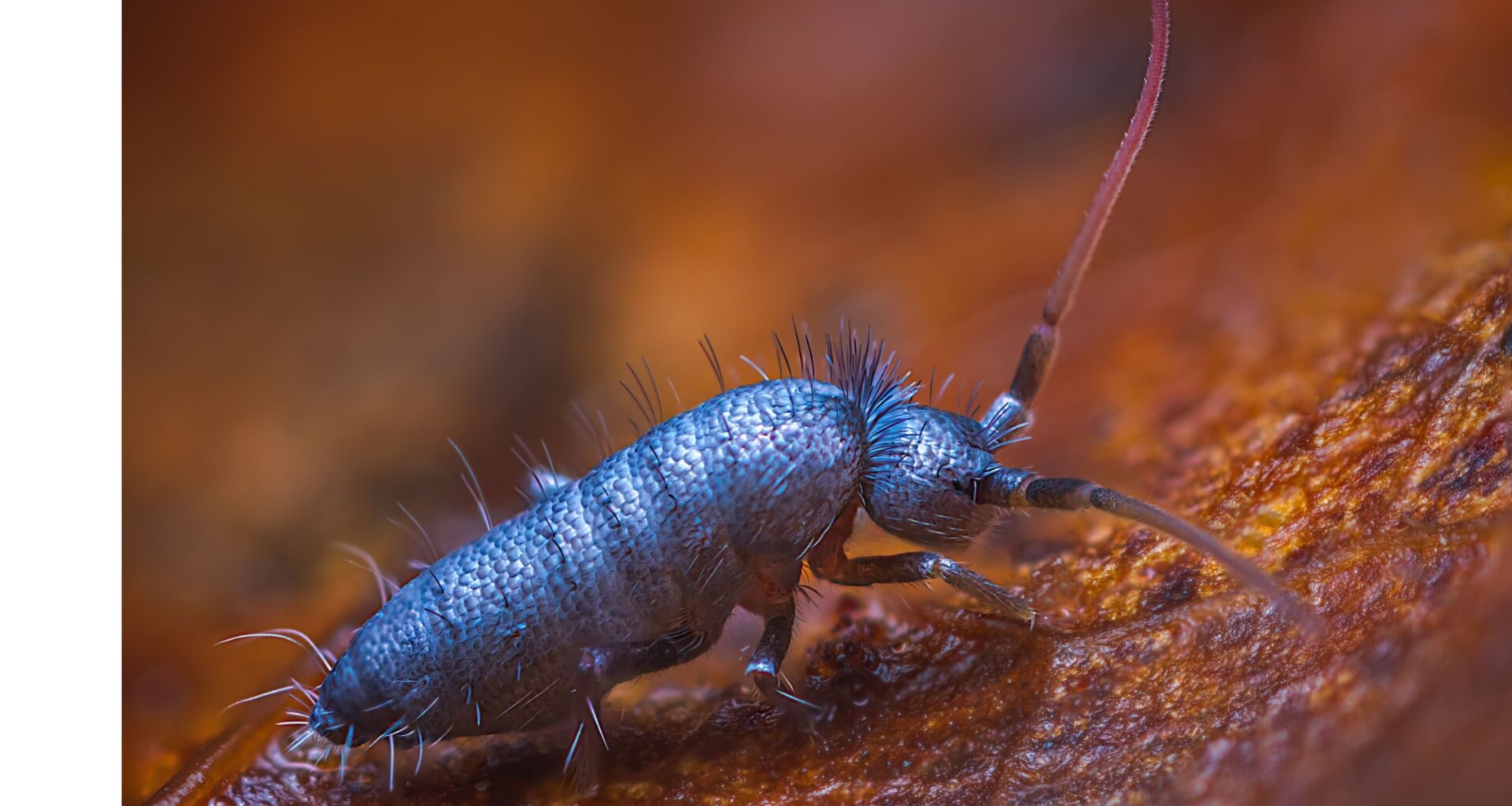
Scientists have documented four previously unknown species of tiny, insect-like springtails in China. Each one is smaller than a grain of rice and lives almost entirely out of sight.
Known as springtails, these animals inhabit the thin layer of decaying leaves and soil that carpets forest floors, where they quietly help break down organic matter.

The finding redraws a small but meaningful part of China’s biological map, revealing diversity that had remained invisible beneath forest floors.
Springtails found in leaf litter
The evidence emerged from leaf litter in Yintiaoling National Nature Reserve (YNNR), a remote, mountainous, forested area in southwestern China. The new, soil-dwelling springtails revealed traits never before recorded in the country.
Careful documentation by Xiaowei Qian at Nantong University (NTU) tied all those specimens to the genus Lepidosira. Their identity was confirmed through direct comparison with known species.
The record extends a genus once thought absent from mainland China and places these animals within a broader, global pattern of distribution.
That geographic expansion sets clear limits on what was previously assumed and opens the door to deeper questions about how many similar organisms remain unrecognized.
Why springtails matter
Most springtails spend their lives hiding away under leaves. Biologists group them into the class Collembola, tiny soil arthropods that are closely related to insects.
By grazing on fungi and microbes, springtails speed plant litter breakdown and help soil particles clump into stable crumbs.
Their waste and movement also feed bacteria and open tiny pores, which can change how water and nutrients flow around the forest floor.
When a new springtail genus turns up, ecologists gain a clearer tool for judging how a forest floor responds to stress.
Where the springtail genus fits
Until now, Lepidosira looked like a genus with most of its members far from mainland China.
A global checklist tracks 57 described Lepidosira species, and roughly 9,600 springtail species overall.
Most known species live in Oceania, with smaller clusters reported from places such as Indonesia, Japan, and Vietnam.
Adding China to that map forces taxonomists to rethink how the genus spread and where future surveys should look.
Two ways to spot springtail species
Microscope work showed tiny differences in the arrangement of scales and bristles, but the team also needed an answer that numbers could back.
They turned to DNA barcoding, reading a short gene tag for identification, and that approach became standard after early tests.
For these springtails, the team sequenced a mitochondrial gene and stored matching barcodes in GenBank for future comparisons.
That pairing of genes and body traits helped them separate species that looked alike, reducing the odds of false matches.
Color can fool taxonomists
Color often changes with age or environment in springtails, and the team’s paper explains the trap.
Researchers also compared chaetotaxy, the pattern of body bristles, because it stays more constant than pigment in close relatives.
“The original descriptions of many of the early described species do not include body chaetotaxy and were mainly based on their color pattern,” wrote Qian.
When color misleads, genetic tags and bristle maps can prevent a species from being lumped under the wrong name.
Four newcomers in Chongqing
Each new species came from leaf litter in the same reserve, but the microscope showed consistent differences in color patches and bristles.
They introduced four distinct members of the genus, each named for a defining feature or the place it was found.
Adults measured under one-tenth of an inch (2.5 millimeters) long, and each species carried a distinct mix of scales and violet pigment.
Those small differences matter because later surveys can recognize the species quickly, even when rain and light change color.
A name change, two transfers
The discovery also required scientists to clean up how a few related species were labeled in China.
Two springtails that had already been named turned out to belong in the same genus as the newly discovered insects, based on how their bodies were built.
One of those names was already in use elsewhere, so the Chinese species was given a new name to avoid confusion.
These adjustments help scientists avoid mixing up species in databases and field records. This is especially important as new genetic evidence reshapes long-standing classifications.
Springtail key that speeds future work
Beyond naming species, the authors updated an identification tool that many field workers rely on when they sort springtails.
Their revised identification key, a step-by-step guide for telling groups apart, focuses on springtails that carry body scales.
That matters in Entomobryinae, a large subgroup within the springtail family, where scales and bristles help sort genera.
With a cleaner key, later teams can flag unusual specimens faster, then decide which ones merit further DNA work.
Springtails from leaf litter to databases
Back in NTU labs, the team preserved springtail specimens on slides and stored reference material so others can recheck every claim.
They also uploaded the DNA barcode sequences to GenBank, a public genetic database that allows scientists worldwide to compare new samples against verified records.
That shared record matters when two species look alike, because a matched sequence can confirm identity without shipping specimens overseas.
The National Natural Science Foundation of China and NTU’s Large Instruments Open Foundation supported the work, but many regions still lack taxonomists.
Soil life still surprises
By pairing genetics with close observation, the team expanded China’s springtail list and sharpened tools that others can reuse.
More surveys in overlooked forest litter could reveal even more tiny animals, but attributing an identification and name depends on long, patient sorting.
The study is published in Deutsche Entomologische Zeitschrift.
—–
Like what you read? Subscribe to our newsletter for engaging articles, exclusive content, and the latest updates.
Check us out on EarthSnap, a free app brought to you by Eric Ralls and Earth.com.
—–