
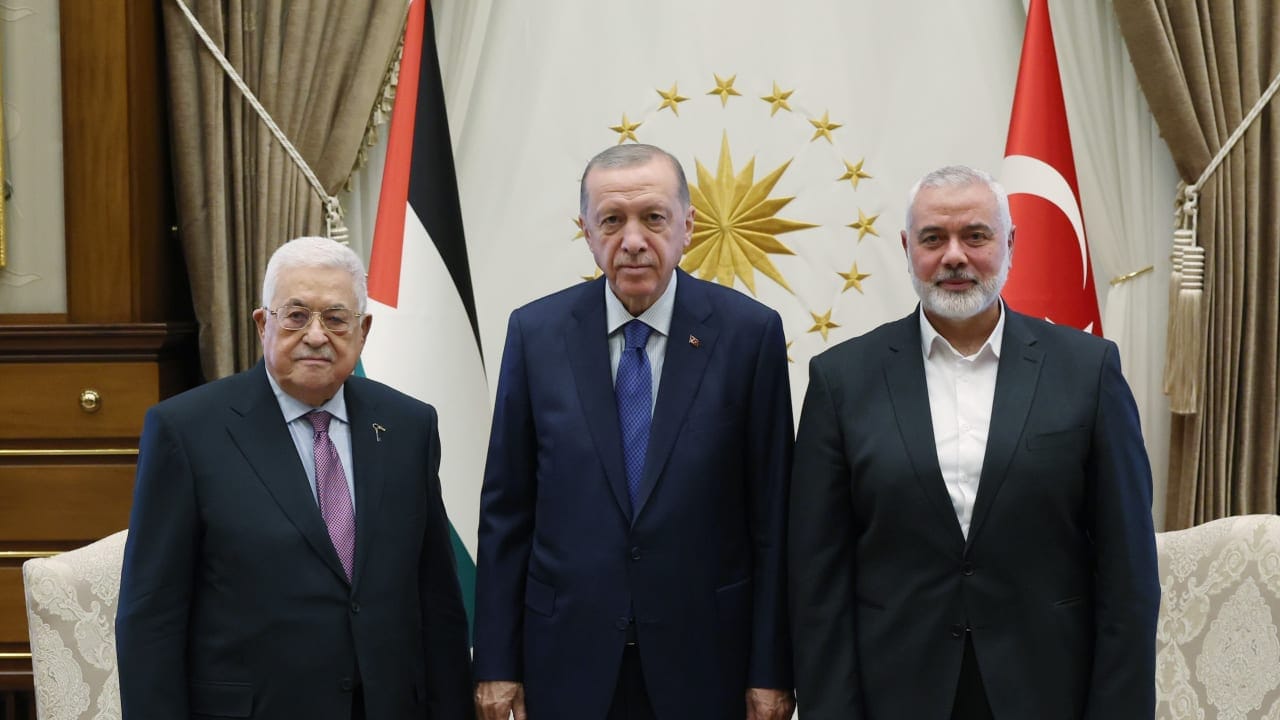
As Israel continues to firmly oppose Turkish involvement in the administration and reconstruction of Gaza, and amid US President Donald Trump’s declaration that he intends to soon announce a deadline for Hamas to disarm, a coordinated diplomatic initiative has been taking shape behind the scenes in recent weeks.
The emerging move points to a substantial deepening of Turkish involvement in the Palestinian arena and is advancing in clear opposition to Israel’s stated position, rejects any political legitimacy for Hamas, and any role for the organization in a future arrangement.
The first phase of this initiative was revealed through official publications from Ankara. On January 25 and 26, meetings took place between Turkey’s foreign minister and deputy foreign minister and senior members of Hamas’s leadership, including the head of the organization’s Shura Council and members of its political bureau.
These meetings, reported by the Turkish Foreign Ministry itself, are not regarded as routine diplomatic engagements, but rather as a deliberate expression of Ankara’s policy toward Hamas, even after the events of October 7 and amid the ongoing fighting in Gaza.
Shortly afterward, on February 6, the Turkish consulate in Jerusalem began publicizing a series of intensive meetings with senior officials of the Palestinian Authority. These included meetings with the PA’s vice president, senior Fatah figures, and officials directly involved in discussions concerning the “day after” in Gaza.

According to statements issued by the consulate and the Turkish Foreign Ministry, the talks addressed “intra-Palestinian reconciliation,” “the next stage of the political process,” and “comprehensive political arrangements.”
Ankara works to integrate Hamas into Gaza plans
When viewed together, however, the combination of overt meetings with Hamas’s leadership and the sustained series of contacts with the Palestinian Authority reveals a broader and more coherent picture.
An examination of the sequence of events and official statements indicates that Turkey is working to advance a framework in which Hamas would be recognized and integrated into any future Palestinian arrangement, both on the political level and within governing mechanisms, including in Gaza.
Within this context, the Turkish consul general in Jerusalem appears to be operating as part of a coordinated diplomatic effort aimed at applying sustained pressure on the Palestinian Authority’s leadership to accept Hamas as a legitimate partner in any unified Palestinian structure.
This pressure is conveyed through repeated references to “national unity,” “intra-Palestinian reconciliation,” and “reconstruction of Gaza,” terminology that obscures the fact that Hamas remains an active terrorist organization that has not abandoned its violent path.
This Turkish initiative does not exist in a vacuum. Ankara is seeking to position itself as a central actor in the Palestinian arena, in line with a neo-Ottoman worldview that identifies Jerusalem as a key strategic hub of influence.
In practice, the Turkish consulate in the city is functioning not only as a consular mission but as an active political arm, creating a diplomatic channel that bypasses Israel, from within Jerusalem itself.
From Israel’s perspective, this development is particularly alarming. Any incorporation of Hamas into a future framework for Gaza or the Palestinian Authority contradicts Israel’s official position, which denies legitimacy to a terrorist organization responsible for massacres, kidnappings, and sustained rocket fire at Israeli civilians.
The fact that Turkey is advancing such a policy from within Jerusalem highlights both the depth of its involvement and the growing gap between Ankara’s approach and Israel’s security interests.
Ran Yishai, head of the research department at the Jerusalem Center for Applied Policy, warns that “this is a move of diplomatic subversion and a grave risk to Israel.
Turkey is acting openly vis-à-vis Hamas’s leadership and exploiting its presence in Jerusalem to pressure for the integration of a murderous terrorist organization into any future arrangement. This is not diplomacy, but hostile interference aimed at preserving Hamas and the threat to Israel.”
According to him, “the obvious Israeli conclusion is clear, there is no place for a Turkish consulate in Jerusalem in its current format.”
Alongside the diplomatic track, a troubling security dimension emerged this week. Official publications by the Israel Police, which included video documentation of weapons seized from a terror cell in Jerusalem, showed firearms bearing manufacturer markings and identifying serial numbers.
An open-source review of the data visible in the images indicates that the weapons originated in Turkey.
This finding, based on the police’s own publications, adds a disturbing layer to Ankara’s diplomatic activity and sharpens the broader picture. While political pressure is being applied to integrate Hamas into Palestinian governing mechanisms, weapons manufactured in Turkey are ultimately appearing in terror arenas in Jerusalem.
Firearms of the type and origin documented in the police materials are not legally marketed in Israel and do not reach the local civilian market. Based on market data and professional assessment, it can be reasonably concluded that these weapons were smuggled into Israel rather than acquired through legal channels.
Yishai, who previously served as director general of the Ministry of Jerusalem Affairs and as an ambassador in the Foreign Ministry, concludes: “The accumulation of data, both diplomatic and security-related, requires a renewed examination of the activity of the Turkish consulate in Jerusalem and its actual role, not only as a diplomatic mission, but as an active political player shaping reality on the ground, to Israel’s detriment.”