
For the last three years, discussions around artificial intelligence (AI) chips have mainly revolved around Nvidia (NASDAQ: NVDA). Nvidia’s Hopper, Blackwell, and upcoming Rubin graphics processing unit (GPU) architectures serve as a core hardware foundation on which generative AI applications are designed.
But over the last several months, another semiconductor stock has come into focus. Let’s dig into why Wall Street’s new favorite AI chip stock is Micron Technology (NASDAQ: MU), and explore why the company could be following in Nvidia’s footsteps.
Will AI create the world’s first trillionaire? Our team just released a report on the one little-known company, called an “Indispensable Monopoly” providing the critical technology Nvidia and Intel both need. Continue »
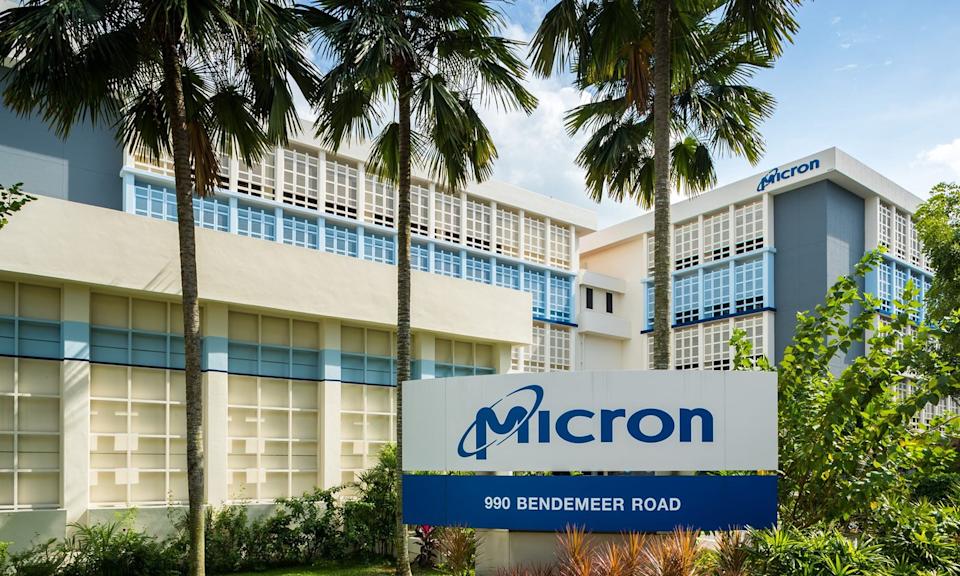 Image source: Micron Technology.
There are several layers to the AI chip value chain. GPUs from Nvidia and Advanced Micro Devices are general-purpose, versatile pieces of hardware. They are capable of processing large datasets at high speeds, making AI application development more efficient.
On the other hand, Broadcom specializes in custom application-specific integrated circuits (ASICs). Custom silicon is currently leveraged by hyperscalers such as Alphabet and Meta Platforms for specific workloads across deep learning or specialized inference needs.
According to Bloomberg Intelligence, the total addressable market (TAM) for AI accelerators is expected to grow at a 16% compound annual growth rate (CAGR) through 2033, reaching a size of $604 billion. These trends serve as a powerful secular tailwind for Micron.
As AI workloads scale and become more complex, an adjacent pocket of the chip realm that expands alongside GPUs and ASICs is memory and storage. Micron is a dominant player in high-bandwidth memory (HBM), dynamic random access memory (DRAM), and NAND chips.
In 2025, Micron’s TAM was estimated to be just $35 billion. However, the company’s management is forecasting the memory market to grow to $100 billion by 2028.
The subtle takeaway here is that demand for memory chips is accelerating at a much faster pace than the GPU market — suggesting that Micron’s chip solutions are poised for explosive growth in the coming years.
The primary reason memory and storage chips have become so expensive is due to rising capital expenditure (capex) budgets from the hyperscalers. Just this year alone, big tech is expected to spend more than $500 billion on AI infrastructure.
These spending patterns have fueled massive shortages in HBM solutions specifically. Industry research from TrendForce suggests that prices for DRAM and NAND chips could soar by as much as 60% and 38%, respectively, in the first quarter alone.
Story Continues
Over the last year, shares of Micron have gone parabolic, rising 348%. Given that level of momentum, some may think it’s too late to buy the newest chip darling. Smart investors understand that looking at a stock price in isolation reveals little when it comes to valuation, though.
 MU PE Ratio (Forward) data by YCharts.
Currently, Micron trades at a forward price-to-earnings (P/E) multiple of 12. As the chart above illustrates, Micron trades at a steep discount compared to other leaders in the AI chip market.
Given the strong tailwinds fueling a multi-year supercycle for HBM chips, in combination with an attractive valuation profile, I see Micron stock as a no-brainer.
While it may not experience a run-up like Nvidia’s, I do think Micron’s critical role in the memory market parallels that of Nvidia’s early days in the AI revolution. For this reason, I think Micron could reasonably be seen as a “new Nvidia.”
Before you buy stock in Micron Technology, consider this:
The Motley Fool Stock Advisor analyst team just identified what they believe are the 10 best stocks for investors to buy now… and Micron Technology wasn’t one of them. The 10 stocks that made the cut could produce monster returns in the coming years.
Consider when Netflix made this list on December 17, 2004… if you invested $1,000 at the time of our recommendation, you’d have $443,299!* Or when Nvidia made this list on April 15, 2005… if you invested $1,000 at the time of our recommendation, you’d have $1,136,601!*
Now, it’s worth noting Stock Advisor’s total average return is 914% — a market-crushing outperformance compared to 195% for the S&P 500. Don’t miss the latest top 10 list, available with Stock Advisor, and join an investing community built by individual investors for individual investors.
*Stock Advisor returns as of February 8, 2026.
Adam Spatacco has positions in Alphabet, Meta Platforms, and Nvidia. The Motley Fool has positions in and recommends Advanced Micro Devices, Alphabet, Meta Platforms, Micron Technology, Nvidia, and Taiwan Semiconductor Manufacturing. The Motley Fool recommends Broadcom. The Motley Fool has a disclosure policy.
Is Micron the New Nvidia? was originally published by The Motley Fool