
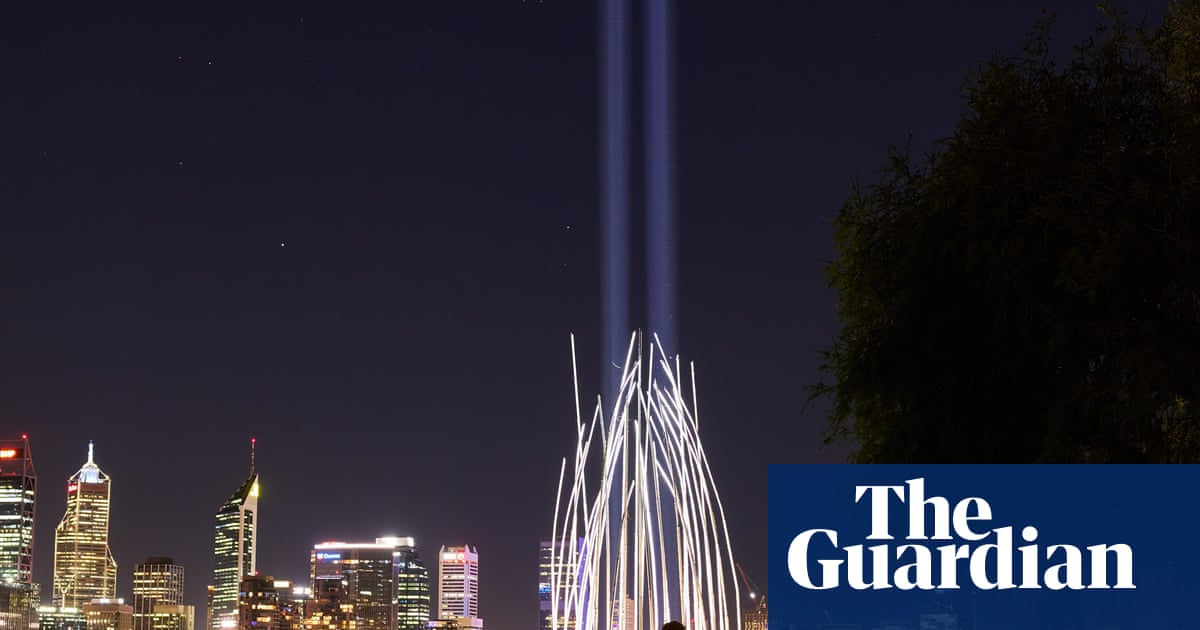
As families gather for sunset at Perth’s Kings Park, a giant golden orb glows on the horizon, shooting ribbons of light into the night sky.
“It looks like an upside down jellyfish!” a child shouts gleefully, gazing up at this mysterious beacon. Others watch from park benches or drift slowly around its base, as a gentle wash of sound spills from its centre.
The work is called Karla Bidi, translating to “fire trail” in Noongar: a light and sound installation that draws on the ancient practice of lighting campfires along the Derbarl Yerrigan (Swan River), which marks the opening of this year’s Perth festival.
Featuring 11 installations stretching from Mandoon (Guildford) to Walyalup (Fremantle), Karla Bidi lights a path between communities along the river – a trail of gathering places that recalls how these banks have always been a place for story and connection.
The installation features a 15-minute looped track, written and performed in Noongar by McGuire and Wilkes. “The sky is bleeding,” it says. “We can no longer see the stories the stars tell us.” The lyrics move from loss toward something enduring: “Today many stars shine bright, not just in the sky but all of us are made up of stars.”
In the wake of the alleged terror attack at an Invasion Day rally in Perth last month, the work’s message feels particularly poignant.
“From a bird’s eye view, you see these symbolic fires all along the river,” says artist Ilona McGuire, who developed the work alongside Jacob Nash, Chloe Ogilvie and Ian Wilkes. “It’s a symbol of belonging.”
‘It’s a symbol of belonging’: one of 11 light installations that stretch along Derbarl Yerrigan/Swan River as part of Perth festival. Photograph: Jessica Wyld
Karla Bidi sets the tone for artistic director Anna Reece’s second program for Perth festival, which is now in its seventh decade as Australia’s longest-running arts festival. This year it keeps returning to the Derbarl Yerrigan, the river that runs through the city’s daily life and its oldest stories.
Across the festival, works unfold at the river’s edge – from installations that light its banks to riverside performances at the East Perth power station.
For A View from the Bridge, British artist Joe Bloom turns city bridges into unlikely listening posts. Red telephones appear along the railings; strangers pick up the receiver and find Bloom on the other end of the line, inviting them to talk. Their stories are filmed and later shared with Bloom’s online audience.
Having been staged in London, New York, Zurich and Mexico City, the project feels especially at home in Perth, where 13 bridges connect suburbs, histories and lives on either side of the river.
At Kings Park’s treetop walkway, a short walk from Karla Bidi, Bloom interviewed Dr Richard Walley, a Noongar cultural leader, writer and performer who helped popularise the welcome to country in contemporary Australia, alongside Ernie Dingo.
‘They spoke about us, they spoke to us, they spoke for us. Now we’re speaking for ourselves’: Dr Richard Walley Photograph: Molly Hackney
In a video published on Bloom’s Instagram, Walley speaks of the stolen generations, of his siblings who were taken to missions, and of the deep rupture colonisation inflicted on his people. “They spoke about us, they spoke to us, they spoke for us,” he says. “Now we’re speaking for ourselves.”
Walley’s connection to the river is personal. Later, he recalls an uncle who camped for long periods under the Narrows Bridge in the 70s and 80s. The pull, he says, was intergenerational: nearby was where his ancestor Yellagonga met the colony’s first governor, Capt James Stirling, whose tenure was marked by brutal frontier violence.
“We’ve always been part of the river … swimming in it and fishing from it and telling stories about it,” he says. “The river was drastically altered by colonisation, but it still holds its spirituality.”
‘You really just share a lot, I think subconsciously, because it’s just down a phone line,’ says A View from the Bridge participant Yvonne Armarego. Photograph: Molly Hackney
A little farther upstream on the Boorloo Bridge, Bloom also spoke with Yvonne Armarego, a 35-year-old woman from Burswood. Last year, she and her husband lost their first child, Theo, at four and a half months old. They made the decision to donate his organs, saving two lives. “It’s really nice to know that he’s physically living on somewhere else,” she said. “We’re very proud of Theo and his legacy.”
Just across from Boorloo Bridge is the South Perth foreshore, where Armarego used to take Theo for “a little lap that we call the Theo walk” – a place she plans to take her newborn daughter, Madeline, one day. Armarego said she felt “honoured” to share Theo’s story. Standing on the bridge, she found herself opening up. “You really just share a lot, I think subconsciously, because it’s just down a phone line.”
On the suspension bridge over the Avon River in Northam, around 100km north-east of Perth, Bloom interviewed Jarred Casey, with his daughter Elsie on his shoulders. “My favourite thing about my dad,” Elsie says, “is how he’s so nice, kind and lovable … the one that most loves me.”
Casey tells Bloom he was serving a prison sentence when he learned he was going to be a father, and something shifted. “Then this one come along,” he says of Elsie, and “my whole thinking changed.” Now, nearly five years clean, his focus is simple: “to do the right thing … to show her how to live. Like, to be a good person and be kind.”
Jarred and Elsie Casey. Photograph: Molly Hackney
That is the strange intimacy of Bloom’s project: a voice offered into the distance, and something unguarded emerging in return. Together, the calls form a fragmented portrait of Perth – moments of grief, memory, humour, survival, and a reminder that every passerby carries a story as deep and complex as the water moving beneath them.
Bloom’s A View from a Bridge interviews will be published on Instagram throughout Perth festival, which runs until 1 March. Every night, Karla Bidi will illuminate parklands and picnic areas along the Derbarl Yerrigan