
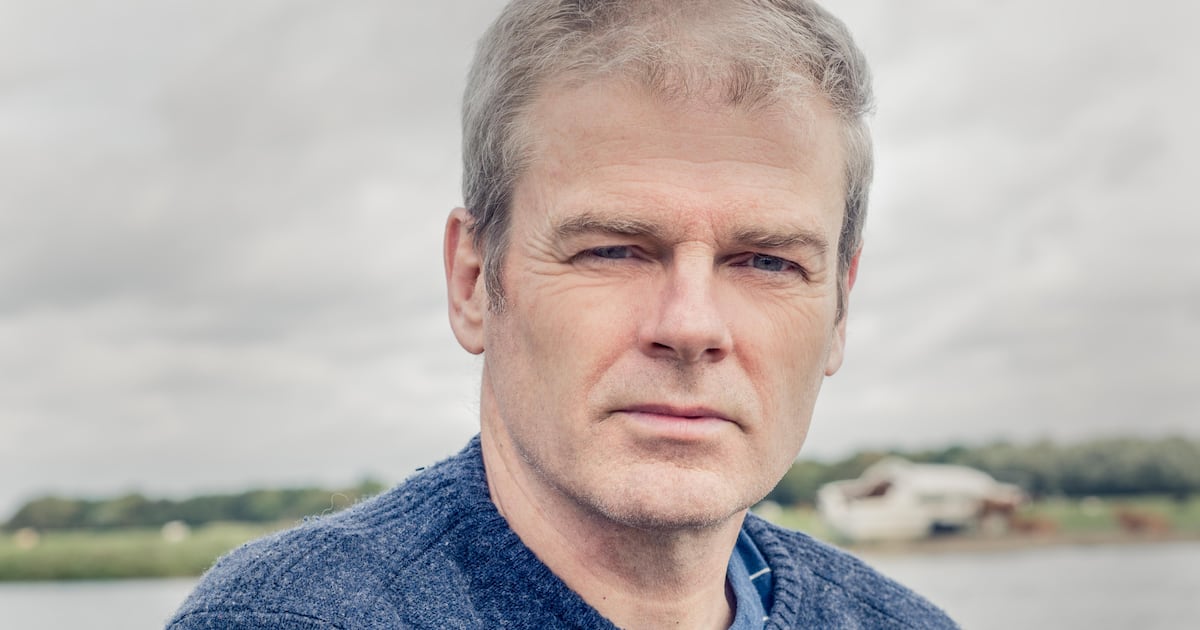
Mark Haddon had emergency root-canal surgery recently, but he’s in loquacious form nevertheless as he talks about his new memoir, Leaving Home.
It’s a book whose design strikes you even before you start reading, as it’s full of photographs and drawings by the English author, who before writing The Curious Incident of the Dog in the Night-Time, his best-known book, worked for years as a illustrator, both for magazines and for his own books for children. It resembles the sort of compendium that people of a certain age will remember from their schooldays.
“It’s a paean to encyclopaedias of my youth,” Haddon says with a laugh, showing no sign of dental distress. “As a kid I wasn’t reading books you’re meant to read as a novelist in training. I was reading big fat encyclopaedias. I still have some of the school prizes I won as a swot in the 1960s, like a history of fossil man and a guide to the universe.”
It “can’t properly be called nostalgia”, he writes on the first page of Leaving Home, “because the last thing I’d want is to return to that age and those places where I was so often profoundly unhappy and from which I’d have been desperate to escape from if escape had been a possibility”.
One of the book’s many photographs shows Haddon’s mother embracing the young boy and his sister, Fiona, but Haddon “had no memory of being hugged by her, no memory of Mum saying she loved us, no memory of her showing us real affection as children”.
He doesn’t harp on about an unhappy childhood: he just presents the evidence as he recalls it. There’s no getting around the fact that his mother was a tricky customer, however. “I’ll take that, yeah,” he says.
An “ardent Brexiteer” who detested the idea of “being connected to France by the Channel Tunnel”, she didn’t read books, didn’t listen to music, ignored her son’s artistic endeavours, regarded his grandparents as common and didn’t visit his sister when she was hospitalised, with meningitis, because “your father has golf in the morning”.
The last words she said to her daughter, according to Haddon, were, “I’ve never believed a word you’ve said.”
[ Mark Haddon: ‘Writer’s block is my default state’Opens in new window ]
You’ll find his account of her very funny in places – but, then again, she wasn’t your mother. “My sister and I survived partly by means of a very dark sense of humour,” Haddon says. You’d have little choice.
“I think she lived most of her life frightened – of change and difference and decay and death,” he says. “When she became ill in later years, it was partly because she had spent her life fleeing from anything that was difficult or challenging, and I think she treated the entire world like that. She really wanted things to stay the same forever. You can’t live like that.”
Haddon writes in Leaving Home: “In truth, I don’t think she wanted children at all, but she had a lifelong fear of being different.”
“Yes, I’m fairly sure,” he says now. “But making the choice to not have children would have made you a pariah in small-town England at the time. Even now people write articles in the Guardian about the difficulty of maintaining that position, but back then it was almost impossible.
“I think what was particularly difficult for her – and this is what made my sister’s position worse than mine – was that there’s a certain generation of women who bought into the patriarchy wholesale. They were going to be mums and housewives, and then they saw their daughters and other young women enjoying freedoms they’d given up.
“I think she was embittered seeing that, but she was not someone who could adapt to a changing world.”
Had she still been alive, would Haddon have told her about turning down an OBE in 2023? “Oh, dear God, no,” he says. “I’d already turned down an invitation for a royal garden party, but I didn’t mention that to her. Just dealing with the aftermath would have been too much hard work.”
He says he had four reasons for turning down the OBE. “Anything that condones the idea of empire, I do not want to touch with a barge pole. Rishi Sunak was prime minster, so I didn’t want anything to do with him. I’m very much a republican: on a bone-deep level, I dislike the idea that one family is seen as superior to others. The fourth thing is that I want to feel free in perpetuity to criticise the establishment when I see fit, and I think one of the unspoken roles of honours is to make you beholden.”
It’s a controlled hallucination: we conjure what we think is out there and adjust as we get new information
— Haddon on consciousness
Given his mother’s emotional remoteness, it’s perhaps no surprise that Haddon grew up with phobias and a certain hypochondria. He thought he had skin cancer at one point and multiple sclerosis at another – then had all health anxiety removed by having his chest opened for a triple heart bypass, after which death was no longer a terrifying prospect.
“There’s nothing like touching the hem of the robe of the grim reaper to realise he’s not all he’s made out to be,” Haddon says, beaming. “Actual death is so much less scary than the fear of death.”
He escaped the reaper’s clutches only to succumb to long Covid, the debilitating effects of which stretched on for years. In 2024, as he recounts in his memoir, he ended up in the emergency department after cutting himself because there was “just too much pressure inside my head”.
“It’s not something that’s happened to me very often,” Haddon says. “I think, for me and for a small number of people, it’s just a case of getting immensely frustrated and angry with what’s going on in your head.”
His account of the incident in Leaving Home is brief and matter-of-fact. “One of the reasons there’s not much context or explanation in there is because I don’t really have much context or explanation myself. If you’re suffering in that complicated, messy mental way, it’s much easier to suffer in a physically painful constraint.”
Some people find solace in faith at difficult times in their lives. But religion, for Haddon, is a “baroque edifice constructed to reassure human beings that they aren’t just animals briefly colonising a lump of rock in the Orion-Cygnus arm of the Milky Way before being utterly and unendingly forgotten”.
At times of pain, however, including when his wife, Sos Eltis, an Oxford academic, was hit by a car while pregnant, did the thought of crying out for divine intervention ever arise?
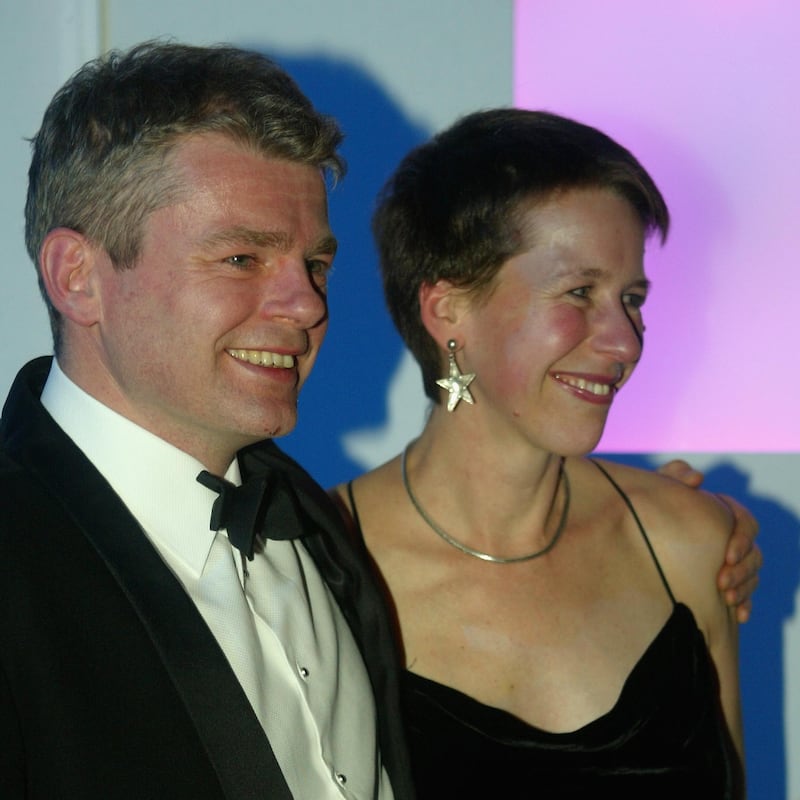 Mark Haddon and his wife, Sos Eltis, after receiving his award for The Curious Incident Of The Dog In The Night-time at the Whitbread Book Awards in 2004. Photograph: Bruno Vincent/Getty
“Actually, it did,” he says of his wife’s accident. “It went briefly through my head but then left, because there was stuff to do. I do remember when I was feeling mentally unwell, at my absolute worst – particularly when I was frightened of dying in the abstract – I thought how good it would be to believe that it was not the end.”
Haddon’s work has been influenced by the notion of the “plausibly hypothetical”, which the critic James Wood identified in Hilary Mantel as a literary mode that enables you to write without necessarily knowing everything about your subject: get a few facts right, then let the writing take over.
He offers his own book The Porpoise, from 2019, some of which takes place in Jacobean London, as an example.
“If you’re writing a novel that’s historical, I’d suggest don’t get bogged down by research, because you’re never going to please the experts,” he says. “What you have to please is the ordinary reader out there, and what they want is not historical accuracy. They want to feel they’re in safe, confident hands.”
You enter another universe, in other words.
“When you lose yourself in a book, there is something profoundly strange and paradoxical happening, which is that you’re fully conscious in that world but totally unconscious in this world,” he says.
“The philosophy of consciousness is the graveyard of many intellectuals, but most psychologists and neuroscientists now talk about us as if we were reading the world around us like a book.
“It’s a controlled hallucination: we conjure what we think is out there and adjust as we get new information. I sometimes think the world is a book, another invented world we’re conscious in, and there’s no ‘real’ world behind it – it’s all hallucination.”
Are we straying towards the simulation hypothesis here, the idea that our reality is merely a computer program on some higher being’s laptop?
“That one drives me up the wall,” Haddon says with a smile. “What’s extraordinary about a novel, or any kind of writing that makes you suspend your disbelief completely, is that it’s still squiggles on the page, little black marks on white paper, and yet we have these intense, vivid experiences.
“The page dissolves, the words disappear, and you’re there, reading but not reading. Some of my most profound artistic experiences are about moving back and forwards across that boundary, leaving my body completely behind.”
Leaving Home: A Memoir in Full Colour is published by Chatto & Windus
Samaritans’ free helpline is at 116-123, or email jo@samaritans.org; Pieta House is at 1800-247247, or text HELP to 51444