
Monday saw the US dollar index (DXY) fall to about 97.5, its second straight session of losses as traders remained cautious ahead of key US
Written by:
Arslan Butt
•
Monday, February 9, 2026
•
2 min read
•
Last updated: Monday, February 9, 2026
Add an article to your Reading List
Register now to be able to add articles to your reading list.
” aria-hidden=”true”>
Quick overview
The US dollar index (DXY) fell to about 97.5, marking its second consecutive session of losses amid uncertainty over delayed economic data.Investors are closely watching upcoming releases of January employment data and consumer price index data, which are crucial for assessing inflation trends and Fed policy direction.Market expectations indicate that the Federal Reserve may keep interest rates steady in March, with potential rate cuts anticipated later in the year.Political drama surrounding the Federal Reserve leadership transition adds to the uncertainty affecting the dollar’s performance.
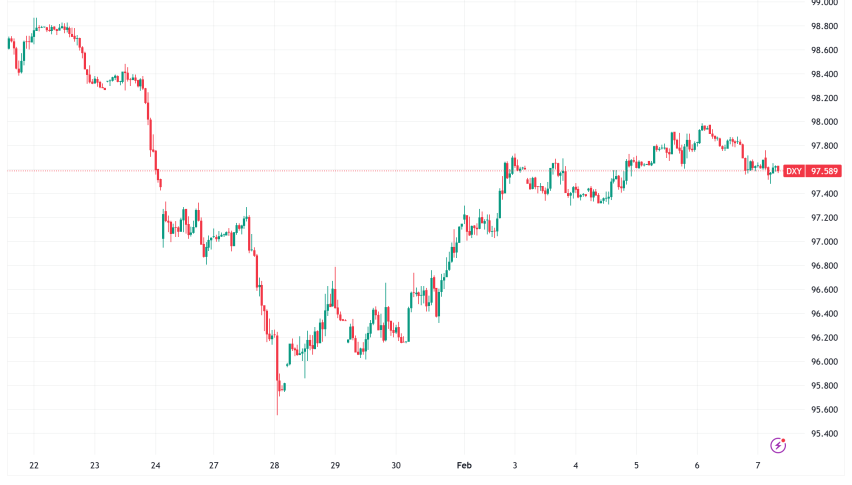
Monday saw the US dollar index (DXY) fall to about 97.5, its second straight session of losses as traders remained cautious ahead of important economic data that were postponed due to the recent partial government shutdown.
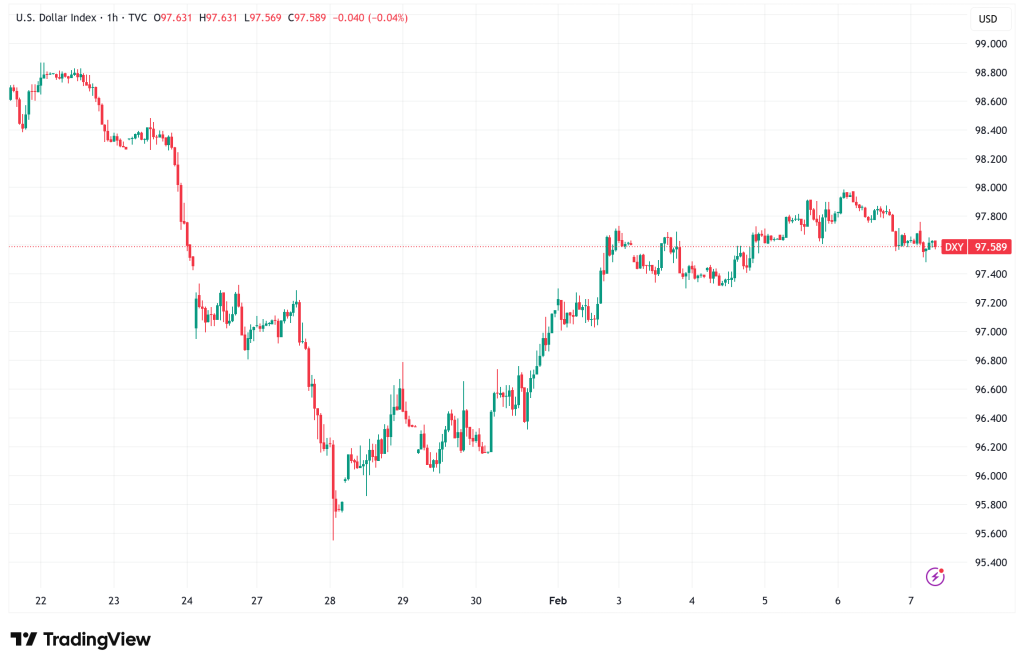 US Dollar Index (DXY) Retreats as Markets Eye Critical Economic Data Amid Fed Uncertainty
The decline in the dollar occurs as markets negotiate a challenging environment of delayed data releases and growing ambiguity over the path of monetary policy and Federal Reserve leadership.
Key US Market Data on the Horizon: Jobs, CPI
Investors are anticipating Wednesday’s release of the January employment data, which has gained increased importance in the wake of recent indications that the labor market is cooling. December retail sales data will accompany the report, which was initially postponed because of the now-completed four-day government shutdown.
The January consumer price index data, which has also been postponed, is scheduled to be released on Friday, adding to the week’s important releases. This reading will offer crucial information about inflation trends that will influence the Fed’s policy direction.
Fed Policy Expectations Shift
With possible rate cuts expected in June and potentially September, current market pricing indicates the Fed will keep interest rates at their current levels when policymakers meet in March. Only 19.9% of traders currently anticipate a rate drop at the March Federal Open Market Committee meeting, down from 23% over the weekend, according to CME FedWatch data.
Mary Daly, the president of the San Francisco Federal Reserve, said Friday that in order to combat labor market weakness, one or two more interest rate reduction might be required. At least two 25 basis point reductions are currently priced in by the markets for 2026.
Federal Reserve Leadership Transition Fuels Uncertainty
The current decline in the dollar is occurring at the same time that the political drama around the change in leadership at the Federal Reserve is getting more intense. The tenure of current Fed Chairman Jerome Powell ends in May 2025, and Senate confirmation of his nominee, Kevin Warsh, is a work in progress.
Despite a stalemate with Republican Senator Thom Tillis, who has vowed to halt the nomination process until the Department of Justice’s investigation into Powell is finished, Treasury Secretary Scott Bessent has called for confirmation hearings to move forward for Warsh. Powell has rejected the accusations as politically motivated, and the investigation, headed by Attorney Jeanine Pirro, focuses on costs associated with a multi-year refurbishment project at Fed office buildings.
Broader Market Risk Sentiment Dynamics
Global markets’ improving risk sentiment has contributed to the dollar’s slide. While cryptocurrencies and precious metals have had notable increases, technology equities have recovered. Silver rose more than 4% after recording gains of almost 10% the day before, while gold jumped past $5,000 an ounce on Monday, continuing its 4% increase from Friday.
In her most recent newsletter, economist Lyn Alden proposed that instead of implementing the extreme quantitative easing that some proponents of Bitcoin had hoped for, the Fed is moving into a “gradual print” mode, growing its balance sheet at a rate that is about in line with nominal GDP growth. “Overall, it means I continue to want to own high-quality scarce assets,” Alden stated.
Following Prime Minister Sanae Takaichi’s coalition’s overwhelming victory in weekend elections, which may open the door for expansionary fiscal policies in Japan, the dollar also fluctuated against the Japanese yen.
All eyes will be on Wednesday’s employment statistics and Friday’s inflation data as the week goes on, as these releases will be crucial in defining the direction of the dollar in the near future and the Federal Reserve’s policy course for the rest of 2026.

Arslan Butt
Lead Markets Analyst – Multi-Asset (FX, Commodities, Crypto)
Arslan Butt serves as the Lead Commodities and Indices Analyst, bringing a wealth of expertise to the field. With an MBA in Behavioral Finance and active progress towards a Ph.D., Arslan possesses a deep understanding of market dynamics.
His professional journey includes a significant role as a senior analyst at a leading brokerage firm, complementing his extensive experience as a market analyst and day trader. Adept in educating others, Arslan has a commendable track record as an instructor and public speaker.
His incisive analyses, particularly within the realms of cryptocurrency and forex markets, are showcased across esteemed financial publications such as ForexCrunch, InsideBitcoins, and EconomyWatch, solidifying his reputation in the financial community.
Related Articles