
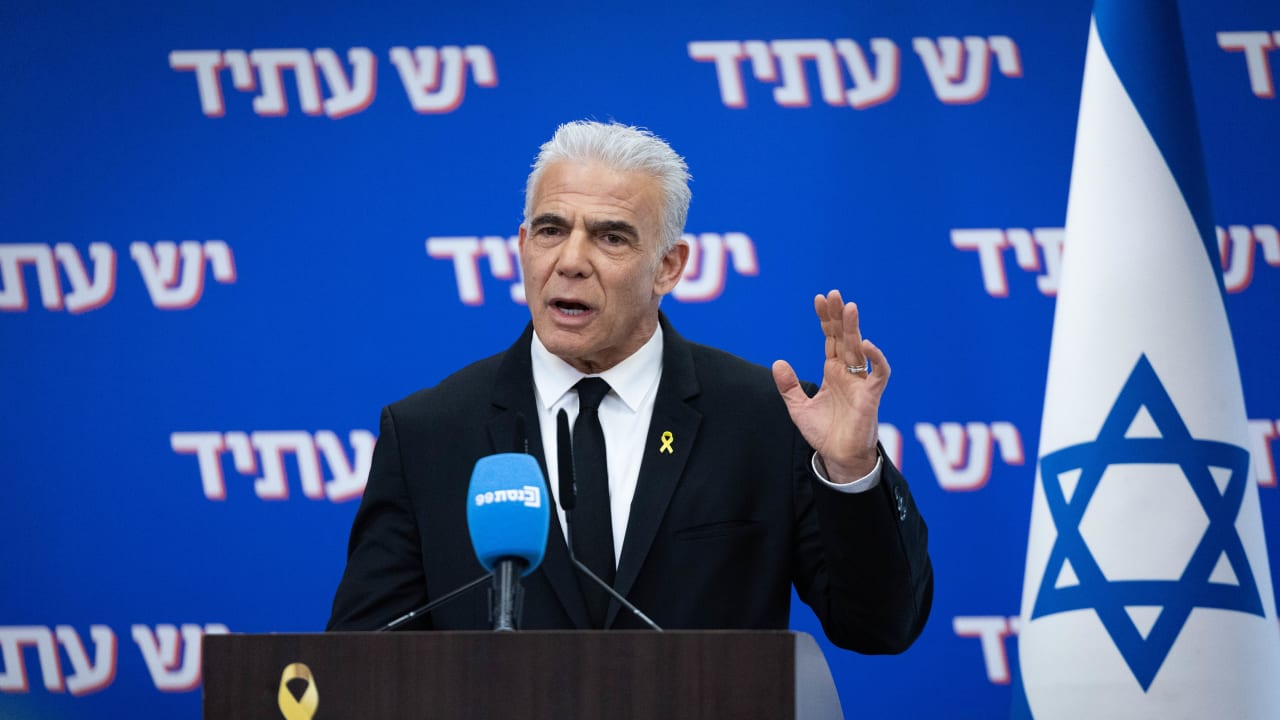
Opposition leader Yair Lapid (Yesh Atid) on Sunday accused Prime Minister Benjamin Netanyahu of presenting a “false” account of the government’s conduct during the October 7, 2023, Hamas terror attack.
The accusation came in response to Netanyahu’s testimony to State Comptroller Matanyahu Engelman, in which the prime minister defended his actions during and prior to the attack.
Lapid alleged that Netanyahu attempted to cover up the truth by relying on “a series of manipulations of secret documents, deliberate deceptions, false versions, and a consistent attempt to cast blame on his subordinates.” These actions, he said, were central to the prime minister’s deposition.
Lapid asserted that the core failure leading to the attack was Netanyahu’s longstanding policy of strengthening Hamas “as a counter-force to the Palestinian Authority to prevent any possibility of unifying the arenas.”
By establishing this policy, Lapid said, Netanyahu “prevented the collapse of Hamas,” and failed to mention this policy in his testimony to the comptroller.

He emphasized that ultimate responsibility for the country’s security lies with the prime minister: “In his hands is the supreme authority, and upon him is the responsibility,” Lapid said.
Lapid: Netanyahu blocked full October 7 investigation
The opposition leader accused Netanyahu of blocking the establishment of a state commission of inquiry into the attack, thereby preventing a “full and transparent investigation that would prevent another failure and lead to the correction of flaws in the political and security systems.”
In doing so, Lapid said, the prime minister was “harming the security of the state.”
Recalling an August 2023 security briefing, Lapid said, “The intelligence materials presented to me horrified me. They clearly pointed to a danger of escalation at levels entirely different from anything we had known in recent years.”
He also expressed concern at what he described as Netanyahu’s “complacency” in the face of serious warnings raised at the time.
In a press conference held in September, Lapid warned of a potential escalation across multiple fronts, including the Gaza Strip.
“On the eve of Yom Kippur, I am forced to warn the citizens of Israel: we are approaching a dangerous proximity to a violent confrontation,” he had said.
“All the heads of the security establishment – the IDF, Shin Bet (Israel Security Agency), Police, and intelligence agencies – are warning the government and the cabinet of a violent escalation.”
Lapid asked, “If the leader of the opposition knew, how can the prime minister claim he did not? If the leader of the opposition was familiar with the intelligence warnings, how can the prime minister claim there were no warnings, or that the security establishment hid the severity of the situation from him?”
Lapid also raised questions about Netanyahu’s timeline of events on the morning of the October 7 attack. According to the prime minister’s testimony, he received a report of the assault at 6:29 a.m., but did not hold a situation assessment until 9:50 a.m.
Lapid questioned what could have happened during the three-hour gap.
“There is no obstacle to holding a situation assessment via the Red Phone with all senior members of the security establishment. Their physical presence is not required.”
Lapid addressed a document from the Shin Bet director dated October 7 at 5:15 a.m., suggesting that Netanyahu’s narrative implied former director Ronen Bar had fabricated the documentation.
He emphasized that the records were stored in Shin Bet’s internal system, which cannot be retroactively edited.
Lapid also criticized Netanyahu’s handling of Qatari funding sent to the Gaza Strip. In his testimony, the prime minister claimed that “the Qatari grant funds were not directed directly to terrorism.” However, Lapid said, former Shin Bet director Nadav Argaman had already presented intelligence in mid-2019 showing that Hamas military chief Mohammed Deif and the group’s military wing received approximately $4 million per month from the grant, specifically for weapons procurement.
Section 6 of the prime minister’s testimony, Lapid said, clearly showed Netanyahu was aware of how the funds were being used.
Netanyahu claimed that “not a single official recommended reducing the funds flowing to the Strip,” but Lapid countered that both the Shin Bet and Military Intelligence had recommended finding alternative channels for the money. “Prime Minister Netanyahu knew that the Qatari money was used to buy weapons and decided to ignore the information,” Lapid said.
He concluded, “It is not true that the October 7 disaster was inevitable. With different conduct and a different policy, it could have been prevented.”