
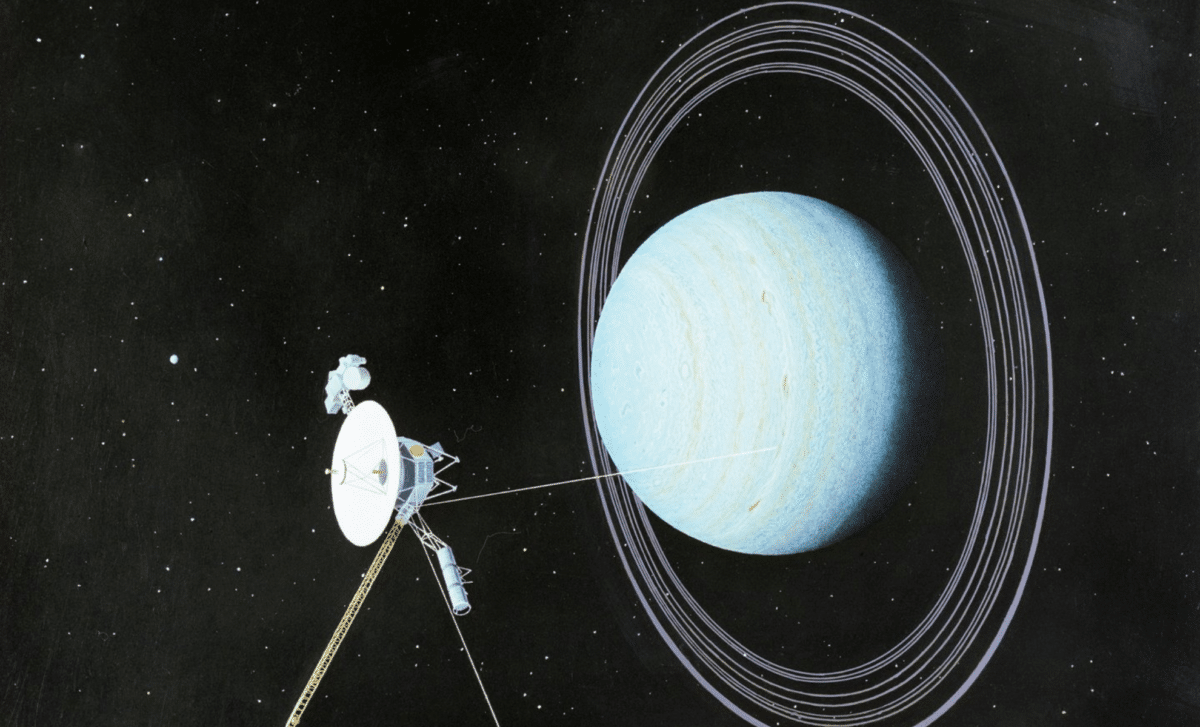
In 1986, NASA’s Voyager 2 spacecraft made an unprecedented flyby of Uranus, uncovering a mystery that would puzzle scientists for decades. The spacecraft’s instruments recorded unexpectedly high radiation levels around the planet, much higher than anticipated based on prior knowledge. This discovery challenged current understanding of planetary radiation systems and left scientists wondering how Uranus could trap so much high-energy radiation.
However, new research published in Geophysical Research Letters has provided a breakthrough explanation, linking the unexpected radiation levels to a rare space weather event that may have supercharged Uranus’ radiation belts. Scientists believe that the conditions Voyager 2 encountered during its flyby may have been caused by a solar wind disturbance similar to those observed near Earth.
New Insights into Space Weather and Planetary Radiation
The study, led by scientists at the Southwest Research Institute (SwRI), and published in Geophysical Research Letters, revisits the data collected by Voyager 2, aiming to unravel the mystery of Uranus’ powerful radiation.
“Science has come a long way since the Voyager 2 flyby,” said Dr. Robert Allen, lead author of the paper. “We decided to take a comparative approach looking at the Voyager 2 data and compare it to Earth observations we’ve made in the decades since.”
By examining more recent space weather events, particularly those observed near Earth, the team was able to draw parallels with the unusual conditions encountered by Voyager 2.
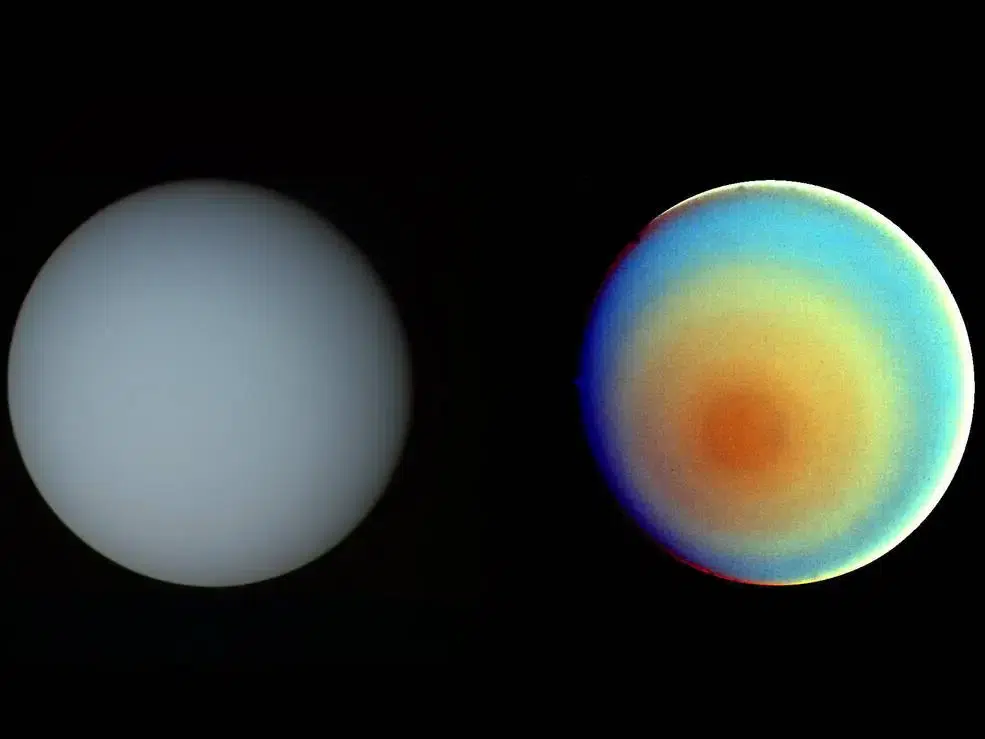 Voyager 2 images of Uranus in natural color, left, and false-color to highlight atmospheric features on an otherwise rather bland looking planet, taken from 5.7 million miles away.
Credit: NASA
The new analysis suggests that during Voyager 2’s flyby, Uranus was likely experiencing a powerful solar wind event known as a co-rotating interaction region (CIR). This disturbance is a phenomenon that occurs when streams of solar wind interact, creating a region of increased energy. On Earth, similar solar wind events are known to dramatically accelerate electrons in Earth’s radiation belts, which can lead to spikes in radiation levels. It appears that Uranus experienced a similar event, explaining why the spacecraft recorded such extreme radiation levels.
The Role of Co-Rotating Interaction Regions (CIR)
Co-rotating interaction regions are not unique to Uranus, but they are rarely observed in the outer solar system. These regions occur when fast solar wind streams overtake slower ones, causing a compression of the solar wind. On Earth, CIRs have been linked to significant space weather events that boost radiation levels in the planet’s radiation belts. While researchers initially assumed that these waves would scatter energetic particles and cause them to dissipate into the planet’s atmosphere, new research has revealed that under certain conditions, these waves can actually accelerate electrons, increasing the energy within the radiation belts.
Dr. Sarah Vines, a co-author of the study, pointed out the significance of this finding by referencing a similar event on Earth.
“In 2019, Earth experienced one of these events, which caused an immense amount of radiation belt electron acceleration,” she said.
“If a similar mechanism interacted with the Uranian system, it would explain why Voyager 2 saw all this unexpected additional energy.”
This discovery is crucial for understanding how space weather can influence planetary radiation systems, not just on Earth but also on distant planets like Uranus.
Potential Implications for Future Space Missions
While this new study has resolved one of the longstanding mysteries of Uranus’ radiation belts, it has also opened up new questions. For instance, scientists are still trying to fully understand the specific physical processes that create and transfer energy so efficiently within the solar wind. The results also have important implications for future space missions. According to Dr. Allen, the findings make it clear that Uranus is still a planet worthy of further exploration.
“This is just one more reason to send a mission targeting Uranus,” he said. “The findings have some important implications for similar systems, such as Neptune’s.”
Future missions to Uranus would allow scientists to explore these phenomena in greater detail and improve our understanding of space weather on distant planets. In addition, the discovery could help refine models of space weather that apply to other planets in the solar system, including Neptune, which shares some similarities with Uranus. As space agencies like NASA continue to plan missions to the outer planets, this new research provides an important framework for understanding how solar wind and radiation belts interact across different planetary systems.