
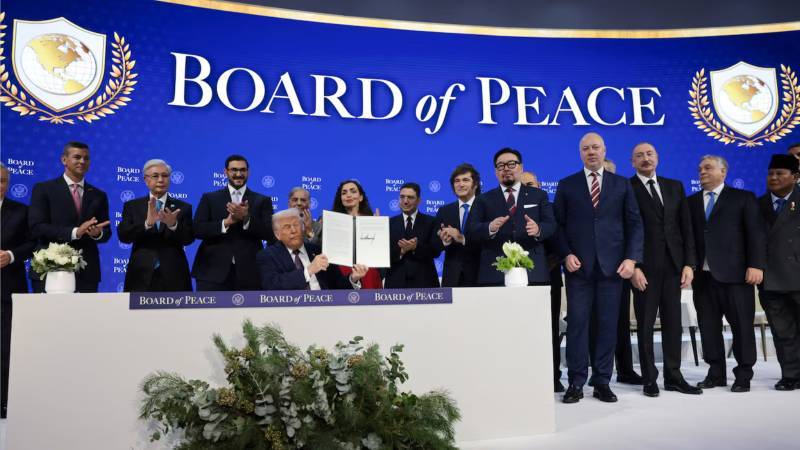
On 22 January 2026, in Davos, Switzerland, President Trump formally inaugurated the “Board of Peace” (BoP). He invited around 60 countries to join this initiative, including China, France, and Russia. China, however, chose not to participate.
Beijing explained that it would firmly adhere to the UN-centred system, which it considers a more legitimate and collective platform compared to the BoP. Another reason cited for not joining was the defence of the Global South and its diplomatic needs, which, China argued, are better represented within existing multilateral platforms.
Proponents of the BoP contend that it aligns with the existing international order and international humanitarian law. For instance, United Nations Security Council Resolution 2803, adopted on 17 November 2025, contains multiple provisions, including: (i) the formation of the Board of Peace to act as a legal entity overseeing Gaza’s development; (ii) a Temporary International Stabilisation Force to ensure demilitarisation and stability; (iii) the withdrawal of Israeli Defence Forces; (iv) the resumption of aid to Gaza; and (v) the establishment of a Palestinian committee of technocrats to manage day-to-day civil administration under the supervision of the BoP, among other measures.
However, ambiguity remains regarding the use of force. While UNSCR 2803 authorises “all necessary measures,” a legal code for the use of force, this has been deliberately omitted in the BoP’s framework. In the future, this cannot be denied, as the UNSCR provides a legal basis for BoP action.
A major critique of the initiative is how such a body would genuinely safeguard the interests of the Palestinians. By not joining, China has left space for other participants to withdraw if the BoP fails to achieve its purpose.
Although the BoP has been launched, questions remain about its effectiveness without the active participation of the Global South. It could be seen as an attempt to create an alternative to the UN or other multilateral platforms.
However, there is no meaningful comparison between the UN and the BoP. The UN is the world’s largest international organisation, with all states as members of the General Assembly and major powers exercising veto authority at the Security Council. For the BoP to become a truly global body, it requires majority participation.
Invited countries are offered only a three-year term or permanent membership for $1 billion, raising concerns about equity and transparency. This reflects Trump’s preference for a top-down framework in which he dictates the terms and shape of global engagement
A key problem with the BoP is the US’s unilateral approach, centralising power in President Trump rather than Gaza’s reconstruction. Under the draft charter, he would serve as lifelong chairman with sweeping powers, including veto authority and control over the board’s agenda.
Furthermore, invited countries are offered only a three-year term or permanent membership for $1 billion, raising concerns about equity and transparency. This reflects Trump’s preference for a top-down framework in which he dictates the terms and shape of global engagement.
Most importantly, if this is to be a framework for reconstructing Gaza, the voices of Gazans and their representatives are absent. Reconstruction should follow a comprehensive plan outlining the roles of all actors and the allocation of funds.
China’s rise in recent years places an even greater responsibility on it to continue defending the rights of the Global South and promoting egalitarian policies on the global stage. Scholars such as Robert Keohane, John Ruggie, Joseph S. Nye Jr., and John Ikenberry have published extensively on US contributions to establishing and strengthening international institutions. Yet, following President Trump’s formation of the BoP, those contributions appear diminished.
Similarly, scholars who previously defended US hegemony and advocated containing China have remained silent in response to this stark deviation from longstanding US foreign policy goals.
Beyond Gaza, the Board of Peace seems to aspire to a broader global role. It also faces questions about its continuity after President Trump leaves the Oval Office.
Other crucial countries, including Russia, India, Norway, and Sweden, have not joined. While Trump claimed at the World Economic Forum that Russian President Putin had agreed to participate, no subsequent developments have been reported.
Post-World War II leaders invested enormous energy in aligning the UN with international law. Compared to the UN and other multilateral organisations, the BoP’s scope and functions are seriously lacking.
The success of any organisation is gauged by global participation, and the BoP currently falls short of this benchmark. Meanwhile, the UN retains the capacity to act on Palestinian issues; failure to do so risks further erosion of its legitimacy.