
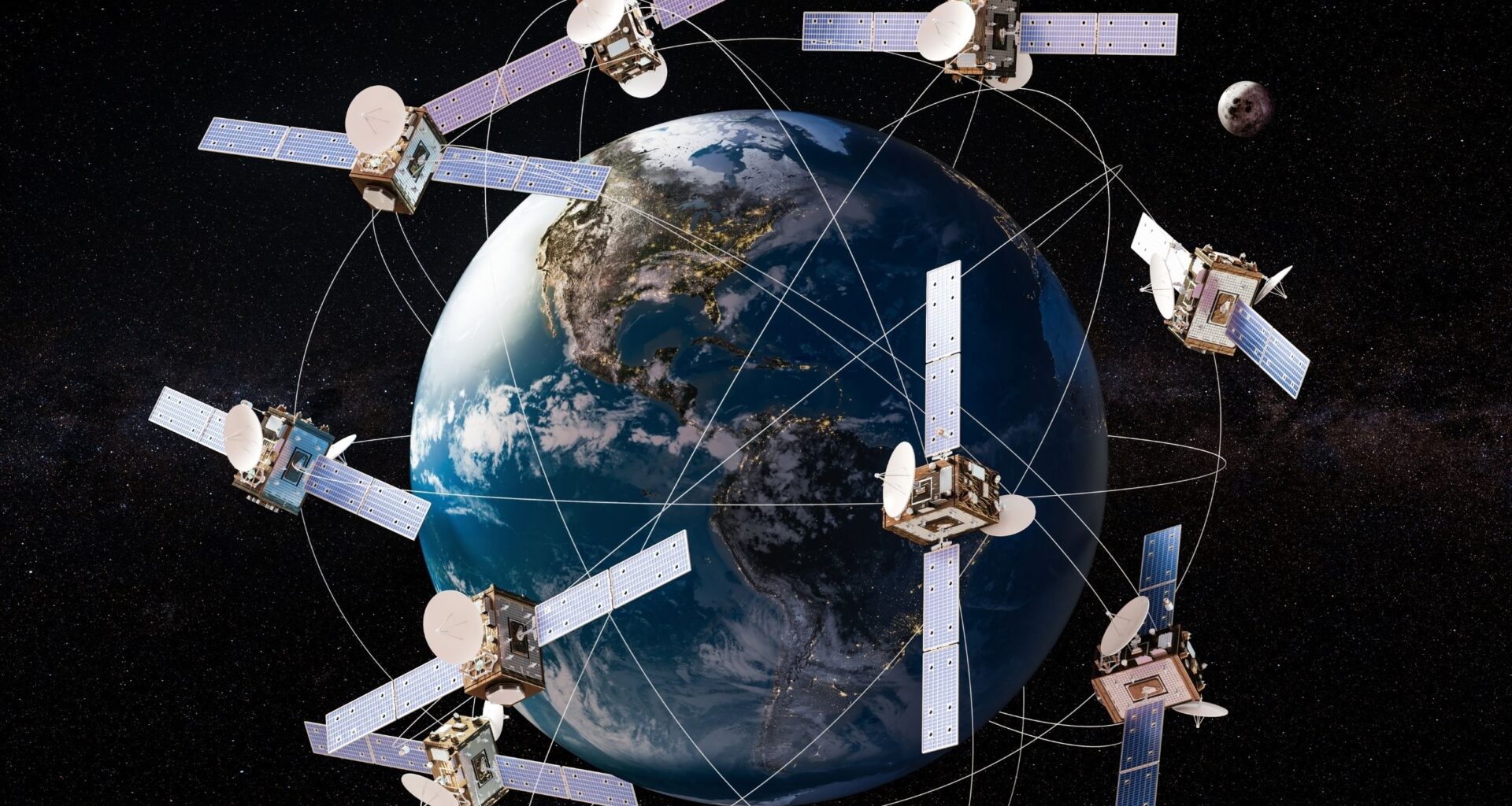
Dead satellites burning up during reentry have emerged as a new, accumulating source of aluminum pollution in the upper atmosphere.
The fallout concentrates near the poles, alters high-altitude temperatures and winds, and intersects directly with the fragile processes that govern ozone recovery.
The burnup pollution problem

Satellite disposal now unfolds inside the thin layers of air where small disturbances can trigger outsized atmospheric responses.
Working within a National Oceanic and Atmospheric Administration (NOAA) laboratory, Christopher Maloney and colleagues documented how aluminum released during satellite burnup can persist, migrate, and build up far above weather systems.
“If we scale up to these situations where we have these 60,000+ satellites in low Earth orbit, we might actually start influencing the middle atmosphere,” said Maloney.
That realization reframes routine satellite disposal as a sustained atmospheric input whose consequences unfold slowly and largely out of public view.
A fleet that constantly renews
Tracking networks now follow more than 9,000 active satellites in orbit, and the count keeps rising.
Most satellites in low Earth orbit last about five years, so operators replace hardware on a fast schedule. To keep space lanes clear, companies often lower the orbit and let the old craft burn up in the air.
That adds up to thousands of controlled and uncontrolled reentries every year – and they would continue even if launches stopped tomorrow.
When aluminum turns to dust
Many satellites carry lots of aluminum, and reentry heat quickly turns much of it into alumina, aluminum oxide dust from burned metal.
Maloney’s team modeled about 11,000 tons a year of alumina by 2040, after roughly 3,000 satellites burned up annually.
In that scenario, the incoming manmade mass could rival the natural dust that meteors shed as they blaze.
The researchers treated alumina as the main pollutant, while other reentry metals still lack reliable estimates and testing.
Where the particles build up
Once formed, the particles did not spread evenly in the simulations, and they clustered toward both poles.
The model built a burden of about 22,000 to 44,000 tons between 6 and 19 miles up, poleward of 30 degrees. Air currents carried the material from reentry heights down into the ozone-rich layer within 1 to 3 years.
The buildup concentrates at high latitudes, targeting regions where small temperature changes can disrupt seasonal circulation.
Heating high above the clouds
Even modest changes in how the air absorbs energy can warm or cool the middle atmosphere in measurable ways.
The simulations showed temperature anomalies as high as about 3 degrees Fahrenheit, over Southern Hemisphere high latitudes.
Alumina reflects some sunlight and absorbs infrared heat, reshaping how energy moves through the thin upper atmosphere.
Those temperature swings happened far above weather systems, but they still nudged circulation patterns that guide winds and ozone chemistry.
Winds that protect ozone
Winter winds circle Antarctica in a polar vortex, a ring of fast winds around the pole. The new simulations linked reentry pollution to a 10% slowdown of that vortex, which led to a weaker spring ozone hole.
A global assessment put ozone’s return near 2040 in most regions, near 2045 in the Arctic, and near 2066 in Antarctica.
Any added stress on polar winds could stretch that timetable, especially if satellite burnups accelerate over coming decades.
Chemical reactions in the air
The study treated the reentry dust as pure alumina and focused on how it moved and absorbed energy.
For now, the simulations kept the particles chemically inert, not reacting with other chemicals in the air.
In real air, alumina can mix into existing sulfate haze, and its surfaces may speed reactions that break apart ozone.
Until labs and aircraft pin down those surface effects, the true ozone risk from dying satellites will stay uncertain.
Proof in airborne samples
Researchers have already sampled the stratosphere, a cold layer about 6 to 30 miles up, and found reentry metals there.
High-altitude measurements showed that about 10% of stratospheric aerosol particles, tiny particles suspended in air, carried reentry metals.
The same sampling detected more than 20 elements associated with spacecraft alloys, indicating that reentry debris can exceed some natural sources.
Those metals may not threaten people on the ground, but they can alter the high-altitude aerosol layer in unknown ways.
Choices for satellite disposal
Not every satellite dies the same way, and the study showed that where reentries happen can change the outcome.
In the NOAA paper, a polar-focused disposal pattern produced the smallest climate impact, while lower-latitude patterns produced stronger responses.
A federal report warned that reentry emissions could affect temperatures and ozone, but it also emphasized a lack of data.
Better tracking, shared standards, and targeted sampling could help satellite builders reduce this pollution before it becomes a permanent feature.
Thousands of routine burnups may soon add a new layer of metal dust to the same air that protects ozone.
Scientists and regulators can still steer the risk by improving measurements, updating models, and thinking harder about how satellites retire.
The study is published in The Journal of Geophysical Research.
—–
Like what you read? Subscribe to our newsletter for engaging articles, exclusive content, and the latest updates.
Check us out on EarthSnap, a free app brought to you by Eric Ralls and Earth.com.
—–