
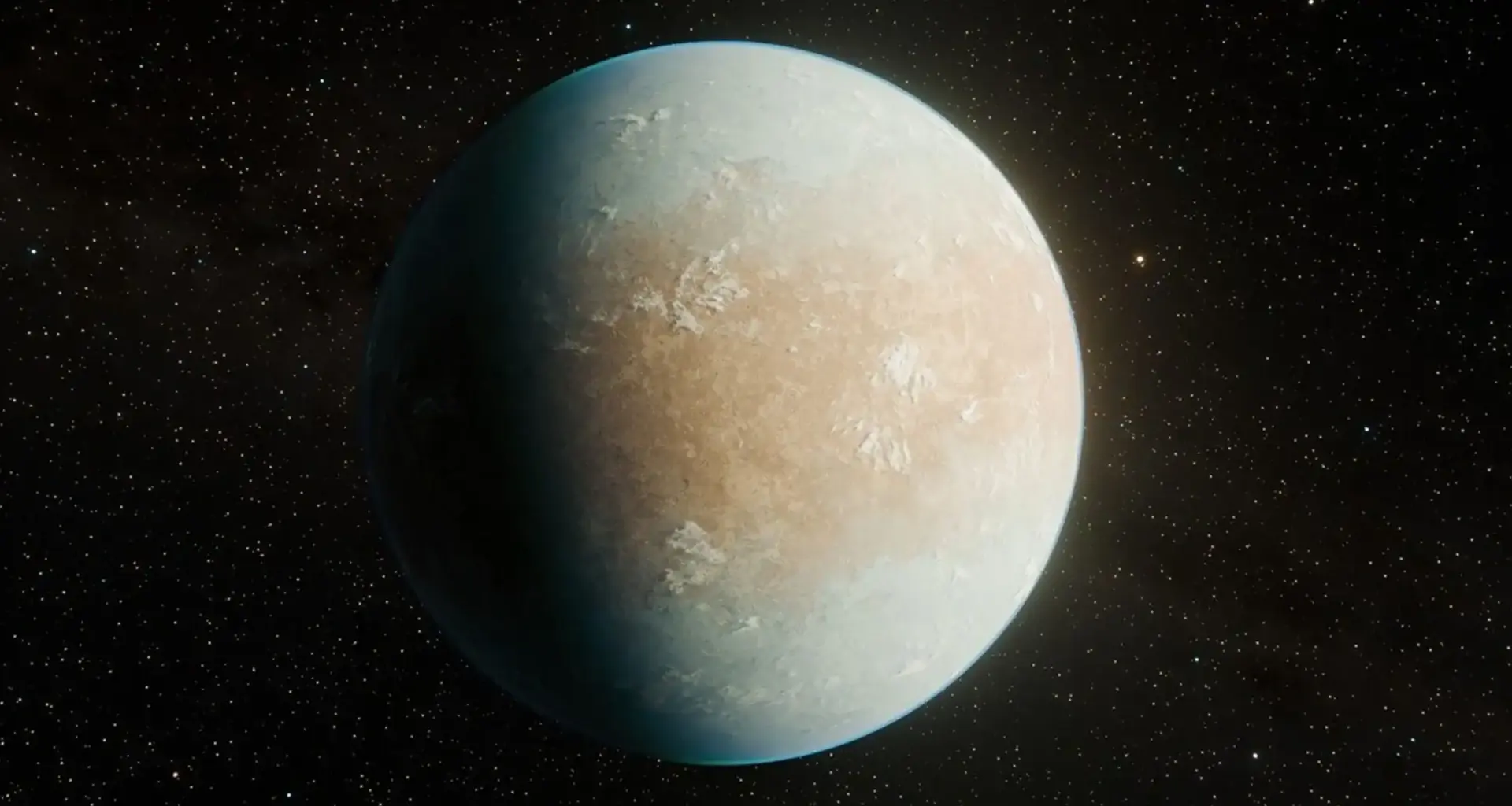
 Artist’s concept of HD 137010 b. This candidate exoplanet is rocky and just slightly larger than Earth, with a similar orbit to Earth’s. Credit: NASA/ JPL-Caltech/ Keith Miller (Caltech/ IPAC).
NASA’s Kepler Space Telescope is no longer operating, but its data still has surprises. Astronomers re-checking observations from Kepler’s extended K2 mission have identified what looks like a small planet crossing in front of a nearby star — an Earth-size candidate that may take about a year to orbit, yet would likely be far colder than Earth.
The candidate is coined HD 137010 b. It would orbit a K-type dwarf star approximately 146 light-years from Earth. The evidence comes from a single transit pattern seen in K2 data from 2017: the star dimmed by a tiny amount for around 10 hours, the kind of dip that can happen when a planet passes between its star and a telescope.
Ice-cold Earth
The team measured the subtle transit depth of roughly 225 parts per million — small enough that it would be easy to miss in a quick scan, but strong enough to stand out when the data is processed carefully. From that depth, the researchers estimated the planet’s radius at about 1.06 times Earth’s. Using the transit duration time, the star’s mass and radius, the best estimates make the rotational time around the sun at 355 days.
Temperature is the other reason this candidate is getting attention. The star HD 137010 is cooler and dimmer than the Sun. Even if the planet’s orbital period is close to a year, the amount of energy it receives is not. The researchers estimate the planet would get only about 0.29 times the starlight Earth receives from the Sun.
Using estimates that assume no greenhouse atmosphere, the team found the planet would be deep in the cold. Their estimates sit around -90 degrees Fahrenheit (−68 Celsius). Those temperatures are cold enough to justify NASA’s description of the object as an “ice-cold Earth.”
Still, astronomers are careful with what that means. Equilibrium temperature is not a surface forecast. It does not tell whether the planet has an atmosphere, how thick it might be, or whether greenhouse warming could raise the surface temperature. It is a first-pass tool for comparing worlds, not a final verdict on conditions.
That is why the candidate can be described as icy while still attracting interest from scientists who study habitability. A planet can sit near the outer edge of a star’s habitable zone and still have liquid water in some form if its atmosphere traps enough heat.
Whether HD 137010 b has any atmosphere at all is unknown, and a cold energy budget makes surface liquid water harder, not easier. But the candidate sits in a region of parameter space — small size, long period, nearby bright-ish star — where confirmation would be valuable even if the world turns out to be frozen.
×
Thank you! One more thing…
Please check your inbox and confirm your subscription.
Before any of those questions become more than speculation, the basic issue remains: is the signal truly a planet?
Single transits can be mimicked. Background eclipsing binaries can create dips that resemble a planet crossing. Instrument effects and data-processing quirks can sometimes produce planet-like features. The research team reports they ran checks aimed at common false-positive scenarios, and the planet interpretation remained plausible. Even so, the strongest way to settle the issue is to catch another transit.
Follow-up, however, is not easy. If the orbital period is near a year, the next transit opportunity rarely arrives. On top of that, the uncertainty in the period spreads the predicted transit time across a wider window. That makes scheduling observations challenging, since telescopes have limited time and cannot simply stare at one star endlessly.
NASA has pointed to space-based follow-up as a possible route if the timing can be pinned down enough. The star’s brightness helps, since a brighter target allows cleaner measurements of shallow dips. If observers catch a second transit, the orbital period estimate tightens sharply, turning the candidate into a far more secure detection and setting the stage for deeper study.
For now, HD 137010 b is best described as a strong hint pulled from a familiar place: Kepler’s archive. It is a reminder that “retired” does not mean “finished” for a mission like Kepler. Sometimes the next story is currently sitting on a hard drive, waiting for someone to run the numbers again — and then waiting for the sky to cooperate one more time.