

A few weeks ago, pastry chef Keren Kadosh stepped into an elevator near Mahane Yehuda in Jerusalem with two other people: an ultra-Orthodox man and an ultra-Orthodox woman. While riding, she gathered her hair into a ponytail. When the doors opened and she stepped out, the woman behind her suddenly kicked her forcefully from behind. Kadosh first assumed it must have been an accident and turned to ask if everything was all right. The answer she received was not an apology. Instead, the woman told her she had been kicked on purpose, because “Tying your hair in a ponytail in front of a Haredi man is not modest.”
I wonder whether she thinks kicking another human being counts as being modest. Just saying.
Seriously, it is astounding to me that in all her education about piety and religiousness and acting in the Divine image or as chosen people or whatever, that in all that information, the idea that it is wrong to violently attack another person apparently never made it into the curriculum.
And it wasn’t just the attack itself but also the absolute certainty behind it that is shocking. As if there is a whole world out there in which this kind of attack is perceived as normal, even righteous.
We are at a point in Israeli society in which certain kinds of violence have become the status quo, especially violence against women. Or non-Jews. Or non-Orthodox Jews. Or leftists. But especially women. Religious environments where enforcement of women’s bodies is normalized — like every single Orthodox school where girls are present — have created this monster. We are living in a broader cultural environment in which women’s bodies are treated as public terrain, open to gaze, judgment, correction, and punishment by the general public it seems. We are seeing this in many different corners of Israeli society, not just in government actions as I wrote about in my previous post, but across the culture. And this should be sounding massive alarm bells.
This normalization of violence against women did not appear overnight, and it is not accidental that it is intensifying now. In my 2014 book, The War Against Women in Israel, I chronicled some trends that were terrifying at the time – women being sent to the back of the bus, women being excluded from conferences on women’s health and fertility, women being attacked with rocks or acid for walking on the “wrong” side of the street. In the years that followed, there seemed to be some improvement on the issue, as several key High Court rulings established that such actions were illegal. Bus drivers were fined if women were harassed on their buses, and that seemed to lower the incidence of such things. The radio station Kol Berama was forced to allow women to speak on the airwaves after the Court accepted that even ultra-Orthodox women audiences did not accept their silencing as normal. The story of little Hadas Margolis who was assaulted on the way to school in Beit Shemesh woke people up and there were mass protests to protect the rights of women to walk freely down the street. These were signs of hope.
Unfortunately, the pendulum seems to be swinging the other way as religious leaders work to assert their power and dominance via women’s backs.
Heading towards theocracy?
The campaign to send women backward is about to get more power.
This government has been actively working to increase the powers of religious authorities with the bill to expand the role of rabbinic courts. The bill, promoted by the Yachin Institute that is closely aligned with Simcha Rothman and Moshe Gafni that actively pushes for an “alternative” legal system (i.e., a halakhic system), already passed first and second readings and is set to be voted on next week to turn it into law – and is expected to pass. Under this new law, rabbinic courts would not only preside over the actual divorce process but also all matters that until now were determined by family courts, such as custody and financial arrangements. What’s more, this law would expand rabbinic powers to but also over a whole slew of financial and welfare matters, such as labor disputes, building ordinances, as well as all lawsuits.
This is a terrifying situation because not only do religious judges lack training in actual Israel law, but they also often make grand declarations about answering to a “higher authority” rather than the state. Meaning, this is a massive step towards turning Israel into a theocracy, and forcing women to be bound by the halakhic system which sees us as, well, not quite equals. Jewish law not only deprives women of the right to divorce without the husband’s absolute will, but also holds that women cannot testify, cannot be judges, and in many cases cannot inherit.
And that’s just the beginning. We know how the ultra-Orthodox community, who make up the population of rabbinic court judges, feel about women’s dress, women’s voices, women’s bodies, women’s ambition, and women’s equal participation in things like conferences and politics. The process of giving this ultra-Orthodox culture this much power over the lives of women in Israel is no less than terrifying.
In last week’s emergency session of the Knesset Committee on the Advancement of the Status of Women discussing this bill, a rare and broad consensus of opposition emerged. Survivors of rabbinical court proceedings, women’s organizations, leading women from religious-Zionist and ultra-Orthodox communities, LGBTQ organizations, the Sharia courts, research institutes, the Reform Center for Religion and State, and even the State Legal Aid Department all warned of an unprecedented threat to women’s rights and to Israel’s civil legal system.
Particular concern was raised about marginalized women who may receive a summons by letter to appear before a rabbinical court. Many will feel obligated to comply, without understanding that they have the legal right not to appear. In conservative communities, genuine free choice will not exist at all. As expected, no substantive answers were provided.
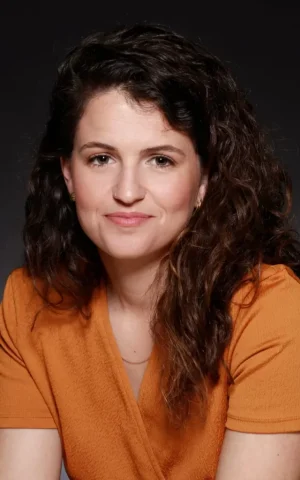
Tal Hochman, CEO, Israel Women’s Network, courtesy of the Israel Women’s Network
As Tal Hochman, CEO of the Israel Women’s Network, said, “This process is not about religious sensitivity or personal choice—it is about the systematic erosion of women’s civil rights. Expanding the authority of rabbinical courts means dragging women, often the most vulnerable, into a system where equality is structurally impossible and power is fundamentally imbalanced. When the state enables this, it is not offering choice—it is institutionalizing discrimination and calling it consent.”
Legalizing women’s exclusion
The current government has even more tricks under its sleeve for women’s exclusion. For example, MK Limor Son Har Melech, who has in the past held anti-feminist pro-women’s exclusion Knesset conferences in which women’s groups were officially banned from attending, she is now advancing a law to make gender segregation in universities legal. That means that women would be able to legally be banned from teaching, speaking, or even sitting in the cafeteria if a group of male students makes that demand. Right now, such demands are against the law and the High Court rulings that determine that gender segregation is permitted only in bachelor degree programs – not to mention against the principles of equality and basic common decency towards women. And I cannot even began to explain the immense sadness I have that women are leading this charge. On the other hand, Son Har Melech is an advocate of Jewish religious purity that her spokesperson shared a video explaining why he believes the West Bank village of Khawara should be “wiped out.
She is also working with MK Zvi Sukkot on this initiative, a religious radical who did not serve in the army and was recently summoned for police questioning following his involvement in the break-in at the Sde Teiman detention facility. Recently MK Sukkot was appointed to serve as the head of the Knesset Education Committee (!). I had the misfortune of seeing Sukkot recently when he showed up at a peaceful protest at Ras Al Ouja screaming and cursing at the protesters, calling us vermin and such, while we were registering our opposition to settler violence and the forced expulsion of the entire Palestinian community from Ras Al Ouja. Sukkot’s Jewish Supremacy militarism is the real threat to Jewish survival. Not the presence of women in university.

From the IWN campaign to raise awareness about the violent radicalism of Sukkot.
As Hochman says, “Academia is meant to serve as a bridge to the job market, but if that bridge is built on gender segregation, it is fair to ask how women are then expected to enter the workforce. At the end of the day, how can women be given equal opportunities, or be expected to prove their competence, if their education does not allow them to study or work in mixed-gender environments, or prepares them only for spaces that are open exclusively to men?….Gender segregation is not a neutral personal preference that can be neatly “managed.” In Israel, segregation is rooted in power relations, and it never remains contained. It spreads, expands, and quickly becomes a mechanism that excludes women from central public spaces — not only in theory, but in everyday life.”
Perhaps it is not surprising that this anti-feminism is bubbling up right now. After all, Israel is entering an election year marked by deep public anger, prolonged war fatigue, and a growing sense of political instability. Religious Zionist and ultra-Orthodox parties are under increasing pressure from their own communities, particularly families bearing the burden of extended reserve service. The prime minister, meanwhile, remains deeply unpopular outside a shrinking base, leaving coalition partners focused less on broad legitimacy and more on survival. Perhaps we can assume that in moments like these, power tends to harden rather than soften. Political actors look for clear loyalties, rigid boundaries, and mobilizing symbols. And as usual, certain men work to prove their worth by how much women in their communities “know their place”. It is the same strategy that Ahasverhus took so many centuries ago, thinking he could consolidate his empire by controlling his wife.
Or perhaps, the trend of leaders trying to control women never actually went away. Perhaps that was just an illusion.
The Knesset Foreign Affairs and Defense Committee is finalizing the wording of the draft law right now to allow for the creation of “women-free” or “sterile” spaces within the military. This is our last window of opportunity to ensure that MK Boaz Bismuth, chair of the committee, hears our voices.
 Our demand is basic: clear protection mechanisms for women soldiers must be written into the draft law. Equality for one group cannot be advanced at the expense of another. Women have proven their courage, strength, and indispensability as part of the IDF’s operational needs.
This is our moment to ensure that everything we have fought for is not taken away — and to make sure we are not pushed backward.
Click here to send an email to MK Bismuth
Dr Elana Maryles Sztokman, two-time winner of the National Jewish Book Council Award and co-host of the Women Ending War podcast, is a Jewish feminist author, activist, educator, researcher, indie-publisher, coach, consultant, and facilitator. She writes and speaks widely about culture, society, gender, and equality. She has been involved in many causes, is one of the founders of Kol Hanashim, the new women’s political party in Israel, and was Vice Chair for Media and Strategy for Democrats Abroad-Israel from 2016-2021. Follow Elana’s newsletter, The Roar, for news and updates, at https://elanasztokman.substack.com/ listen to her podcast at https://open.spotify.com/show/0XZ1Xc0IN6auZ7eP25wVCV or watch on Youtube https://www.youtube.com/@elanahope, or contact her at elana@jewfem.com.