

In patients with severe mitral regurgitation (MR), low left atrial (LA) reservoir strain (LASr) and prior atrial fibrillation (AFib) intervention or LA appendage (LAA) ligation may predict low invasive LA compliance and limited V-wave reduction after transcatheter mitral valve therapy (TMVT), and low LA compliance may be associated with worse clinical outcomes following the procedure, according to research published Jan. 30 in JACC: Cardiovascular Interventions.
Study authors Ziad Zalaquett, MD, MSc, Samir R. Kapadia, MBBS, FACC, et al., retrospectively analyzed 255 Cleveland Clinic patients (mean age 77; 37% women) who underwent transcatheter edge-to-edge repair (TEER; n=214) or valve-in-valve transcatheter mitral valve replacement (TMVR; n=41) between 2019 and 2023. Of these, 107 (42%) had a compliant LA, defined as a baseline LA mean pressure ≤12 mm Hg with severe MR or a V-wave decreased by ≥50% after MR resolution following TMVT.
Results showed that patients in the noncompliant LA group (n=148; 58%) had more AFib or atrial flutter (74% vs. 51%; p<0.001), prior AFib intervention or LAA ligation (35% vs. 7%; p<0.001) and prior cardiac surgery (53% vs. 34%; p=0.002), as well as lower LA reservoir strain and worse left ventricular global longitudinal strain (p<0.001 for both).
Multivariable analysis found that low LA reservoir strain (odds ratio [OR] 0.89; p=0.001) and prior AFib intervention or LAA ligation (OR 4.27; p=0.009) significantly predicted low invasive LA compliance.
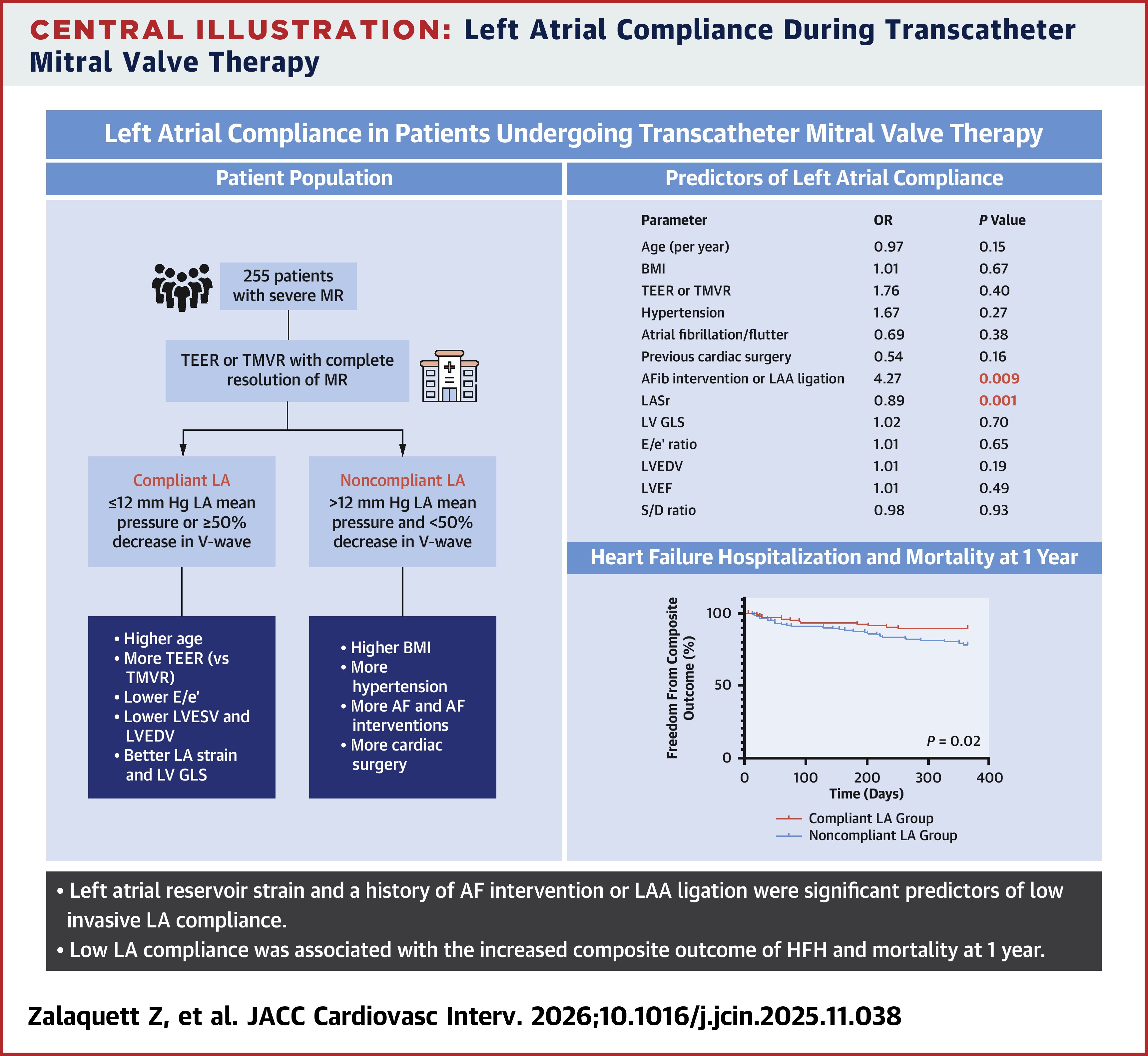
Noncompliance was also significantly more common in TMVR patients vs. TEER (81% vs. 54%; p=0.001). Those in the noncompliance group also tended to be younger with higher BMI and prevalence of hypertension.
Additionally, those in the noncompliant group had significantly higher risk of the composite outcome of heart failure hospitalization and mortality at one year compared with the compliant group (hazard ratio 0.45; p=0.02).
“The invasive assessment of LA compliance … is not practical in routine clinical settings, highlighting the need for reliable noninvasive markers,” write Zalaquett, et al. “These findings confirm the multifactorial nature of LA hemodynamic status and support the use of these noninvasive markers of LA compliance to enhance patient selection and improve risk stratification and procedural expectations.”