
Getty
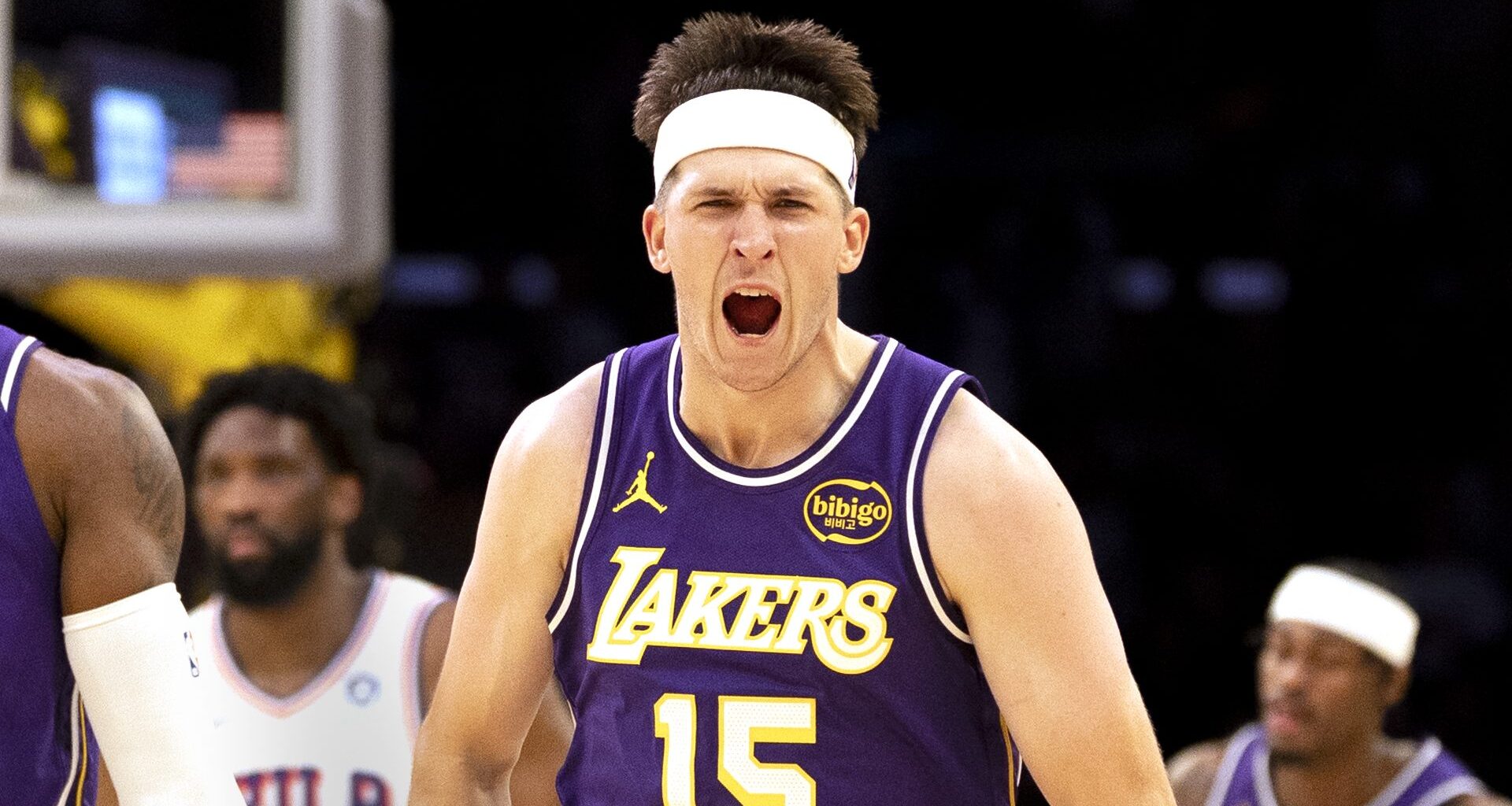
Los Angeles Lakers guard Austin Reaves
The NBA trade deadline is behind us, and for many backers of the Los Angeles Lakers, it was a disappointing couple of days. The team prioritized protecting its first-round draft assets and, more important, protecting its summer of 2026 salary-cap space over everything else, and wound up with one swap, sending out point guard Gabe Vincent with a 2023 second-round pick to Atlanta for shooter Luke Kennard.
And while general manager Rob Pelinka pointed out that there’s no shame in getting the guy who leads the NBA in 3-point field-goal percentage–Kennard is shooting 49.7% from the arc–the real prize for the Lakers was in the space still afforded to them under the salary cap in four-plus months.
With the Utah Jazz trading for Jaren Jackson Jr. and the Wizards getting Anthony Davis, the Lakers are left standing as the kings of cap space for the summer. The trick might be finding players to spend it on, but the level of flexibility in L.A. is just not something we typically see.
Lakers Leading the NBA in Cap Space
As the dust settled, Spotrac numbers guru Keith Smith broke down the Lakers’ advantage.
He wrote on Twitter/X: “Moves made at the NBA trade deadline vaporized a lot of 2026 potential cap space. Here are the teams I now project to have cap space this offseason:
Lakers: $48.2M
Nets: $45.7M
Bulls: $34.6M
“Both the Hawks and Pistons could have $31M, or could stay over the cap.”
Smith pointed out that projections of the Lakers creating $100 million in cap space were never quite accurate, because star guard Austin Reaves, even as he hits free agency, will have a cap hold of $21 million that the Lakers will need to keep in place to maintain his Bird rights. There are also players with contract options who are likely to opt in, including DeAndre Ayton ($8.1 million) and Marcus Smart ($5.4 million).
The Lakers could probably carve out a bit more cap space from a projected cap of $166 million, but the big takeaway is that no one will have more space than they will.
Overpriced Trade Chips Could Land in L.A.
Of course, there is less cap space around the NBA in general these days, and thus, there are fewer free agents on the board, which will be an issue for the Lakers. But having space gives the Lakers different avenues to acquire players–they can absorb larger salaries into their space with trades, for example, and pluck good players from desperately overspent teams.
If the Bucks wanted to get out of Myles Turner’s contract, the Lakers could take him on and send minimal assets back. They could absorb Kyrie Irving from the Mavericks or Donovan Mitchell from the Cavaliers or Mikal Bridges from the Knicks–if those teams determined they had to move on from those players.
This is all hypothetical, of course, but there will be teams hoping to dump good players with salaries those teams can no longer fit under the tax or aprons. The Lakers could position themselves to take advantage.
GettyBucks center Myles Turner is a potential Lakers target.
Lakers Have Big Advantage on Austin Reaves
The two biggest issues the Lakers will have n the summer, certainly, will be built around the cap space. The first is LeBron James–if the Lakers keep him and keep his Bird rights, their cap space disappears. The space is contingent on James leaving the Lakers.
The other issue is a more positive one for the Lakers, and it’s the free agency of Reaves. With cap space disappearing in Utah and Washington, Reaves has fewer options to ply his services on the market this summer in free agency. He is eligible for a five-year, $241 million contract, but with only two teams besides the Lakers (the Nets and Bulls) able to give him a deal that starts at more than $34 million, there won’t be much competition for his services.
Thus, the Lakers would be in position to give Reaves something like four years and $140 million ($35 million AAV) and no one would match it.
It’s a good position to be in. Yes, the Lakers made one meh move at the deadline. But they’re well-positioned from here.
Sean Deveney is a veteran sports reporter covering the NBA, NFL and MLB for Heavy.com. He has written for Heavy since 2019 and has more than two decades of experience covering the NBA, including 17 years as the lead NBA reporter for the Sporting News. Deveney is the author of 7 nonfiction books, including “Fun City,” “Before Wrigley became Wrigley,” and “Facing Michael Jordan.” More about Sean Deveney
More Heavy on Lakers
Loading more stories